Tag Archives: Aldersbrook

Snow Survey of London (1946 – 2025)

Winter 2024/25, considering the DJF mean, sits 68th out of 79 winters back to 1946/47.

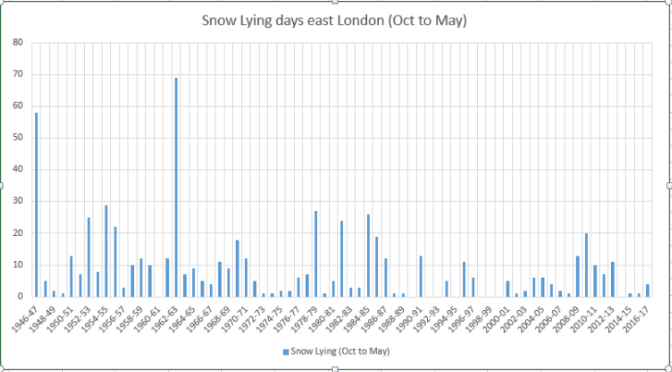
It was the 13th snowless winter in the series . The only ‘top 10’ winter for snowfall of the past 30 years was 2009/10!

Snow is a very rare commodity in lowland Great Britain – even rarer in the Home Counties, and in our part of east London. Pulling back the curtains on a cold winter’s morning to be greeted by a fresh fall of deep, crisp and even snow is something most children experience and hold dear for life. The slush, ice and chaos that inevitably follows all too quickly is forgotten.

OLYMPUS DIGITAL CAMERAMy memories of winters in the 1970s and 1980s is that they were far snowier and colder than they are today. But were they *always* cold and snowy? I decided to have a look back through the archives to find out. My first stop was the Met Office’s now defunct Snow Survey of Great Britain. This excellent compilation of reports logged by observers nationwide was printed annually as part of British Rainfall. But through lack of interest and cuts printing ceased after the 1991-92 season. Data continued to be collected though the modern version of the survey uses satellite technology to estimate daily UK snow depths – the Met Office website says that this is far less subjective than an individual nipping out at 9am every morning to ‘stick in a ruler’ and, those within sight of high ground, to observe where the snow line is. This does a disservice to the hundreds of observers who down the years diligently logged all their information as objectively as possible. But on to the data…

Regional data was not included in the survey until the 1965-66 season. Though Wanstead isn’t listed I have taken an estimate from data supplied from stations at Eastcote (53m), East Barnet (70m), Charlton Park (46m), Twickenham (13m), Teddington (9m). Because this area is influenced by Thames streamer snowfall that blows in off the North Sea and is funnelled upriver I have also considered readings from Epping (107m), Rayleigh (73m) and Southend (27m). Indeed, in some years Wanstead’s snowfall is much more similar to Rayleigh and Southend than it is to Greenwich and Teddington. Though my site is only 18m it seems to catch the snow much better than surrounding areas – probably to do with the fact that Aldersbrook is surrounded by greenery. People walking down from Wanstead village often remark that Wanstead Park is far snowier than the village a couple of dozen metres or so higher. Before 1965 I have used data from Woburn, Bedfordshire, which at 89m and 40 miles away as the crow flies, is the closest station in that long running series.

The mean temperature of a winter can look cold but it doesn’t always tell the full story. You can have a winter dominated by high pressure over the near continent making things very dry. But the anticyclones that ridge from Central Europe to the Azores can leave us in the ‘warm’ part of the high – and often lead to days of anticyclonic gloom; cold grey, dank and boring weather with little sunshine. On paper a season can look cold but in reality totally unremarkable; it is the number of days with ‘snow lying’ that people remember. For snow to settle it needs to be cold! For this reason I haven’t bothered with ‘snow falling’ data as it can snow at 4C in very dry air – yet nothing settles. Most weather geeks find ‘snow falling’ the most frustrating when it doesn’t stick. So on to the results.

The Top 20 winters in Wanstead, using 'snow lying' and 'mean temperature' in stats. Click the image to view all 67 winters
The Top 20 winters in Wanstead, using ‘snow lying’ and ‘mean temperature’ in stats. Click here to view all 79 winters back to 1946/47

Once I worked out the ‘snow lying’ days I decided to devise a winter index by dividing ‘snow lying’ by seasonal mean temperature. Because the results using Celsius were problematic in that 1962/63 becomes very skewed upwards I decided to use Kelvin.

The results are quite surprising. Coming out top, not surprisingly, is 1962-63 with an index of 25.2 and 69 days of snow lying. Second is 1946-47 with an index of 21.1. Third is 1981-82  with an index of 10.5 – surprisingly ahead of 1978/79, the first winter in the series that I can recall; I remember returning home from school one night in December 1978 and the snow being as deep as the twelve-inch step to our house.

The index of 25.2 for the 1962/63 winter and 21.1 for 1946/47 – over double the amount of 1981/82 – shows how ‘off the scale’ those two winters really were. My father, who doesn’t share my enthusiasm for the weather, can distinctly recall the severe conditions of 1962/63. He said the roads were so thick with snow that when the thaw finally arrived in March he’d become so used to driving on snow that he crashed through somebody’s front garden wall, after losing control of his Mini on surface water sat on the ice.

More recent winters, which pale by comparison, rank surprisingly highly. The 2009/10 winter comes in at Number 10, higher than the legendary 1986/87, where the coldest day in recent times was recorded in London, which came in at Number 12. It should be noted that January 1987, when on the 12th the temperature did not rise above -5.5C all day, was sandwiched by a mild December and February.

OLYMPUS DIGITAL CAMERAJust by looking at winters with a mean of, say, 5C doesn’t tell you much about snowfall. When you look at 1985-86 (mean 4.1C)  there were 22 days of snow lying at 9am – yet 2005/06 was colder (3.9C) and only 3 mornings saw snow lying – though that winter was particularly dry – the 13th driest in the series.

The median for ‘snow lying’ days in this series is six. The rolling median of the past 30 years, however, is only 2 so, with this in mind, if it does snow you should get out there and make the most of it.

You can view over 70 years of winters in this area, all ranked using my winter index here.

Screen Shot 2017-12-21 at 14.44.05

*It should be noted that a day of ‘snow lying’ only qualifies if there is more than 50% cover at the observation time of 9am. This means that it could snow 1cm at 10am – if that snow thaws by 9am the next day it won’t count. Though 8 winters appear snowless it is possible that these winters did see temporary coverings

Will it be a White Christmas this year?

Will it be a white Christmas this year? It’s the question most forecasters get asked year after year as the big day looms less than a month away.

The snow probably won't arrive until after Christmas this year
The snow probably won’t arrive until after Christmas this year

It always fascinates me why Christmas and snow are so closely associated with each other when the odds, especially in London, are so stacked against it happening.

Perhaps it is the Christmas card scenes of Dickensian winters that get people yearning for the white stuff. Indeed, the image of snow covered cobbled streets can probably be blamed on Charles Dickens. The backdrop of A Christmas Carol, and a host of other books, were written when winters, and Yuletide, were generally much colder than they are now. Perhaps it was also the cold Decembers, which came during notably cold years as he was coming of age, that sowed the seed of his impressions of life in London. The Central England Temperature (CET)  for December 1829 and 1830 were 1.4C and 1.8C respectively. To give you perspective the average mean temperature for the Wanstead region in December is 5.6C. Of course we had a taste of what a Dickensian December was like three years ago in 2010 when the average mean temperature was 1.5C. Though bear in mind the mean for 2010 was 10.5C – way above the 8.2C and 8.7C mean temps of 1829 and 1830!

Christmas toys of yesteryear also took every opportunity to perpetuate the snow myth

But back to this Christmas… First of all, what do we mean by a white Christmas? The definition used most widely – notably by the bookies – is for a single snowflake, even if it lands in the midst of heavy rain, to be observed falling in the 24 hours of 25 December at a specified location recognised by the Met Office. Interestingly, the Met Office uses weather observations from Gravesend-Broadness, some 12 miles away, to show current conditions in Wanstead. A lot, however, could be said by us weather anoraks about the different microclimates between here and south of the Thames.

Technically, there has not been a white Christmas in Wanstead for over 30 years. In 2010, we could still see the Christmas card Victorian snow scene in small patches of our gardens, but these were leftovers of a previous dump, so it doesn’t count. Frustratingly, there has been snow on several Boxing Days in Wanstead (1995 and 1996) and in the weeks running up to Christmas, but not on Christmas day itself. The most typical Wanstead Christmas day weather is mild and dry, although it has rained on 12 of the last 33 Christmas days.

So why does it often snow either side of Christmas but not on the actual day? For Wanstead, Christmas is at the beginning of the period when it’s likely to snow. Looking at climate history, wintry weather is more likely between January and March than December.

iced anemOn average, snow or sleet falls in the UK 5 days in December, compared with 7.6 days in January, 6.8 days in February and 6 days in March. White Christmases were more frequent in the 18th and 19th centuries, even more so before the change of calendar in 1752, which effectively brought Christmas back by 12 days. Climate change has also brought higher average temperatures over land and sea and this generally reduces the chances of a white Christmas.

For snow to fall we need moisture in the atmosphere. Snowflakes start their lives as ice crystals thousands of feet up, and when these tiny ice crystals collide they stick together in clouds to become snowflakes. If enough ice crystals stick together, they’ll become heavy enough to fall to the ground.

Precipitation falls as snow when the air temperature is below 2°C. It is a myth that it needs to be below zero to snow. In fact, in this country, the heaviest snowfalls tend to occur when the air temperature is between zero and 2°C. The falling snow does begin to melt as soon as the temperature rises above freezing, but as the melting process begins, the air around the snowflake is cooled. If the temperature is warmer than 2 °C then the snowflake will melt and fall as sleet rather than snow, and if it’s warmer still, it will be rain.

It sounds a simple combination, but getting precipitation on the days when there are temperatures low enough for snow are few and far between.

temple snowChristmas day in Wanstead, on the balance of probability and from previous patterns, is most likely to be a green and mostly cloudy but dry one. Some brightness is possible with temperature peaking at around 10°C. You can read my full methodology on why I think this may happen here.

Though my attempt to find the probability of a White Christmas effectively rules one out, there is still an outside chance that one could happen.

At this time of year the UK can effectively become a battleground between cold polar continental air to the north or east and moisture-laden mild tropical maritime air to the south and west. Where these air masses meet, snow is possible, but a lot depends on which air mass wins the battle. When battleground situations occur, in one location it can be snowing, but just 20 miles or so down the road it can be raining. This is because there is a fine line between the boundary of the warm and cold air.

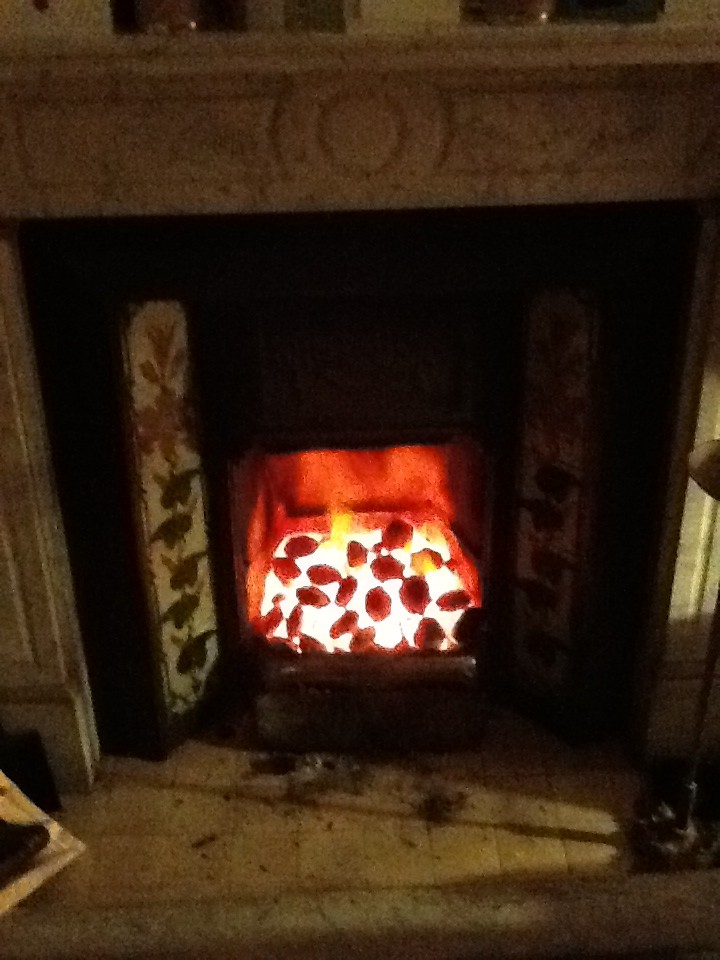
There's nothing like an open coal fire. It's even better when it is cold enough outside to have one
There’s nothing like an open coal fire. It’s even better when it is cold enough outside to have one

In years gone by, Wanstead and the surrounding area has often ended up in the cold air mass or the warm air mass. In these situations dry and mild or dry and cold weather is often the result. Of course, in a cold air mass situation there is always the chance of showery activity of the North Sea. The weather so far this winter has not been anything out of the ordinary, so I’m afraid there is nothing to suggest a white Christmas is likely.

If it does turn very cold on December 24, pray for clouds to appear and we could be in with a chance. But at the end of the day we still need that vital combination of temperature and moisture. Snow, like Christmas in that sense, requires some magic.

Winter Forecast 2013/14 (with no apologies to the Daily Express)

Much has been printed in the tabloids over the past month or so that we are in for a severe winter. Not a week goes by without the Daily Express splashing that the ‘Worst winter EVER is on the way’. Just this morning the same rag told us that three months of ‘exceptionally cold’ weather are due. On closer inspection the story elaborated the scene with quotes from James Madden of Exacta Weather, one of the ‘experts’ feeding these fantastical stories.

The Temple, Wanstead Park, always looks that much more stunning with a covering of snow

Quite how Mr Madden and other experts arrive at these forecasts is a bit of a mystery. The mystery has deepened further since I decided to crunch a few numbers and try to predict what is in store for the months ahead. Looking at data for this area stretching back over 130 years to 1881 I decided to calculate a seasonal average and arrived at a final figure using singularities – basically looking at the weather patterns we’ve had during October and November.

Many professionals would scoff at this method of pattern-matching, so I’ve incorporated a couple of other ‘now’ factors and taken on board current variables such as sea surface temperatures in the Atlantic and Pacific.

The figure I arrived at, taken as an average of the closest matching autumn periods, is a mean temperature of 4C with rainfall totalling 133mm over the months of December, January and February – that’s about a degree colder than average and 90% of average rainfall. The probability of a winter with a mean temperature of between 4C and 5C is 37% – the most likely outcome. With this in mind a winter in the form of 1986-87 is possible – though whether we would see the same extremes of temperature and snowfall that we experienced in January 1987 is open to question.

Here is a link of my method to predict the coming winter.

The Met Office, with all their computing power and expertise, seem to be hinting at something similar – ie slightly colder than normal. The opening couple of weeks to my forecast seem quite plausible, looking at tonight’s models. Look at the similarity in the synoptic charts for December 8th here.

Shoulder of Mutton lake, Wanstead PArk
Shoulder of Mutton pond, Wanstead Park

Over the last few years the snow lovers among us have been spoiled after a run of very mild winters during the late Nineties and early Noughties that prompted climate expert Dr David Viner to utter the immortal words that one day “children just aren’t going to know what snow is”. It was only a matter of a few years before the words from the senior research scientist at the University of East Anglia seemed a bit hollow.

Mark Twain, born this day in 1835 , once uttered the famous phrase: “Climate is what we expect; weather is what we get” – there is always a chance we could suddenly lurch back to milder winters. This winter could spring a surprise, be it very cold or very mild. But judging what’s happened over the last 130-odd years – a 1962/63 or a balmy 1989/90 look very unlikely.

* Forecasting models use probability on any given outcome. Millions of observations are fed into the Met Office database (and other countries’ weather agencies) every day. Supercomputers then crunch through this data to give probable outcomes. With the volatility of the atmosphere it is not surprising that certainty of any outcome often falls away rapidly. Forecasting has improved greatly in the last 20 years – though anything the models churn out beyond three to five days should be handled with caution. Long range models can give *some* idea of general trends for the months ahead – but changing just one variable can vastly alter an outcome at the end of the run.

* *Over the past few months I have been collating data for the area around Wanstead. This data is freely available from the excellent Met Office library and is emailed via Excel spreadsheet. Rainfall stats include a near-complete daily archive, stretching from 1961 to 2003, from City of London Cemetery . Sadly the rainfall station, along with many others, ceased to supply the Met Office after cuts were made shortly after the turn of century. Prior to 1961 I have used monthly figures taken at the Greenwich Royal Observatory stretching back to 1881. Though this is 6 miles away the difference in temperature between the two areas would be miniscule compared with rainfall data and so can be used. I use my own stats for the period after 2003.

91 years ago: Wanstead Flats Bonfire Night

Wanstead Flats has put on some spectacular Guy Fawkes’ nights over the years. I didn’t realise quite how many years until I stumbled upon this old British Pathe clip which shows nurses at Wanstead Children’s Home building a huge bonfire for the children in 1934.

The footage shows the nurses struggling to get the Guy atop the bonfire, using numerous ladders, while the children, including 12 sat in an old perambulator, look on. I don’t have the stats for what the day was weatherwise locally but the climate station at St James’s Park recorded a dull day with a high of 8.3C after an  overnight low of 3.9C. That November was drier than average.

'To Go Up in Smoke' is available to buy from British Pathe http://www.britishpathe.com/video/to-go-up-in-smoke/query/Guy
‘To Go Up in Smoke’ is available to buy from British Pathe http://www.britishpathe.com/video/to-go-up-in-smoke/query/Guy

The Aldersbrooke Childrens Home for Waifs & Strays is still there in Brading Crescent on the Aldersbrook Estate, although the five lodges have been converted to flats.

The former Aldersbrook Children's Home is still there in Brading Crescent but has been converted to flats
The former Aldersbrook Children’s Home is still there in Brading Crescent but has been converted to flats

A bit of history…

In 1907, the West Ham Guardians purchased the Aldersbrook site. In 1911, five receiving homes were completed. The homes were called lodges and were: Elizabeth Fry Joseph Lister, Tom Hood, Edward North Buxton and William Morris

In 1913, a workshop, for training of the older boys and girls was opened. Skills learnt were in tailoring, carpentry, laundry work and needlework, under skilled industrial trainers.

In 1930, on the 1st April, the ownership of Aldersbrook homes and the leases of the Scattered Homes, were under the 1929 Local Government Act, and by agreement with the Essex County Council and the West Ham Corporation, vested in the East Ham Corporation who are required to continue to receive destitute children from the Essex County Council and West Ham, formally comprised in the West Ham Union area.

On 27th May 1933, the Aldersbrook Children’s Homes new nursery was opened. The County Borough of East Ham owned it. Alderman T.W.Burden, Chairman of the Public Assistance Committee, opened it. The Mayor of East Ham, Alderman G.H.Manser J.P, proposed a vote of thanks, which was seconded by Alderman C.W.Brading J.P, and supported by Alderman Mrs Taylor (East Ham) and Councillor G.Doherty, of West Ham. After the official opening, the older children (14 to 16 years old) of the homes put on the play “David Garrick”.

The superintendent of the home was W.T.P. Steele, and the matron was E.M.Steele. S.R.N. The building was described as being divided into three sections – ground floor, babies under twelve months and toddlers one to three years, first floor staff. Accommodation is given for ninety infants under three years. Wards are provided for these age groups were newly admitted children will be housed for three weeks before being sent to the general rooms. Two ranges of isolation rooms are also provided where “suspects” can be nursed to reduce the risk of infection. The south end of the building is allotted to the youngest or cot babies and comprising of long dormitory with sun rooms at the end, designed to catch the winter sun.

The programme went on to describe the building as being the most modern of children’s institutions. The building has a veranda at the front. The first floor has 21 separate staff bedrooms. The building had an oil fired heating system and flooring with fire resistant Terazzo material whilst the children’s play room and dormitories are protected by rubber flooring. The lighting and power points are controlled by locking device to prevent the children switching them on and off. The building was built by Messrs Hammond & Barr Ltd Chelsea.

The Nursery is now gone and the Aldersbrook estate covers the area, although the recreation Hall, the lodges (See photo) and the porters lodge are still there.

Bang goes chance of a frosty Guy Fawkes

Is Guy Fawkes’ Night going to turn into a damp squib this year? The forecasts don’t look good – our best hope is for a brief ridge to briefly quieten things down before the next frontal system trundles in from the Atlantic.

What was a very wet week last year led to the cancellation of the public display on Wanstead Flats – with 10.2mm of rain on the Saturday flooding the already sodden land. The forecast for this year doesn’t look much better with 16mm of rain due between Friday and dusk on Sunday.

The cloud cover / rainfall chart for 6pm Tuesday shows that the front may have cleared through by the time the bonfires are lit. At this range, though, it is a big if

But what about the actual 5th of November? Monday looks very wet for this region with yet another frontal system sweeping across the south. Up to an inch of rain could fall before dusk on Tuesday driven along by a stiff westerly wind. The only positive, if you can call it that, is it will be very mild. Temperatures will only fall to around 14C which is very warm for a night in early November.

It wasn’t always like this – ask most people of a certain age what the weather was like on Bonfire Night in their youth and most will answer ‘calm, cold and frosty’ – the bonfire providing a source of warmth as well as somewhere to roast the chestnuts and toast the marshmallows. But were frosty nights on Guy Fawkes in the 1980s that common? I decided to have a look back through the archives and find out.

The FAX for November 5 shows an occluded front right over our region at 12noon. This may have cleared through by 6pm

Only 4 nights in the Eighties could really be described as approaching frosty – they were 1980, 1981, 1989 and 1988 which was the coldest Guy Fawkes’ of the past 30 odd years with the temperature falling to 0.4C. All the other years had minimums of between 5-10C. One thing that is noticeable is how dry November 5 was in the 1980s – just 2 years had any measurable amounts of rain; 1986 (0.5mm) and 1984 (3mm). Nineties Bonfire Nights were even warmer – nearly 1.5C warmer on average – the coldest years being 1991 and 1998 with 2C.

Noughties Bonfire Nights were a continuation on the Nineties – mild though over half were dry affairs. The overall average over the last 30 years is quite surprising – 12C during the day and only falling to just over 6C at night. Taking the average of the last five years the minimum rises to nearly 8.5C! The odds of it raining heavily on Bonfire Night, meanwhile, average out about 1 in 5. Raining lightly the odds increase to a 40% chance.

And as for that wished-for frosty night? Forget it. It seems memories of perfectly frosty Bonfire Nights are about as elusive as the Dickens-style winter snow images that are still so common on Christmas cards.

Heatwave? washout? Or just another changeable British summer?

chicken cloudWith all the talk of heatwaves this week it won’t be long before the media switches from piping on about the UK facing “10 years of miserable summers” to “Is our climate getting warmer?”.

But the simple fact is that the UK’s climate has always varied greatly – some years, as in the last two, the pattern for summer has brought mostly miserable weather. Other years we get a run of warm, dry summers.

A case in point was the heatwave of July 1808. Far removed from images of freezing Georgian winters and miserable summers the July of 205 years ago was among the warmest ever. The monthly mean for July 1808, according to the Central England Temperature series, was 18.4C – the 6th hottest July since the beginning of the series in 1659.

Readings taken by Luke Howard at Plaistow show the build up of heat to the 14th. The series on the right, taken in Wanstead, around 3 miles to the north-east, will be added to by the author as July unfolds
Luke Howard, the ‘father of meteorology’ who at the time lived in Plaistow, referred to the heatwave in his diary on July 13th: “Temperature at 9am 84F. The intense heat of the maximum lasted nearly three hours till about 4pm. At 6pm the temperature was 90F.” Another entry mentions a reading taken nearby. “Another at Plashet, a mile and a half eastward, indicated 96F as the maximum under the shade of a house.”
While Howard’s methods of measuring the temperature ran short of modern standards, his thermometer was hung under a laurel bush, the values still give a valid insight into the heatwave.

Tales of the heatwave, which particularly affected east and north-east England, can be seen in letters sent to local newspapers around the country. Many describe labourers dying from heat exhaustion while working in fields. Farm animals and horses suffered a similar fate. One letter from Hull, published in the Coventry Mercury, said: “At Sigglesthorne, the honey in some beehives melted, ran out upon the ground, and most of the bees drowned in it. At Sutton, a lamb and a dog belonging to the Rev Mr Croft of Rowley, expired in the heat; and several birds dropped down dead, while flying over the streets of this town.”
Of course it is impossible to know about the health of people and animals that died but that birds dropped out the sky suggests extreme heat.

screenWhile temperature records of July 1808 are not unheard of in an English summer one record that remains is the size of the hail – which fell in damaging storms when a thundery breakdown arrived on the 15th.

The main storm missed Wanstead and the surrounding area – though Howard, writing in his Plaistow observatory, knew the weather was on the turn: “Dew on the grass, a fine breeze from ENE. Much lightning in the west this night, a few drops of rain.” Howard would have been referring to all the action about 120-odd miles west where one of the most ferocious storms in recorded history was unfolding.

Much was reported in the local press on the days following the storm which affected an area from Somerset northwards. As well as local records Luke Howard also noted national events in his diary: “After several days of uncommon and oppressive heat the city of Gloucester experienced a storm of thunder and lightning which extended many miles round and exceeded in awful phenomena any one remembered for many years past.”

Trees were “shivered to atoms”, livestock killed by lightning, crops were ruined and countless windows and glasshouses smashed by huge hailstones. A lot of the detail of the storm was compiled by a man named Crocker, then governor of Frome school, Somerset. One account from Batcombe describes a hailstone that measured 13.5 inches in circumference. To give you an idea of the size of a 342mm circumference hailstone I, with the help of my daughters, made one of my own.

It is thought the size of the 1808 hailstone may, along with a storm in 1697, be the national record for hailstone size - being 20mm greater in diameter than those measured in a Horsham, Surrey, storm in 1958
It is thought the size of the 1808 hailstone may, along with a storm in 1697, be the national record for hailstone size – being 20mm greater in diameter than those measured in a Horsham, West Sussex, storm in 1958

Howard’s report continues: “The most tremendous circumstance of this storm was the destructive hail shower which accompanied its progress.”

The Tornado and Storm Research Organisation (TORRO) grades haistorms from H1-H10, where the hail increases in size from 5-10 to over 125mm in diameter. From the historic descriptions the 1808 storm was an H8/9.This exceeds the British record made during the Horsham, West Sussex, storm of September 5, 1958, which produced hailstones up to 80mm in diameter. Hailstones for the 1808 storm were about 109mm in diameter. Since 1650 there have been 119 independent H5 hailstorms in England and Wales.

Since 1900 there has been a halving in the frequency of recorded destructive hailstorms. Scientists are undecided on whether this is a result of climate change or just a variability of the British weather. But any future uptick in destructive hail should be tempered by this historic record.

It is my belief that people’s current expectations for summer were raised to unrealistic levels when we had a run of warm, dry summers a few years ago. The fact is that because of our maritime climate warm, dry summers occur in this country only occasionally. ‘Default’ summer weather is changeable, rather cloudy and, for many in the north, rather cool

So, if any media outlets do start coming out with any stories of “unprecedented heat” or “worst storm in history” bear in mind that it has probably all happened before.

Scott Whitehead
@wanstead_meteo
http://www.wansteadweather.co.uk

Whatever happened to proper summer thunderstorms?

Is anyone else yearning for a good old-fashioned summer thunderstorm? As we move in to what is traditionally the most thunderstorm-prone month – the Met Office average for this area is three days of thunder – you would be forgiven for thinking that we have plenty to look forward to.

Looking north toward Aldersbrook. The Flats can be very exposed during a thunderstorm
Looking north toward Aldersbrook. Wanstead Flats, a 186 hectare open space that is larger than Hyde Park, can be very exposed during a thunderstorm

It was George II who some time during the 1730s apparently characterised the British summer by saying that it was ‘three fine days and a thunderstorm’.

The reality these days, at least in this part of the country, is quite different. Yes, brief fine spells do still break down – but the classic stormy nights I can remember being kept awake by when I was a lad in the Eighties are now a distant memory. A look back through the records shows that our most thundery month happened in June 1982, when thunder was heard on 13 days. On the 2nd a woman was killed after being struck by lightning while walking in a park in Willesden. More storms followed over the next couple of days and there were three more deaths in the UK caused by lightning. One thunderstorm over Loughton flooded 200 houses, some up to the ground-floor ceiling and at least 12 properties were struck by lightning. One observer recorded 79mm of rain, one and a half times the monthly average, in 90 minutes.

Despite a couple of instances of good potential for thunder this past month has been, so far, completely thunder-free, with all the activity passing well to our east. On June 20-21, there were 235,809 lightning strikes in 24hrs over Germany. To put that into perspective the UK, on a typical ‘thunder day’ in summer, receives up to 10,000 ground strikes although the exceptional day of 24 July 1994 produced 85,000 ground strikes.

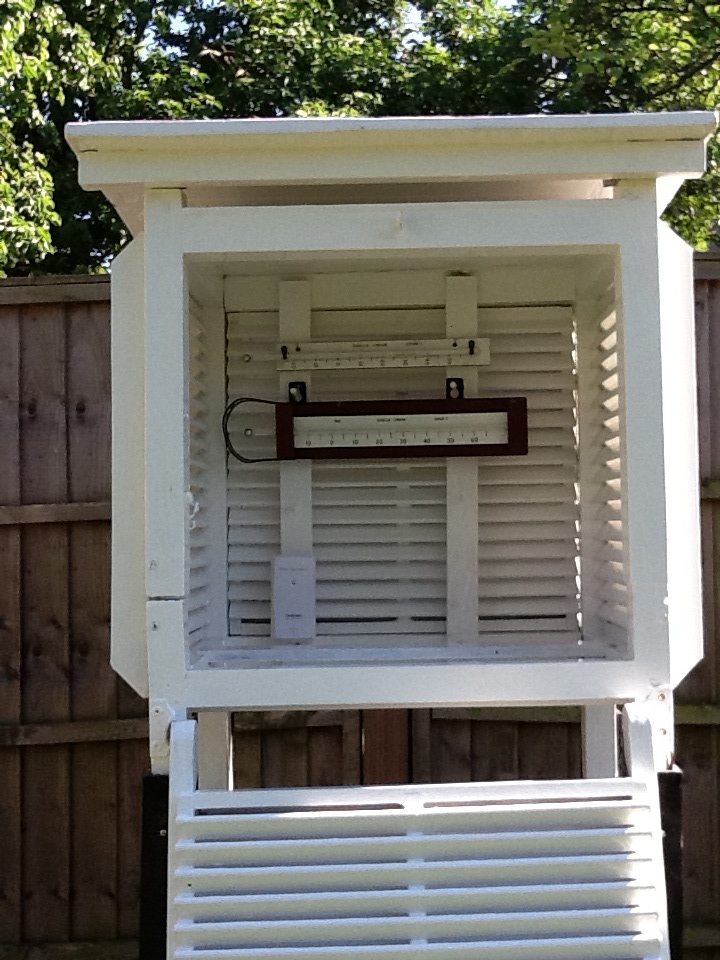
The meteo is sited on the Aldersbrook Estate and uploads data to the web every 10 minutes, 24 hours a day

So what is the potential for thunder in July? Looking back at Wanstead and the surrounding area’s local records the average number of days that thunder was recorded works out as 3.5 – though some years thunder occurred considerably more than others. But to get thunderstorms first we need the ingredients. The classic scenario happens at the end of a short heatwave, a cold front advancing from the west undercuts hot and humid air that has been in occupation for two or three days. If there is sufficient moisture in the upper atmosphere, cumulonimbus clouds will bubble upwards to the base of the stratosphere, and thunderstorms will soon follow.

Apart from the first couple of unsettled days at the beginning of July the above scenario looks unlikely to happen at least in the first half of the month. The North Atlantic Oscillation is predicted to stay positive into July – this spells good news for us as it suggests that the Azores high will dominate our weather, bringing lots of fine and dry conditions. With the jet stream and westerlies being kept just north of Scotland, temperatures should be average to slightly above. It is possible that the high could further dominate as the month goes on. But it is also possible that pressure will start to fall after around the middle of the month. Though it is impossible to predict in detail perhaps a date of around 20th would be the most likely for thunder?

It is too soon to say if the recent trend for a paucity of thunderstorms is just a blip. It could just be another typical variation of the British weather and we will shortly see an upturn in summer thunderstorm activity.

Scott Whitehead
@wanstead_meteo
wansteadweather.co.uk