I’ve put together a few top 10s of stats for Wanstead, St James’s Park and Heathrow for the month of December.
Probably most notable is how the month in 1978 lurched from being very mild and wet to very cold in under three weeks later, setting up one of the coldest-ever winters.
Some national UK December values according to TORRO
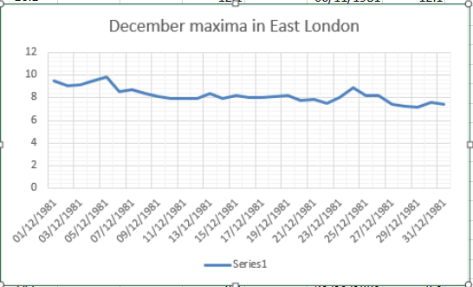
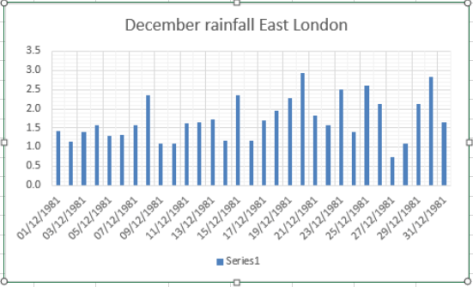
Here’s a couple of graphs showing the maxima and rainfall. Notice the spike just before Christmas day which reflects the singularity which has an 84 per cent probability.
I’ve put together a few top 10s of stats for Wanstead, St James’s Park and Heathrow for the month of November.
Probably most notable is how the month in 2010 lurched from being so warm at the start to so cold three weeks later, setting up December to be one of the coldest on record.
Some national UK November values according to TORRO
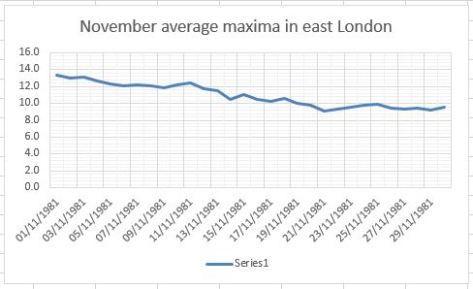
In terms of climatology November maxima, considering the 1981-2010 average, shows a steady fall until the 15th. And another steady fall to the 22nd before things level off. This would reflect the November singularities; St Martin’s Summer, between 15th and 21st, peaking on the 18th, occurs in 66 per cent of years. The Early December storms singularity can arrive this month, on the 24th, the air off the Atlantic raising the mean temperature.
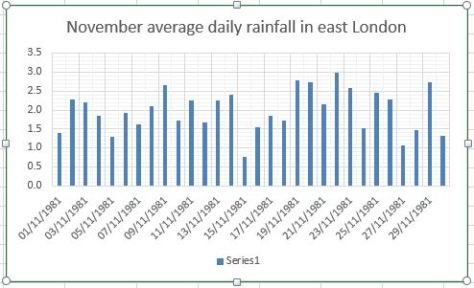
The average rainfall graphic shows that downpour amounts are variable through the month. A tendency for dry weather around the 15th reflects the St Martin’s Summer singularity.
This graphic shows the average 9am air pressure in November since 2013.
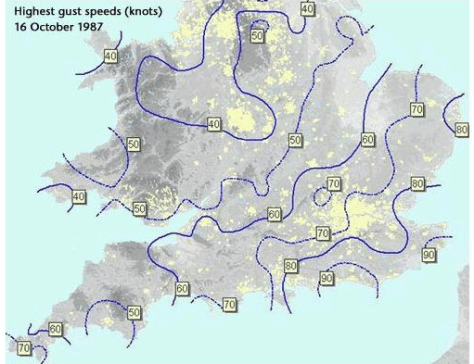
This month marks the 30th anniversary of the Great Storm. Some 18 people were killed as winds gusting to nearly 100mph affected London and the South East. Around 15 million trees were lost with Sevenoaks in Kent losing six of its seven historic trees.
Courtesy of the Met Office
The rapid development of ‘Low M’ took forecasters by surprise, the favoured outcome was for the low to move up through Brittany, remaining in or to the south of the English Channel.
I was living in a fairly sheltered corner of the London borough of Havering in 1987. I remember heavy rain just before midnight, around three hours before the storm reached its height, was heavy enough to send water trickling into my room, thanks to an overflowing roof valley. I thought it strange that Michael Fish hadn’t mentioned its severity in his lunchtime forecast.
I was awoken around 3.30am by a loud crash. Looking out the window I saw two dustbins flying down the road. You could sense each gust building in strength – the next dislodged a roof tile, sending it crashing on to the family car. By this point my mum and sister had awoken, my sister swearing she could feel the whole house moving: Mum ordered us downstairs. By this point the power had gone off and we sat listening to a small battery-operated transistor radio. We listened to updates from BBC Radio London where, like most other people, nobody knew what the hell was going on. The storm continued and first light gradually revealed the damage in the garden – a couple of trees over and next-door’s shed on its side; nothing compared to the rest of the region. But the disruption meant I didn’t attend school that day.
The storm was obviously a weather nut’s dream, and following so close on the heels of the coldest January I can remember. John Hall, of Surrey, can remember the storm well: “I’m not normally a very heavy sleeper, but I somehow managed to sleep through the worst of it (in Cranleigh, then as now).
“It was still windy when I woke around 7 am, but presumably not nearly as much as it had been earlier. By some miracle we still had mains power, and it was only when I switched on the radio and there was no sign of Radio 4 that I realised that something was up. (I assume the transmitter must have been damaged.) I walked the half-mile to the centre of the village to get my morning paper and then to catch the bus to Guildford station for my journey to work.
“It was only then that I learnt from the newsagent that there were no papers and wouldn’t be any buses, as every road in and out of the village was blocked by fallen trees. So I went home, switched on the TV and learnt all about what had happened.”
Dave Cornwell, of Laindon, south Essex, said: “Quite exciting but scary for me at home in Laindon. I awoke probably around 3.00 am to the sound of a metal dustbin lid (remember those?) flying down the street.
“Things sounded pretty bad and my sixth sense told me this was no ordinary windy night. I got up and looked outside and there was stuff flying by and lots of strange noises. One was my plastic gutter blown down and banging against the side of the house. I can’t be certain of the timings but we awakened our two young daughters and took them downstairs as I was worried as they slept in a room with a flat roof dormer window and there was a tall brick chimney stack directly above it. I heard more crashing sounds which unfortunately turned out to be a couple of roof tiles landing on my car roof which was parked in the drive. Of course with no internet then I did what a lot of people did and tuned into the police FM radio network. This gave me a better realisation that it was serious as they were describing the carnage on the roads and all of the emergency calls they and the fire brigade were getting.
“At about 5.30am I ventured out into my driveway to see if there was any serious damage but the storm was still raging and I can honestly say I couldn’t stand up and was unable to keep my balance so went back indoors. I think the wind speed was probably over 100mph at this point being funneled down the side of the house which runs south-north.
“By 8.00 o’clock I was getting ready for work and although by then people were being advised to stay at home I worked in a fairly essential service so thought I would give it a try. I managed to get to East London but there was debris everywhere and I saw a car completely crushed by a one of many trees that were blocking some side roads.
“Another thing I noticed that evening was my south facing windows had a layer of salt on them which must have been blown in from the south coast 60 miles away. It was a sight I’ll never forget and to this day I don’t like strong winds (had a scary flight at Heathrow in a severe gale as well) and always get a nervous feeling if I hear the wind getting up. Probably the most dangerous weather I have experienced anywhere in my lifetime.”
Much has been written about the storm, a ‘once in 500 year event’, including this summary by the Met Office. There is also an excellent paper by Bob Prichard published in Weather. The synoptic charts below show how Low M develops from 1200 on the 15th to 1800 on the 16th.
15OCT87 1200
15OCT87 1800
15OCT87 2400
16OCT87 0600
16OCT87 1200
16OCT87 1800
Because of widespread power cuts many television viewers didn’t see this recording of ITV’s Good Morning Britain at the time of transmission. A round up of the immediate aftermath of the storm, including comments from Jack Scott, can be seen in this edition of Thames News.
The following Daily Weather Report was published by the London Weather Centre:
An intense, and almost certainly exceptional, depression crossed the coast of south Devon soon after midnight, moving quickly, and deepening rapidly, with a track across the Midlands and out towards the Humber Estuary, leaving the United Kingdom land area around 0700 hours.
Some very severe conditions due to storm force winds were generated around the southern and eastern flank of the low, with gusts from approximately 0200 hours well in excess of 70 knots, and reaching a peak in the period 0300 hours to 0700 hours, with gusts to 90 knots reported from Herstmonceux and St Catherine’s Point in the early hours, and similar value gusts from the Channel Islands. The very stormy conditions were accompanied by some heavy rain, this rain pushing into Scotland and parts of Northern Ireland after dawn.
Clearer weather, on westerly winds, swept across southern Britain, pushing the worst of the stormy winds away into the North Sea. During the afternoon the country settled down to a blustery westerly with some heavy and thundery showers developing in clusters, running especially into western and southern coastal regions and parts of southeast England.
Across Scotland and northern England the skies remained cloudy, with outbreaks of mostly light rain, but troughs enhanced the showers in the northwest later in the evening with heavy rain. It was a rather cold day in most places, although the temperatures were near normal in the southeast.
The storm remains the most severe I have experienced in this part of the UK. The Burns’ Day storm in 1990 brought severe gale force winds in the London area but the low pressure was centred much further north.
The most recent severe windstorm in the London area, the St Jude Day storm of 2013, brought strong winds but nothing on a par with 1987.
15OCT87 2400
25JAN90 1200
28OCT13 0000
The anniversary of the storm, complete with a question and answer session attended by Michael Fish, will be marked at the Royal Met Society’s WeatherLive event in November.
I’ve seen this phrase uttered more than once over the past couple of days thanks to high temperatures and humidity. But ask anyone to define a hot day and you’ll get a different answer every time.
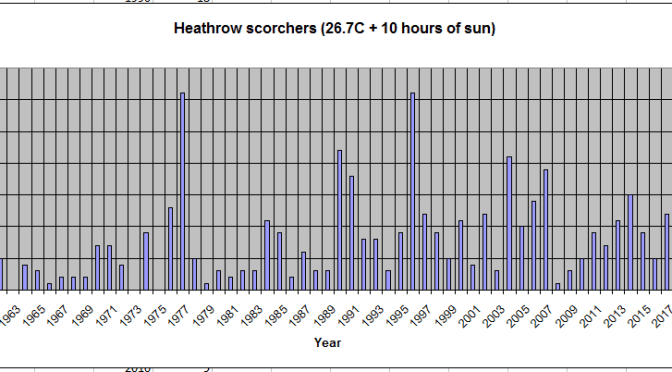
Growing up in the 1970s / 80s redtop newspapers would use the phrase once the mercury was nudging 80F (26.7C). But to ‘scorch’ you need sunshine, preferably at least 10 hours of it. Considering statistics from the Heathrow airport climate station in west London there have been 463 scorchers since 1959, the most recent happening on July 5th with 29.5C recorded and 13.9 hours of sunshine. There have now been 9 scorchers this year, already matching the number that were recorded in 2014 and only 3 short of last year.
But even with last month’s heatwave this year has some way to go, however, to match the amount measured in 1976 and 1995: 31 days!
The unearthing of an ancient Egyptian statue, initially thought to be of the pharaoh Ramses II, in a Cairo suburb earlier this month reminded me of the mysterious stone that was discovered in Wanstead Park in 2014.
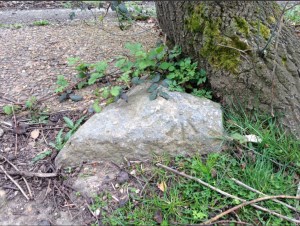
The mystery stone on the banks of Heronry Pond
The granite object, discovered partly buried in undergrowth on the banks of Heronry Pond, was initially thought to be part of the long-lost pyramidion (or capstone) of Tia, overseer of the treasury in the time of Ramses II, from his tomb at Saqqara in the Aswan region.
Though tests made last year at Reading University suggested otherwise the fate of the stone that once had pride of place in the American garden of Wanstead House remains a mystery.
The capstone was placed in the park as part of a landscaping project in 1784. Humphry Repton, the landscape gardener who devised plans in 1813-18, described Wanstead Park as “one of the most magnificent places in this country”.
Unfortunately, owner William Wellesley Pole’s debts caught up with him and the estate’s riches were sold off at auction, including the intriguing stone which was labelled Lot 279.
The catalogue of the 1822 auction
The auction on June 10th coincided with the hottest day of 1822 with the temperature peaking at 92°F. Evening thunderstorms brought some relief but the capstone remained unsold.
A catalogue of the 30-day event showed that Lot 279 was the last item to be sold, being bought by the auctioneer himself who immediately gave it to his son-in-law to display in his garden at Tamworth Castle. There is no evidence, however, that the stone ever reached Tamworth.
Though rainfall during the summer of 1822 was average much of it fell in cloudbursts. Luke Howard’s records in nearby Stratford for June and July reveal many days with maxima well into the 80s and destructive thunderstorms with deadly lightning and hail, some of which measured three inches in diameter.
Archaeologists at the dig in January 2015
It is possible that faced with transporting a very heavy lump of granite some 135 miles on a horse drawn cart on unmade, waterlogged roads those charged with the task instead quietly slid the stone into one of Wanstead Park’s lakes.
Ralph Potter, a member of Friends of Wanstead Parklands, has been following the story of the stone since it was discovered. He explained the reason behind why he thinks the stone’s origin is inconclusive: “Probably the world’s most eminent authority on stone from the Aswan quarries has declared, based on photos alone, that the stone does not originate from Aswan. On the other hand we have an eminent petrologist who within minutes of seeing the stone declared it almost certainly came from the quarry complex at Aswan.”
*A full history of the mystery of Lot 279, written by Chris Elliott, can be found here
**A chronicle of Wanstead Park, written by Alan Cornish, can be found here.
***The statue pulled from the mud in a Cairo suburb is thought to be most likely the first king of the 26th Dynasty of Egypt — Psamtek I .
Wanstead House (Wikimedia Commons)
Luke Howard’s entries in the Climate of London at the end of July tell of a very stormy period of weather
The period after the vernal equinox in 1952 was anything but springlike.
This chart shows the Synoptic setup at 1800h on 29th, the peak of the blizzard with F5 – F6 easterly winds, courtesy of the Met Office
A cold easterly airflow on March 29th and 30th 1952 affecting the southern half of England brought heavy snow whipped into drifts up to 6ft deep in parts of the Chilterns.
According to the Royal Meteorological Society’s weather log the snow varied from 3 to 6 inches and reached 10 inches at Northolt.
Squally winds, which gusted to 60 mph, blocked 330 main roads across the south. In places the temperature on the 29th remained below freezing all day – the snowstorm was probably the worst to affect southern England in late March since 1916.
The wintry weather followed a dry and fairly non-descript winter and must have been quite a shock at the end of what had been a fairly mild March.
Bernard Burton, of Wokingham, has a clear recollection of the event: “I remember the day very well as the Oxford/Cambridge boat race was held that afternoon. I was 14 at the time, and my brother-in-law gave me a ticket for a place on a launch to watch the race.
“My home was in Tooting at the time, and I took the bus to Westminster pier to catch the launch. I recall sitting upstairs on the bus with a thick layer of snow covering the front facing windows, but the roads and pavements were mainly slushy.”
Bernard, who runs Wokingham Weather, added: “I then spent one of the most miserable afternoons I can recall. There was a ‘lounge’ on the boat, which was warm, but was also full of diesel fumes and was very noisy. I alternately stood outside on the deck until the cold got too much, or went below for warmth until the fumes got the better of me.
“I recall bleak views of London with snow on roofs, in a poor grey afternoon light, but I think it was mainly dry at that time, although there may have been slight sleety rain.
“The boat race itself was a close one, but the crowds that usually lined the banks of the river were absent, just a few hardy stragglers, and by the time of the race I had a headache, probably brought on by the fumes. For my part, I couldn’t wait to get back to Westminster and back home to thaw out.”
John Hall, who was three at the time, said: ” I, sadly, don’t have any memory of it at all. That’s in spite of the fact that we apparently moved house from Cranleigh to Effingham (about 15 miles away) on the day of the blizzard.
“According to my father it snowed all day but the following day – which he reckoned was the 1st of April – the weather was glorious and all the snow was gone by noon. I don’t think his memory is quite in accordance with the facts, but of course that’s common with memories of past weather.”
The snow didn’t last long. March 31st saw temps rise to 5C; much of the snow had melted in the strong spring sunshine by April 1st. By the 3rd an Atlantic ridge of high pressure had moved in, raising temperatures to over 10C.
Stats for Kew suggest there was 21cm of level snow
1952 produced two more weather shocks. On August 15th and 16th over 220mm of rain fell on the hills above Lynmouth, Devon, leading to flash flooding of the village and the loss of 34 lives.
Months later, a large anticyclone during the last of five days of December produced the notorious ‘pea souper’ fog that contributed to the death of thousands of Londoners. This fog, initially freezing, became very dense and was directly responsible for the Clean Air Act enabled in 1956.
You can find an analysis of the unfolding pattern that produced the blizzard here. And here’s Xmetman’s take on the event.
Earthquakes in Italy and early season snow cover in Siberia have been well documented in 2016.
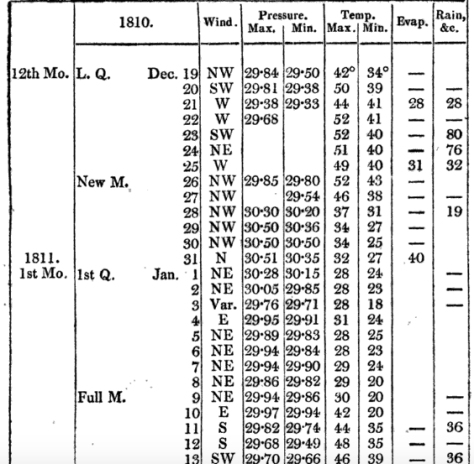
They were also mentioned by Luke Howard in his publication The Climate of London in 1810.
He also mentions winter thunderstorms over the Yuletide period, from Christmas Eve to Boxing Day – the amount of rain overflowing the Thames.
24th: Very windy night with heavy rain. 25th: Wind high all day with rain frequent lightning in the evening from SE. 26th: Wind very boisterous early in the morning day fine the rain of the last three or four days being impeded in its passage to the Thames by the spring tides overflowed the banks and filled the marshes.
Within two days of this wild and wet spell, complete with strong north-westerlies, the wind swung north and then north-easterly to usher in 1811 with a 12-day cold spell.
The conditions of the cold spell were not severe, the coldest night was -8C, it was a pretty standard cold spell for the time and one that the south-east used to experience with fair regularity in the early to mid 1980s.
Models currently show a (fairly) narrow chance of a stormy Christmas period. It would be interesting if it were followed with a cold spell in January – just like the ones we used to get in 1980s.
* The Booty website also contains the following on that notable month…
What is thought to be Britain’s strongest tornado occurred in December 1810. A category of “T8” (on a ten-point scale) occurred on the 14th at Old Portsmouth. The TORRO website says it: “tracked from Old Portsmouth to Southsea Common causing immense damage – although no deaths, it is believed. Some houses completely levelled and many others were so badly damaged that they had to be demolished; chimneys were blown down and the lead on a bank roof was ‘rolled up like a piece of canvas and blown from its situation’.”
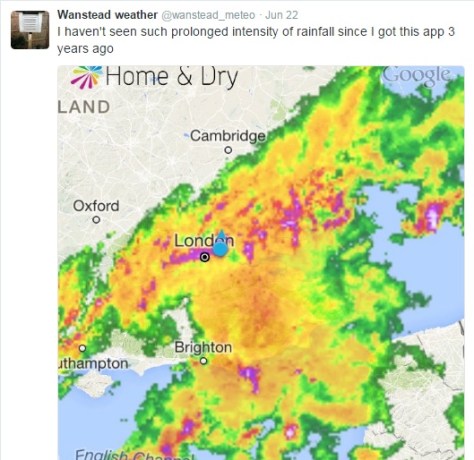
The past week has produced the highest 24-hour rainfall total recorded in Wanstead since at least 1960. The multi-cell thunderstorm on Wednesday night saw 60.8mm fall, most of it in two hours, bringing flash floods to the surrounding area. The spectacular lightning and thunder that accompanied it was almost a side show such was the intensity of the rainfall.
An image from the Home & Dry app revealed a succession of dark red echoes passing over our area. The heaviest rain seemed to run on a line from Battersea to Romford
I was unfortunate enough to be riding home right in the middle of the event: the entire length of the Mile End Road bore a resemblance to a shallow river, the heavy rainfall bouncing back off the Tarmac high enough to create what felt like a powerful drench shower.
The legacy of the downpours caused chaos in the morning and evening rush-hours. Many commuters were stranded at London terminals including Waterloo station because of flooded tracks, possibly robbing many of the chance of voting in the EU referendum. It will never be known if this would have had a bearing on the final result.
Many people think of June as a warm, summery month. The term Flaming June is regarded in most peoples’ subconscious as a reference to past weather. That it is a actually the name of a painting is often missed. Looking back through our local history there has been many notable events of thunderstorms and prolonged rainfall. In 1903 a record-breaking 59-hour deluge left vast swaths of the borough inundated.
The offical UK weather station totals all recorded less than Wanstead
This weekend 200 years ago, during the Year Without a Summer, a powerful tornado, strong enough to carry away objects weighing 60lbs, tore through the Edgware Road area in west London. Luke Howard recorded the event in the Climate of London.
At two o’clock being a still sultry day a whirlwind passed over the nursery ground of Mr Henderson in the Edgware Road which lifted seven lights from the greenhouses and carried them to the height of the highest elm trees, each of the lights weighs 50 or 60lbs at least. At the same time two garden mats were carried to an immense height so that the eye could not distinguish them.
The following day “extremely heavy and prolonged rain from 9am (26th) to 9am on 27th gave 2.95 inches”. This total of over 52mm is notably high though not a record.
This weather was a continuation of what had been an awful May and June – cold with more than twice the average rainfall in June.
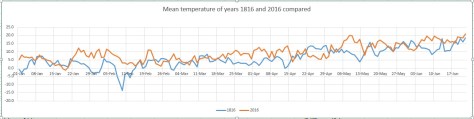
The weather then was not unlike what we have experienced this month. Indeed, a look at the weather throughout this year was similar as this graph shows.
Though the mean temperature at times bears a close resemblance this year is no comparison to 1816: The mean then was running at 6.2C, over 3 degrees colder than today.
Mean pressure was also lower being 992.1mb; the 2016 mean 9am pressure is 1010.6mb.
Perhaps not surprisingly this year’s rainfall actually trumps 200 years ago; the running total for rainfall here is 390.1mm, higher than the 309.6mm recorded in 1816.
The dreary summer and frequent thunderstorms of 1816 inspired Mary Shelley to write Frankenstein. A summer vacation in Switzerland led her to spend much of the time indoors. She, along with Lord Byron and John William Polidori entertained each other with a contest to write the scariest story of all. The unseasonal conditions, along with this dare, led to the creation of Shelley’s Frankenstein: The Modern Prometheus— as well as Polidori’s novella The Vampyre and Byron’s long-form poem, The Darkness.
It will be interesting to see if this June’s weather, along with momentous political changes here and in Europe, produce more fine fiction from the this and the next generation of writers.
Wind speed during the event from 2300 to 1000Temperature during the event from 2300 to 1000Pressure during the event from 2300 to 1000Rainfall from 2300 to 1000Rainfall rate from 2300 to 1000
With the arrival of spring the people of Wanstead and the surrounding region must have thought that the terror of bombs raining down was at an end. Just one raid in February that damaged a few houses was in sharp contrast to the devastation wrought by the Luftwaffe since September.
Synoptic chart for March 19th 1941
But further horror lay in wait in March when four members of the Civil Defence Services, two of them young lads, would lose their lives while heroically carrying out their civic duties.
March continued the theme of the wet, miserable and dull winter. The early part of the month was unsettled with heavy rain at times. On the 6th, over 13mm fell. During the second week it became dry with sunny periods. There were some frosty nights and lingering fog. On the 12th, the maximum temperature was only 5°C. Temperatures slowly rose during the third week.
The morning of the 19th dawned cold and frosty. Patchy fog soon lifted under the warm spring sun – it was the second day running the region was bathed in over five hours of sunshine.
The fog soon returned after dusk but plummeting temperatures were no excuse for the wardens at Post 41 ‘F’ District to undertake their nightly duties from their Aldersbrook Tennis Club headquarters. This area of south Wanstead received a real battering from the early days of the Blitz, earning the nicknames “The Battle Field” or “Hell Fire Corner”.
The following impression of that night is written by one who was at the scene:
“The wail of the siren opposite the Post announced at 8.15pm the arrival of the raiders. The Post personnel saw a startling sight. The Flats were a sea of flame. Thousands of incendiaries were burning on the open space. The guns roared. It was obvious that the enemy was making a concerted and determined attack. Bomb flashes stabbed the blackout. Planes droned overhead. The batteries on the Flats joined those further away in putting up a terrific barrage.
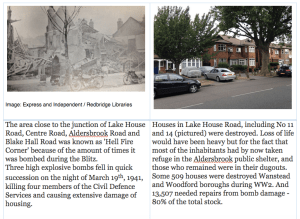
At 8.50pm, three high explosive bombs fell in Lake House Road, damaging a number of houses and partly demolishing Nos 14 and 31. A few casualties resulted, one being a man who was trapped in the doorway of No. 14. Wardens heaved on the obstruction to release him. Gas escaping in the same house caused a fire. This was quickly dealt with and the flames smothered. A nearby barrage balloon had burst into flames, illuminating the scene with glaring brilliance and revealing the widespread damage.
At 9.20pm this first incident appeared closed, and services were awaiting the result of a final search and check-up before being dismissed. Then a parachute mine landed. It exploded a few yards from Aldersbrook corner on the Leytonstone side. A house in Lake House Road, already badly damaged, tottered to destruction. Number 11 caught fire and was destroyed. Loss of life would have been heavy but for the fact that most of the inhabitants had by now taken refuge in the Aldersbrook public shelter, and those who remained were in their dugouts.
The attack died down. Wardens returned to their posts – but the number for 41 was sadly lacking. The two boys’ bicycles stood in their usual place. ‘Busy somewhere’ said the chief. But the absent ones did not return, and a search was made. They were found – in the mortuary, three of them. It was known that two others had been taken to hospital. Warden Barnett was one of these. He died next morning of his injuries.
Just before the mine exploded, the messengers had been giving assistance in one of the less badly-damaged houses. Broome, although officially not on duty, had rushed out to lend a hand. Warden Hutton was endeavouring to turn off the gas at No 14 when the mine fell.
So the four from Post 41 died doing their duty on the Home Front. The two boys, pals in the service, sleep in one grave in Old Wanstead churchyard. The two men lie close by, in Ilford Cemetery.
A few days later their comrades stood silently at attention as the funeral cortege halted outside the Post. A Union Jack covered each of the four coffins.
The four members of the Civil Defence Services who gave their lives were: Thomas Hutton, 44, a warden, of Blake Hall Crescent, Wanstead; William Barnett, 36, a warden, of Belgrave Road, Wanstead; Roy Broome, 17, a messenger, of Lake House Road, Wanstead; and Herbert Stower, 18, a messenger, of Clavering Road, Wanstead.
Winston Churchill’s letter to his constituents
As spring wore on the weather remained mostly miserable though raid incidents lessened and petered out in May. Wanstead and Woodford had its last bombs of the period on May 10th.
In total 129 people lost their lives and 194 were injured during the campaign. This figure would nearly double when the next phase of the bombing, using V1 flying bombs and V2 rockets, would begin three years later in June 1944.
It is hard to imagine how people coped with the constant barrage of bombs during the Blitz. What seems to get lost in articles and historical texts I’ve read is just how grim the weather was at the time – remember this was a time before central heating. Not only were bedrooms freezing cold people must have laid there wondering if they were going to see morning.
It seems to be a human condition that when we are faced with adversity we just find a way of ‘getting on with it’ as best we can.
During the opening months frequent cold blasts brought much wintry weather. Cold weather at the end of January turned severe during the second week of February.
In the early hours of the 7th heavy snow, driven by gale-force north-easterly winds, brought some of the worst winter weather this area has ever seen. Some 35mm of precipitation is recorded on the 8th – this would normally give at least one foot of level snow that could obviously be whipped up into huge drifts.
Luke Howard described the scene in his diary entry saying the abundance of snow “loaded the trees to their tops and weighed down the smaller shrubs to the ground.”
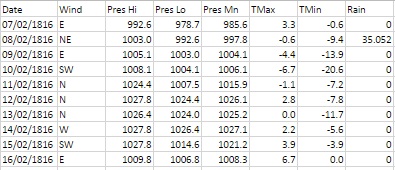
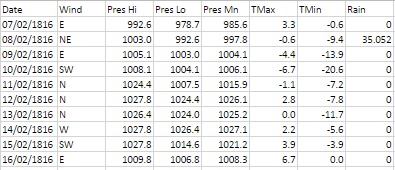
The snow and polar continental air also produced perfect conditions for a textbook radiative cooling night within two days of the snowfall. The minimum recorded on the morning of the 10th: -20.6C has not, as far as I can tell, been repeated since.
To put that into perspective the lowest minimum of the severe winter of 1963 for this area was -12.2C recorded at Greenwich on January 21st. The coldest night I have personally recorded was -10.3C on January 12th 1987.
Howard, who would have taken readings at his laboratory in Stratford and home in Tottenham, remarked on the rare occurrence of the cold and said that the thermometer had remained below 0F (-17.8C) for a number of hours: “an occasion that happened less than five times within a century – the last appearing to be 19 years previous.”
Howard’s theory of the day was that such extremes didn’t occur during long continued frosts but rather at an interval of one winter after such a season. He mentions the frost of 1794-95, which lasted 44 days, immediately before which the thermometer fell to -2F. The following year a low temperature of -6.5F was recorded. The year 1816 followed the cold winter of 1813/14 – the same pattern, so Howard was prepared for the night of February 9th 1816.
Modern climatologists tend to discount these old records by arguing that standard conditions set by the World Meteorological Organisation were not met. However, Howard backs up his findings with a very thorough explanation of how he went about measuring the record low temperature that followed a freezing day where the maximum thermometer didn’t rise above -6.7C.
“Early in the evening on trying the experiment of placing a wet finger on the iron railing it was found to adhere immediately and strongly to the iron. I exposed several thermometers in different situations.
“At 8 pm, a quicksilver thermometer with the bulb supported a little above the snow stood at 0F. At 11pm a spirit thermometer in the same position indicated -4F, the former which had a pretty large bulb had not sunk below -3F. At 7.30am the 10th a quicksilver and a spirit thermometer hung overnight about 8ft above the ground indicated respectively -3F and were evidently rising.
“The thermometer near the surface of the snow had fallen to 5F and probably lower, but at the usual height from the ground of my standard thermometer the temperature was at no time below -5F. The exposure is north and very open.”
Howard goes on to describe the following day:
“From 8am the thermometer continued to rise steadily at noon a temperature of 25F was pleasant by contrast to the feeling and it was easy to keep warm in walking without an upper coat. Even at 0F, however, the first impression of the air on the skin was not disagreeable; the dryness and stillness greatly tending to prevent that sudden abstraction of heat which is felt in moist and quickly flowing air.
“Early in the afternoon the wind changed all at once to SW some large cirri which had appeared all day passed to cirrocumulus and cirrostratus with obscurity to the south. I now confidently expected rain as had happened in former instances but was deceived and the thaw took place with a dry air for the most part and with several interruptions by night.
As often happens with severe cold snaps Howard reported on the 17th that the snow “was mostly gone but very thick ice remains on ponds”; a period of just over a week.
The cold snap saw the mean temperature for February 1816 over three degrees colder than average at 0.8C.
Such extreme temperatures are rare in the capital though not unheard of. I know that there have been cases of sub -20C readings in, for example, the Rickmansworth frost hollow and Ian Currie’s Chipstead Valley, but I have never seen anything so low in east London. Could it be repeated again? Possibly, but like 1816, the synoptics would have to be absolutely perfect for it to happen.















 actually trumps 200 years ago; the running total for rainfall here is 390.1mm, higher than the 309.6mm recorded in 1816.


 At 9.20pm this first incident appeared closed, and services were awaiting the result of a final search and check-up before being dismissed. Then a parachute mine landed. It exploded a few yards from Aldersbrook corner on the Leytonstone side. A house in Lake House Road, already badly damaged, tottered to destruction. Number 11 caught fire and was destroyed. Loss of life would have been heavy but for the fact that most of the inhabitants had by now taken refuge in the Aldersbrook public shelter, and those who remained were in their dugouts.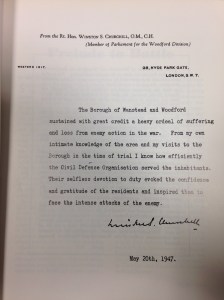


 Wanstead Meteo
You must be logged in to post a comment.