Rain today (January 16th) is the first meaningful fall since before Christmas, putting an end to the 23-day long dry spell.
This meteorological drought, rare given that it spanned Christmas and New Year Storm singularities, these having 84 and 86 per cent probabilities respectively, was the 3rd equal longest winter drought.
The only other similar droughts in a list that dates back to 1887 were 19/12/2008 – 03/01/2009 and 17/12/1972 – 02/01/1973.
The last precipitation I recorded was from a weak occlusion that followed a cold front on the evening of December 23rd.
This synoptic set-up was followed by a build in air pressure that peaked on the morning of January 3rd; 1043.8mb was the highest reading in this area for at least 10 years and is the highest pressure I have measured.
A fuller version of London droughts in all seasons can be found here.
Weather models are continuing to struggle in the aftermath of the stratospheric sudden warming on January 1st. The GFS and ECMWF have flip-flopped: on one run decent northern blocking extends southward only for the dreaded European high to appear on the next.
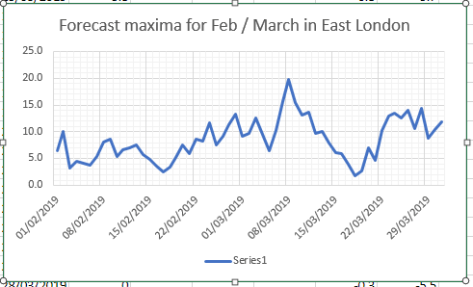
Using a combination of QBO and ENSO data featured in my winter forecast and statistics from previous SSWs (including 2013 and 2018) achieved the following results shown in this graphic.
Although some days in the next week or so will be cold it is not until the 14th that conditions start to bite, the start of a week-long cold spell that will probably be more notable for cold than snowfall.
The rapid recovery in temperature would suggest that the Azores / European high making a return. With the MJO moving back and forth between phase 7 and 8, and looking at the behaviour of previous cold spells, this would make sense.
The GFS has been churning out some very strange charts of late
As for February, unless there are further SSWs to disrupt the polar vortex, and depending on its recovery, it is unlikely we will see a repeat of the winter of 1984/85 that I hinted at last month. The graphic below, however, would suggest another cold spell in the third week of February.
This year finished as the 7th warmest on record – some 0.8C warmer than the 1981-2010 average.
Only two months of 2018 were more than 1C below – the means of April, May, June and July were at least 2C above average.
Rainfall was less remarkable with the year finishing 97 per cent of average. The total of 584.4mm puts it as the 81st driest since 1797, just over 20mm wetter than 2017.
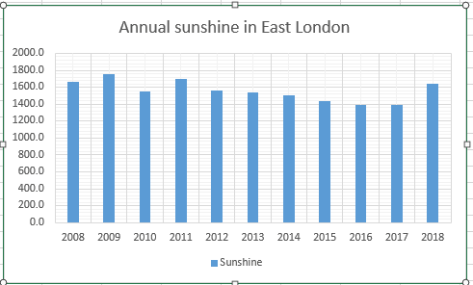
It was a sunny year with 1,641 hours of sunshine recorded. That’s 111 per cent of average, the 23rd sunniest since 1881.
December was most notable for benign weather, totally in contrast to last December which saw snowfall.
The mean temperature finished 7.3C, 1.7C above average, the mildest December for three years though still over 3C cooler than that record breaking December
Some 60.4mm of rainfall was recorded, 114 per cent of the 1981-2010 average, over 20mm less than last year.
Some 39 hours of sunshine were recorded, that’s 97 per cent of average, duller than last year.
Five air frosts were recorded though only one was colder than -1C.
…And not a flake of snow. There’s been lots of talk about how an SSW will eventually usher in a cold January and February but it is by no means guaranteed.
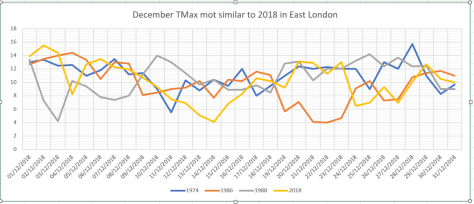
The average maxima for this December will finish 10.2C, precisely the same as December 1985. Other Decembers that finished close to this average maximum are shown below.
As you can see apart from the middle of the month the temperatures are all over the place. And so are the conditions that followed in January and February.
A closer inspection of every year reveals that just three were very similar to 2018: 1974, 1986 and 1988.
Again, there’s plenty of spread. The 500mb reanalysis charts below show the situation of the northern hemisphere on December 31st of each year, including this year.
December 31st 1974
December 31st 1986
December 31st 1988
December 31st 2018
What followed in January 1975, 1987 and 1989?
January 1975 in this area was the warmest on record, back to 1797, while January 1989 was the 12th warmest. Conversely, January 1987 saw one of the coldest spells on record.
Perhaps it is fair to say that there is a 66 per cent chance of a very mild January, though you cannot discount the 34 per chance of another January 1987…
With talk of an imminent statospheric sudden warming (SSW) I thought it would be interesting to have a look back at previous SSWs and see what precedents could be found.
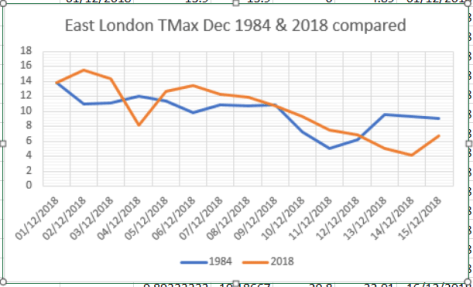
December so far is showing similarities with 1984: mean maxima is within 0.3C of 1984 while rainfall is virtually the same at around 30mm!
During the winter of 1984-85 the polar vortex split on January 2nd, setting up that month to be among the coldest of the 20th century, on a par with 1979 and 1987. A more recent January that was just as cold was 2010.
Indeed, the winter of 1984-85 was among the snowiest of the past 70 years, ranking at number 5 in my survey of winters.
The GFS model is now within range of the big day on the 25th. From now until Christmas Eve I will be having a look to see what is on offer.
The first operational run suggests something of interest but please bear in mind there is a long way to go yet. While operational runs are often exciting, the below suggests a potent northerly with snow for many, the right hand average is much more realistic though admittedly boring.
My own guess at this stage is for something benign, a high of 6C with a low of 2C, perhaps some frost early or late on?
10th: Op run this morning is showing quiet weather. A high of 4C after overnight frost.
11th: Op run now shows a slack north-easterly and possible snow.
13th: An anticyclone to the north of Scotland continues to keep things seasonal on the op run this morning. The average again benign.
14th: More interest on today’s midnight run. The op shows a cold pattern. Frost early and late and a high of 2 or 3C. A chance of flurries. Even the average looks less mild!
15th: The interest of yesterday has faded. Not terribly mild but not cold either. Xmas morning starting chilly, 6C with rain in the evening, a warm sector bring the temp up to 10C in the evening. The average suggests something similar.
17th: All change again on the op run today with an Atlantic ridge with plenty of cloud. High 7C Low 4C. Gloomy. The Average less settled…
18th: The op this morning suggests the 25th will be something of a changover from the present regime to something more settled. The op chart suggests a temperature of 9C day and night though perhaps the reality may see some frost late on in the day.
20th: It’s looking quiet and calm.
21st: quiet and calm.
You can find out what every Christmas Day in London was like weatherwise here.
November was most notable for the amount of sunshine. Some 79 hours were recorded, that’s 135 per cent of average, the sunniest November for two years.
The mean temperature finished 8.4C, 0.4C above average, the mildest November for three years.
Some 72.5mm of rainfall was recorded, 122 per cent of the 1981-2010 average, the wettest November for two years.
Long range modelled forecasts have been all over the place of late and, looking at the underlying signals, it is easy to see why.
When I’ve produced these forecast in the past, in terms of QBO and ENSO data, there’s usually a lot of analogues to compare with. This year, however, seems to be an exception.
Considering QBO first I looked back over data to 1950 and found nothing similar for October. However, looking over the whole series the cyclical nature of this circulation may give some clue.
Some 20 months were revealed, ranging from June 1959 to June 2015. Using NOAA’s Niño 3.4 region I narrowed this list down to the few that had an ENSO value of around +1 with a rising trend. With NOAA’s forecast of a Modoki El Nino (one that occurs in the central Pacific) this narrowed the list to just 1 period: June 2015. Considering maxima anomalies this would give the following winter.
The above would suggest there being a general cool down through December with a cold spell starting just before Christmas into the new year? And another cold spell end of January into the first week of February?
The above precipitation anomaly chart would suggest a wetter than average December, January and February, though February by much less so.
It’s been a very busy autumn so I’m keeping this short.
The below figures, particularly January and February, may be different in the event of an SSW occurring. In all then.
Twitter and other forums have been at fever pitch with excitement for a ‘nailed-on’ cold spell.
But with many getting carried away over tales of a repeat of March’s ‘Beast from the East’ it is important to remember that snow in November is extremely rare in the south-east; despite predictions of the incoming upper air being very cold the ground is still very warm and will take time to cool.
However, as seen in November 1993, a week of hard frosts were enough to chill the ground enough for a decent week-long cold spell. Similarly, although the snow didn’t arrive in London until December, November 2010 was also cold enough.
The weather of late has been in an ‘average mood’ with the mean temperature in September and October both finishing at 0.2C below. The mean for the this month is currently (on the 15th) running 1.8C above average, therefore for the mean to finish the same as September / October would require a big cool down, as hinted by the models.
Will we see another an average, 1993 or a 2010 end to the month. My hunch is it will be something between the three.
Below is a graph that shows this November so far with average, 1993 and 2010 ends. 2018: 0.4 1993: -0.8 2010: -1.4
You must be logged in to post a comment.