A blog that tries to make sense of how the UK's national climate translates into local weather for Wanstead and the surrounding regions of east London and west Essex.
Check out my twitter feed @wanstead_meteo for local weather forecasts, stats, records and phenomena for the east London areas of Wanstead, Aldersbrook, Leytonstone and Stratford. And anything else weather
With flooding in the Somerset Levels dominating the headlines it is easy to get carried away with media hysteria that we are in unprecedented times in terms of rainfall. But as with so many media stories these days you don’t have to look far back in meteorological records to find that we’ve been here before.
The jetstream has been virtually ever present over the UK this winter, driving depression after depression over our isles
Although I base this blog on local figures – two series of stats going back to 1881 and 1959 – it is notable that this particular microclimate has actually been dryer than neighbouring areas, including east Essex where the rain crossing this area often peters out. With such power in the jet stream, however, bands of rain have been pushing right through this winter. Surrey has also been notably wetter, with orographic uplift only partly responsible for the increased wetness. Anyone driving around the M25 will have noticed the flooded fields at the side of the motorway.
It has been mentioned that this winter has been the most cyclonic in recent memory, but you only have to go back to the winter of 2000-01 to find a more cyclonic winter, though that season saw fewer severe gales.
Since the beginning of the meteorological winter on December 1st Wanstead has recorded 235.6mm of rain to February 6th. Considering the 1959 series that’s 7% wetter than the winter of 1989/90 – though this winter is actually 0.9C colder than that season 24 years ago.
Looking at the bigger picture, and with 22 days to go, this winter is currently 7th wettest in the series going back to 1881 – quite a way behind 1915 which saw 343.7mm recorded. Looking at the GFS model out to 9 days, however, there is much more rain to come.
The season so far, in terms of temperature and rainfall, has been notable in that autumn did not really offer any hints as to how winter would unfold. At the beginning of December I would have put the probability of a winter such as we have had so far at 10%. Should the rain continue to fall while the temperature stays mild the probability would fall to 1% – a truly exceptional winter in the same league as 1962/63 – but at the other end of the scale.
After my less than impressive stab at a winter forecast I am a bit loathe to make any more predictions. Trying to predict the weather more than a few days ahead with any detail is impossible. And seasonal forecasting is fraught with difficulty. However, precedent suggests we could be in for a warm and settled March. Indeed, if this year is anything like what followed in 1990 we could be in for a very nice summer. But then again we might not. As Mark Twain said: ‘Climate is what we expect; weather is what we get’.
The last time January was so wet Eddie ‘The Eagle’ Edwards was about to fly the flag for Great Britain in the ski jump at the Winter Olympics in Calgary, Canada, in 1988.
There was occasional respite from the persistent rain
Some 130.6mm of rain (251% of average) fell in January, beating the previous record set in 1988 by just 2.8mm around midnight on Saturday 1st. Unlike 1988, last month followed a December that was 154% wetter than average. The wet spell, which started on December 13th, is only now making a real impact on the river Roding which is now running very high.
January was also warmer than average with a mean temperature of 6.4C (1.5C above the 30-year average) – ranking it 20th in the series since 1881 – and the warmest January since 2008. Though the month was very mild no single day was particularly mild. Highest maximum was 12.7C on the 7th.
The most notable day was probably Saturday 25th when what started as a bright, fine day quickly changed around 4pm as a strong squall with heavy rain blew through with associated thunder and lightning and 6C fall in temperature in an hour. Wanstead escaped the damage of elsewhere. Numerous trees blocked rail lines in Kent and gusts of over 60mph were widely reported.
There were two other incidents of thunder and lightning on 5th and 6th – very unusual in the middle of winter and an average normally observed in high summer.
Air frosts: 5 : coldest night of winter so far was observed on morning of 12th with -2.9C
For anyone who likes cold weather it has been a dreadful winter so far with no snow falling or lying in this part of Britain.
An inversion during the first half of December saw the edges of ponds in Wanstead Park begin to ice up
A very mobile synoptic regime has seen numerous vigorous depressions blowing in off the Atlantic bringing flooding misery for many as swollen rivers burst their banks.
The predominantly maritime air over us has meant that even air frosts have been few and far between.
Since December 1st, Wanstead has recorded just 7 air frosts – half the number of last year. The coldest night was just -2.9C , warmer than the -6.9C recorded by this point last January.
The current mean temperature this winter to January 14th is 6.6C with rainfall 133mm – statistics that are remarkably similar to the winter of 1985/86 (mean 6.8C rainfall 130mm). That December and January was followed by a very cold February – the 4th coldest in a series stretching back to 1881.
However, before any coldies reading this get excited it should be noted that this season is also remarkably similar to winter 1989/90 (mean 6.8C, rainfall 128mm), which was followed by more stormy weather, including the Burns’ Day Storm, and the warmest February on record in this region.
Further scrutiny of stats for the Wanstead area reveal other years were similar. Using my method for finding patterns stretching back over 50 years to forecast this winter I picked out years that were +/- 10% of the mean. From these I then weeded out the seasons where the rain was +/- 10% of the 2013/14 rainfall total. This gave a list of five other winters with similar temperature and rainfall. Leaving aside 1985/86 and 1989/90 the other winters weren’t anything special with ‘snow lying’ days below the median for this area of six.
As I write this there are tentative signs on the weather models that a Scandinavian high may begin to form next week, introducing colder air from the east – exactly what we need to precipitate snow. However, they are just tentative signs and the cold air may never reach this far west anyway. Bear in mind also just how strong the influence from the Atlantic has been so far this winter. The Met Office have said the storms have been the worst in 20 years – which takes us back to the year in the above table of 1993/94. The only snow lying in that DJF season occurred in a short cold snap around February 15th – though, admittedly, an impressive fall of snow happened the previous November.
So, in summary, the probability at this point of at least one fall of snow before the end of February could be put at 75%. No snow: 25%. Abundant snow: 25%.
Damaging gusts associated with the depression on December 23rd felled this tree by the war memorial in Wanstead High Street
While compiling the figures I found that for my winter forecast to be correct would need a second half to winter exactly the same as 1985/86.
Some comparisons have been made between this winter and the balmy winter of 1988/89 – though that winter, the second warmest in the 1960-2014 series up to this halfway point, was a full degree warmer than this season and much drier, with only 30.9mm falling in over 6 weeks.
The culprit of the dry weather of that season 24 years ago was the influence of a very strong European high pressure which ‘blocked’ weather fronts from reaching this part of the UK, sending a conveyor belt of depressions skirting over Scotland bringing incessant rain instead of snow to Cairngorm resorts.
The nature of the weather this time round has been very different. Though December started with a strong anticyclone over Europe fronts associated with very deep depressions off the Atlantic have made inroads deep into the continent.
A classic Genoa low brought over 2 metres of snow above about 1,000m on Christmas day to resorts on the south side of the Alps. The nature of the airflow subsequent to that, however has brought some very high temperatures for the year.
Scottish and continental European winter sports enthusiasts will remember the season of 1988/89 well for all the wrong reasons, with little snow falling before March. I can vividly remember some amazingly cheap skiing holidays advertised on Teletext in January 1990. One deal was a week to Andorra for £19, including flights, transfers and half board in a 3-star hotel. A few of the lads in my A-level economics class took full advantage – only to return with tales about snowless mountains, sprained knees and wrecked skis, though it’s not clear how much of an influence the duty-free booze had.
Although many resorts were already investing in artificial snowmaking it was this season that quickened the pace of investment in snow cannons.
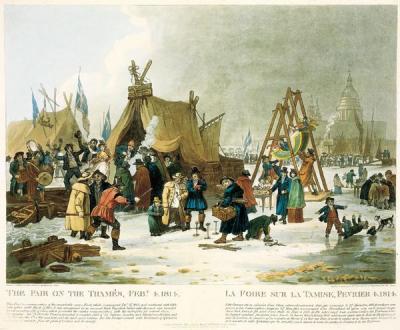
The Frost Fair of 1814 on the River Thames in London. Painting by Luke Clenell, entitled The Fair on the Thames, February 4th 1814
It is 200 years ago this month that London enjoyed its last frost fair.
Weeks of hard frost from the day after Boxing Day was enough to freeze the river between the old London Bridge and Blackfriars, enabling dozens of opportunist London traders to set up stalls and booths selling souvenirs, drinks and food.
Unlicensed gambling, drinking and dancing was the order of the day for those brave enough to venture on to the ice. A sheep was roasted on the ice with the public charged to look at it, and charged again for a slice of “Lapland mutton”. At one point an elephant was led across the ice at Blackfriars.
The ice was however, not very stable. Boatmen deprived of an income charged visitors a penny to cross planks to get on to the ice. They were on hand to rescue two women who fell through, although a plumber carrying lead was not so lucky.
Though changes to the flow of the Thames has vastly reduced any chance of a frost fair being repeated I’ve often wondered what the day to day climate would have to be like to freeze the Thames as it did in 1814.
Luke Howard’s Climate of London provided a starting point. His pioneering measurements of the atmosphere taken outside his laboratory by the River Lea in Stratford, though not as accurate as today’s readings, provide an excellent insight into just how cold the season was.
This line chart shows that the winters of 1813/14 and 1962/63 bore some resemblance
I was surprised to find that the stats compare well with the winter of 1962/63 – the coldest winter in recent memory. Obviously Howard’s readings would not have been as accurate as today’s – his thermometers were initially suspended in a laurel bush to shield solar radiation – but they would still have been close.
I have converted his readings in Fahrenheit to Celsius and plotted them on a spreadsheet here. As well as records of temperature, wind, rain and moon phase Howard also included any notable weather events in his diaries from both home and abroad.
The winter of 1813/14 started mild. On December 16th he noted that “bees quit the hive in unusual numbers for the season”. During the following days up to Christmas Day wind and rain alternated with misty, occasionally frosty, mornings – probably not unlike some of the weather we experienced last month.
However, Boxing Day brought a big change: “Since the 26th we have had a succession of thick fogs with a calm air or at most a breeze from the NE. Yesterday the air cleared a little and today has been fine; a display of cirrus clouds with much red in the morning and evening sky, the peculiar smell of electricity has been perceptible of late when the air cleared up at sunset.” Howard goes on to report that there was an eruption of Mt Vesuvius in Italy.
The beginning of January saw the mists thicken into heavy freezing fogs: “The mists which have again prevailed for several days and which have rendered travelling dangerous.”
The view across to St Paul’s from Bankside at low tide. Images of what it looked like this month in 1814 can be seen on the Corporation of London’s website
In those days, with cloud identification in its infancy, Howard identified the fog as stratus and noted with wonder the formation of rime frost on everyday objects: “The air has been in effect loaded with particles of freezing water such as in a higher region would have produced snow. These attached themselves to all objects crystallizing in the most regular and beautiful manner. A blade of grass was thus converted into a pretty thick stalagmite some of the shrubs covered with spreading tufts of crystals looked as if they were in blossom while others more firmly incrusted might have passed for gigantic specimens of white coral.”
By January 5th a “deep snow brought by an easterly wind had reduced the whole scenery to the more ordinary appearances of our winter”. More snow followed on the 6th and piled into drifts on a strengthening NE’ly. The biting gusts presented Howard with yet another new winter phenomenon: snow rollers: “With the temperature at the surface 33 or 34F presented an amusing phenomenon which was pointed out by my children. Instead of driving loose before the wind it was collected occasionally into a ball which rolled on, increasing till its weight stopped it. Thousands of these were to be seen lying in the fields some of them several inches in diameter”.
On the 9th Howard describes a misty morning and a snowy landscape that had a “bluish tint”. The “blueness” of the air is possibly down to the sheer cold – it was -13.3C that morning. I’ve seen something similar, a bluish hue to the air, on very cold mornings in the Alps. Howard notes that the minimum on the surface of the snow that night, the coldest of that winter, was -14.4C.
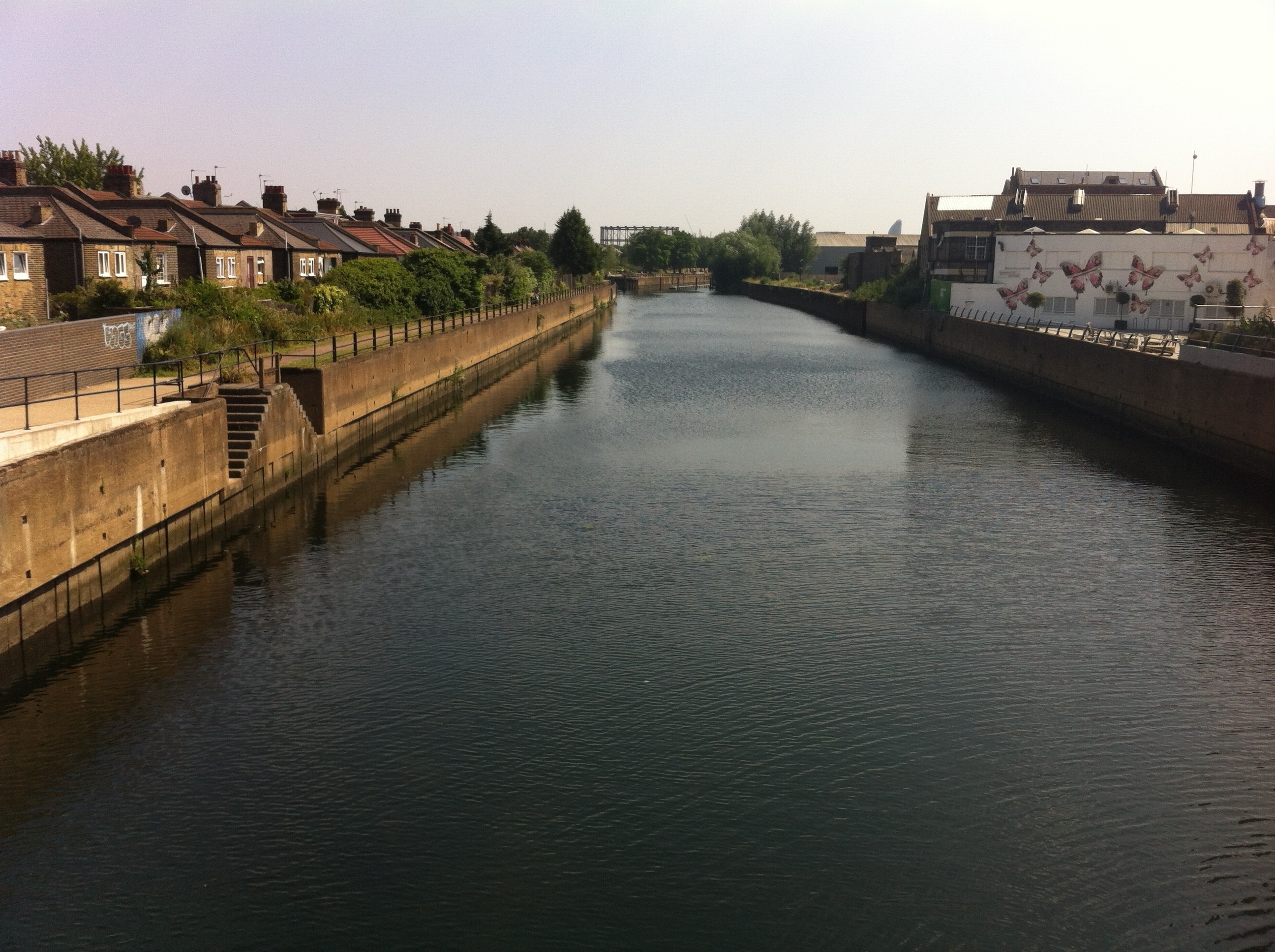
The River Lea close to where Luke Howard’s laboratory stood
On the 11th a “very red” sunrise was observed . By the 12th Howard describes the Arctic scene from his laboratory: “The River Lea is now firmly frozen and the Thames so much encumbered with ice that navigation is scarcely practicable.” Howard also notes on this date that the snow in upper parts of Hampshire and “on the Hind Head” had fallen to a depth of 15 feet in places.
A slight thaw was noted on the 16th from the warmth of the earth. More snow fell on the 18th and 19th. Snow on the 20th was accompanied by a strong NE’ly. On the morning of the 21st Howard noted drifts “many feet deep”.
The 22nd to the 25th saw more outbreaks of snow before the wind swung into the SW on the 26th with snow followed by rain – the cold spell was beginning to lose its grip. Howard notes on the 29th: As the barometer began to rise the wind came round by SW to NW and blew with great violence till near morning”. Classic freeze/thaw conditions followed over the next few days before the real thaw, and the end of the frost fair, arrived on February 5th. Howard notes: “Crimson sky at sunrise hollow wind snow and sleet. 6th A gale from SW with showers of rain at evening.”
The rest of February, and meteorological winter, appears fairly nondescript. Howard notes that on the 12th a gunpowder explosion resulting in a fire at the Custom House, 5 miles south, caused a “shower of fragments of burnt paper”. Sharp frosts and misty mornings prevailed to end of month, Howard noting the “clear orange twilights”, probably caused by the eruptions in Italy that formed a new crater on Vesuvius. Howard mentions a letter he received from Heligoland on February 21 which had also seen intense frost that was preceded by thick fogs and heavy falls of snow. The latter was 10 and 12 feet deep – the frost lasting six weeks.
Howard wrote his own account of the frost fair…
“The Thames Frozen Over
January 15: The masses of ice and snow had accumulated in such quantities at London Bridge on the upper side yesterday that it was utterly impossible for barges or boats to pass up. During the whole of this week that part of the Thames below Windsor Bridge called Mill River has been frozen over and has been crowded with persons skaiting.
February 3: The confidence of the public in the safety of the passage over the frozen surface of the Thames was yesterday increased. All the avenues from Cheapside to the different stairs on the banks of the river were distinguished by large chalked boards announcing A safe footway over the River to Bankside and in consequence thousands of individuals were induced to go and witness so novel a spectacle and many hundreds had what we cannot help terming the fool hardiness to venture on the fragile plain and walk not alone over but from London to Blackfriars Bridge. Several booths formed of blankets and sail cloths and ornamented with streamers and various signs were also erected in the very centre of the river where the visitors could be accommodated with various luxuries. In one of the booths the entertaining spectacle of a sheep roasting was exhibited
February 7: Friday several printers brought presses and pulled off various impressions which they sold for a trifle eg Printed to commemorate a remarkably severe frost which commenced December 27, 1813, accompanied by an unusual thick fog that continued eight days and was succeeded by a tremendous fall of snow which prevented all communication with the Northern and Western Roads for several days. The Thames presented a complete field of ice between London and Blackfriars Bridges on Monday the 31st of January, 1814. A Fair is this day February 4, 1814, held and the whole space between the two Bridges covered with spectators. This field of ice was indeed a very rugged one consisting of 1 masses of drift ice of all shapes and sizes covered with snow and cemented together by the freezing of the intermediate surface. The deceitfulness of the latter caused as is too common on such occasions the loss of some lives by drowning. The following passage announcing the opening of the river soon after is worthy of preservation on account of the spirit in which it is written.
February 11: We are happy to see the lately perturbed bosom of Father Thames resume its former serenity. The busy oar is now plied with its wonted alacrity and the sons of Commerce are pursuing their avocations with redoubled energy. Cheerfulness is seated on the brow of the industrious labourer those who were reduced to receive alms as paupers again taste the sweets of that comparative independence with which labour crowns the efforts of the industrious. What a fruitful source of congratulation does this prospect afford nor can the contemplative mind dwell on the subject without feeling gratitude to that beneficent Being who in a time of such calamity opened the hearts of the benevolent to administer from their abundance to the necessities of their poorer brethren and thus add cement to the bond by which all mankind are linked together. The mischief done on the river during the late frost is greater than can be remembered by the oldest man living. Among the craft alone it is calculated to amount to upwards of 10,000 independent of the damage sustained by the cables tackle & of the shipping.”
The mean temperature of 10.7C makes 2013 0.5C colder than the 1981-2010 average. And makes the year 46th warmest in the series going back to 1881.
Rainfall of 554.9mm is 92% of average for a year in this area, making it the 68th wettest in the series back to 1888. Some areas of the British Isles have been considerable wetter – this just reflects how variable rainfall can be.
Though the year appears fairly average it masks some notable events…
A couple of notable falls of snow were observed in January and February
January saw a couple of notable falls of snow, the first of which arrived on the 18th. By the morning of the 21st there was 13cm lying.
February saw a further snowy spell with 5cm falling on the 10th – but this only lasted a couple of days.
The mean temperature for March of 3.6C made it the coldest since 1892, the 3rd coldest in the series since 1881.
After a cool and dry spring and early summer July surprisingly turned out to be the warmest since 2006 – the mean temperature of 20.7C being the third warmest in the series going back to 1881. The warmest day of the year occurred on 22nd when 34C was recorded. This was followed by a very potent thunderstorm in the early hours of 23rd.
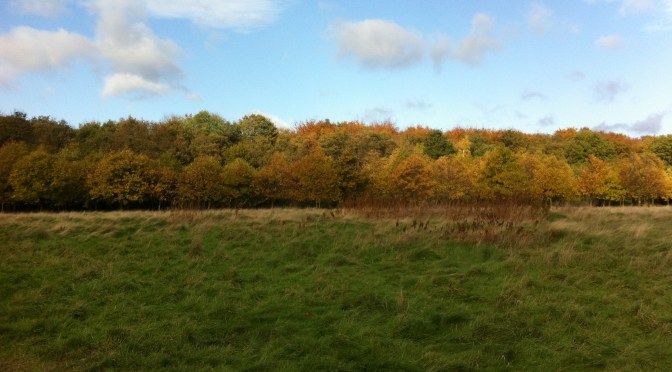
Autumn overlooking The Temple in Wanstead Park
An average August and September saw a couple of notable rainfall events with 32.8mm on 24/8 and 32.6mm on 13/9 being the the 27th and 28th highest 24hr totals in a series going back to 1961. In the August event Maldon in Essex saw in excess of 100mm leading to flooding. What made it more noticeable is that these events occurred during dry spells.
The end of October saw the St Jude storm blast through Wanstead. The strength of the gusts saw the demise of a few mature limes on Christchurch Green as well as trees in Wanstead Park.
The beginning of the month started with lots of calm, quiet weather with fog and night frosts. A high pressure inversion so not a proper ‘cold spell’
December was warmer than average with a mean temperature of 6.5C (0.9C above the 30-year average) – ranking it 33rd in the series since 1881. Rainfall of 81.9mm was 154% of average – ranking it 22nd in the series.
The month was 1C warmer than last December – with 84% of the rain that fell in December 2012.
Despite it ‘feeling’ like it has been the stormiest December for some years this month was not as windy as December 2012. To illustrate this the ‘wind run’ for this month (the number of revolutions of the anemometer) was 2408.7 miles. Last December was 2654.5 miles, in other words last December was 10% more windy.
Air frosts: 4
Ground frosts: 11
Thunder: 1
Small hail: 1
The rain on the evening of the 23rd was heaviest to the south and west of us – with 75mm in the Warlingham area of Surrey. Flooding and high winds caused hundreds of thousands of power outs in Sussex and Kent
There was a time when not too far from the hustle and bustle of Selfridges, Harvey Nicks and Fortnum & Mason stood a fine scientific instrument supplier.
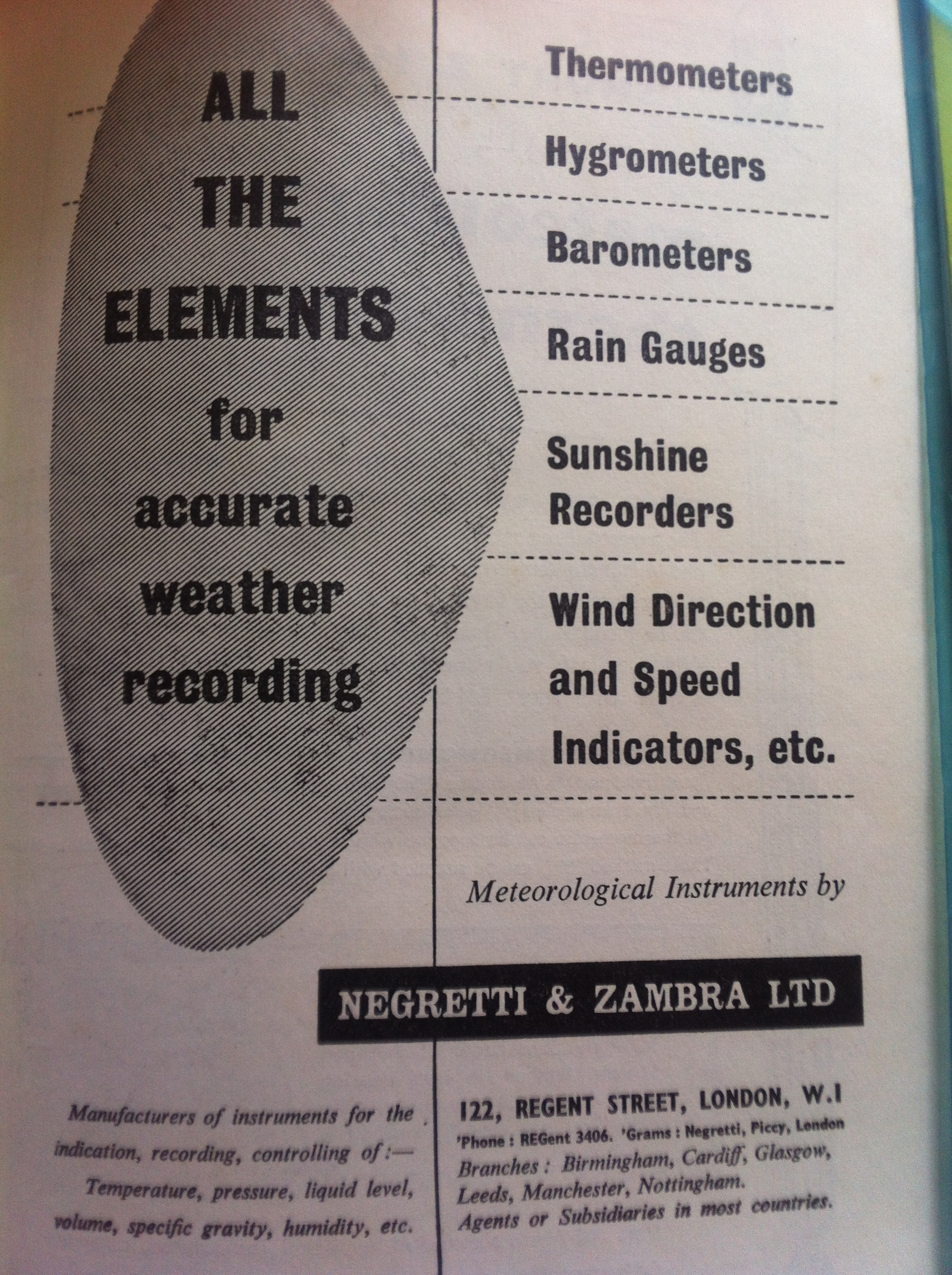
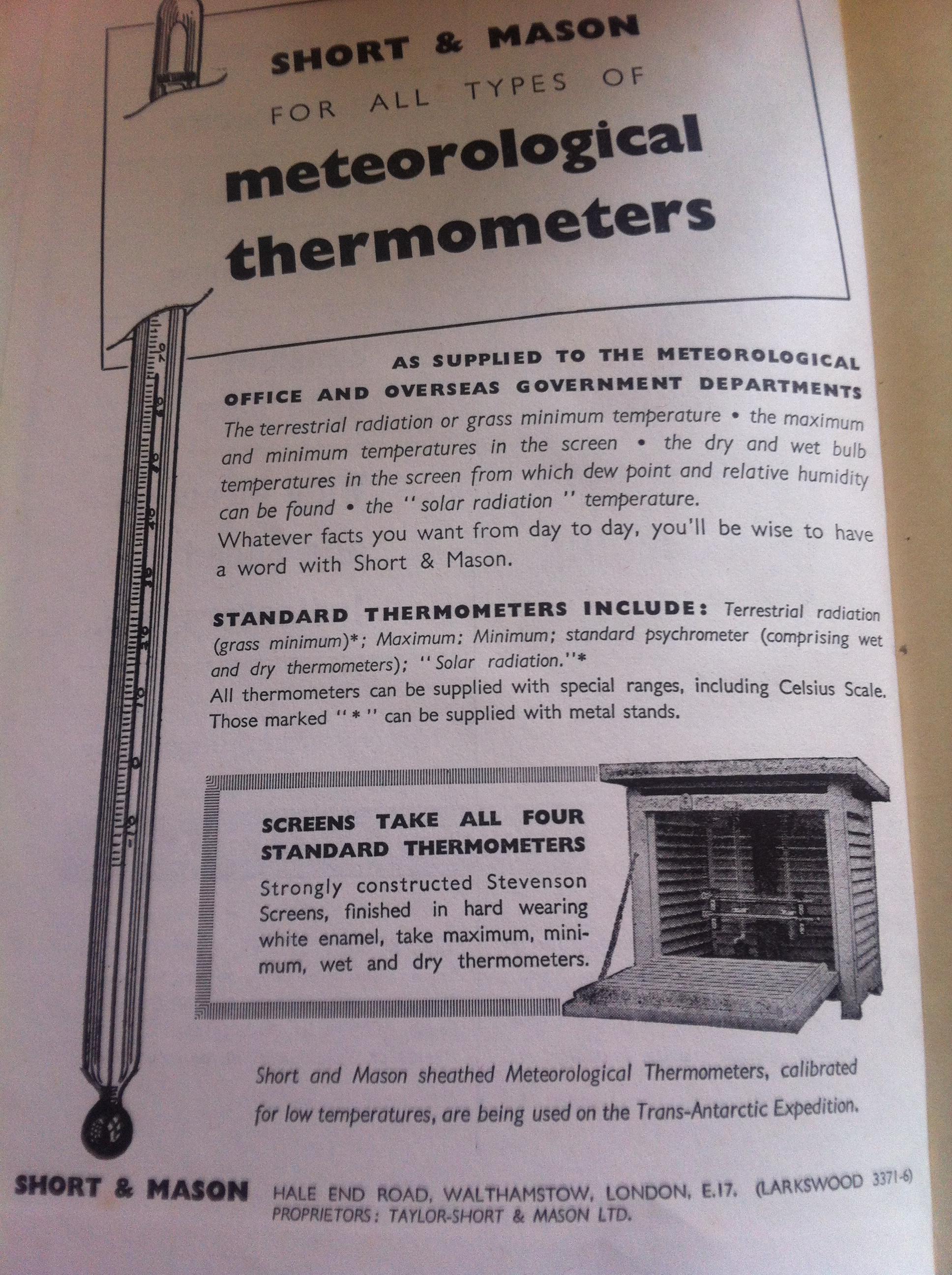
This advert, in an old HMSO Observer’s Handbook, gives a no-nonsense list of what you’ll find at No.122 Regent Street
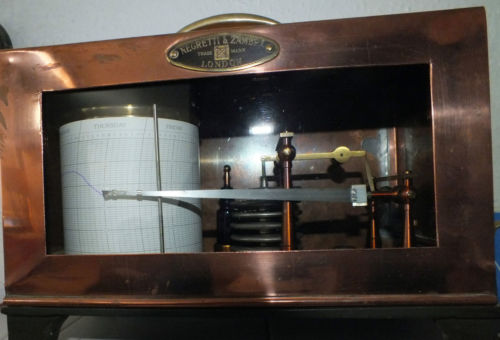
Negretti & Zambra, at No. 122 Regent Street and later at No. 15 New Bond Street, specialised in barometers and thermometers – everything you could need to set up a weather station. The brand among weather anoraks is the byword for quality. The company, along with Short & Mason, probably made the majority of barometers that adorn many hallway walls across Britain. Next time you visit old aunt Flo or uncle Albert chances are the barometer hung on the wall is made by one of these companies.
Enrico Negretti and Joseph Zambra started their company in 1850, which was run by them and their descendents until well after the Second World War. They had shops firstly in Regent Street and later at Holborn Viaduct. The company was highly successful, winning a medal at the Great Exhibition in 1851, counting among their customers the Astronomer Royal, Prince Albert, the Royal Observatory and Admiral Robert Fitzroy.
Initially they specialised in barometers and thermometers, particularly those needed for taking deep sea and atmospheric measurements, which until they arrived were very unreliable. Later they increased their range to include telescopes, gun sights, theodolites and optical instruments. During the Second World War Negretti expanded substantially to meet the demand for instruments for war planes in particular. Their instruments were also produced under licence to supply the USAAF.
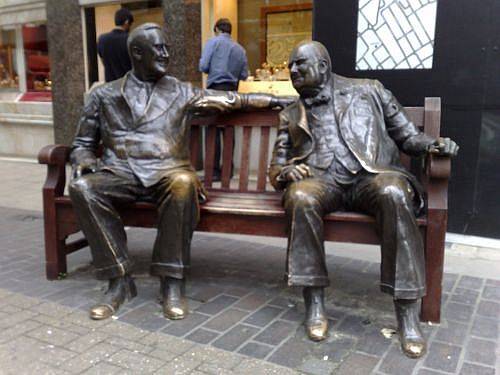
After their stand against Nazism in World War II, the two men helped found the United Nations. Churchill’s mother was American and he and FDR were distant cousins
Go to No.122 Regent Street today and you’ll find a shuttered branch of the Body Shop. The shop at No.15 New Bond Street, which closed in 1975, 11 years after the company moved production to a factory in Aylesbury, is now a branch of watchmaker Patek Philippe. Outside you will find seated bronze statues of Allied wartime leaders Sir Winston Churchill and Franklin D. Roosevelt sharing a joke. The statue by Lawrence Holofcener was unveiled in 1995 by the Bond Street Association to mark 50 years of peace. I’m not sure how intentional this was but how fitting that they are outside Negretti’s old shop, the instruments of which played a big part in helping the Allies to prevail over the Axis.
Back in the day N&Z was highly regarded in the local community and people would phone to access data that the company compiled from its rooftop weather station. In the late 1950s it was the job of Geoffrey John Gill, an office junior who went on to become an apprentice draftsman, to collect these stats.
“I was getting tea, coffee and buns from a Greek cafe in Soho’s Wardor Street for the office staff, collecting the mail and using the franking machine and last but not least the holy of holy’ climbing to the shop roof top and collecting the charts from the sunshine glass ball recorder, the rain gauge, barograph and the hygrometer box. You see it was common in those days for people to phone N&Z to enquire what these readings had been for the past day or so, a typical quality N&Z service.” A full account of his time with the company can be found here.
Short and Mason were based in Walthamstow for nearly 60 years. They supplied instruments to the Polar expeditions of Scott and Shackleton
Short & Mason were established five years prior to Negretti in 1845 by Thomas Short and James Mason. The business was located at 40 Hatton Garden, London, and produced precision measuring instruments including barometers, anemometers, and compasses. They became leaders in the field of barograph design and supplied scientific instruments for the Scott and Shackleton polar expeditions in the early 20th century and for Everest climbers.
In 1910 the company relocated to Macdonald Road, Walthamstow. It was here that 11 years later the company pioneered the theory that a storm forecast could be made from just observing the air pressure and whether it was rising or falling. The company went on to develop aeronautical, medical, meteorological and surveying instruments and were listed exhibitors at the British Industries Fair in 1922 and 1947.
In 1958 the business moved to Wood Street, Walthamstow, where it continued to trade until a merger in 1969 with Taylor Instrument Companies, of Leighton Buzzard, Beds. An account of somebody with experience of working for Short and Mason can be found here.
Many examples of Negretti & Zambra and Short & Mason instruments can be found on eBay and antique shops across the world, the finer examples often turn up at auction houses such as Bonhams where they go for thousands of pounds.
Though, like many industries, weather observing has become mostly automated there are are still probably hundreds of observers who still take the manual measurements every morning ‘because they can’. Though this observer relies on an automatic weather station for daily readings – there is nothing like the daily ritual of emptying the Snowdon raingauge or shaking down the maximum thermometer at 0900 GMT every day. One observer who still supplied the Met Office with monthly rainfall readings while in his 80s said that it was the one thing that got him out of bed every morning.
Examples of Negretti & Zambra instruments can be found on eBay
Perhaps it’s a little similar to the ever growing popularity of classic cars. A sense of being able to hold a piece of British engineering history that was so well designed that it still works today.
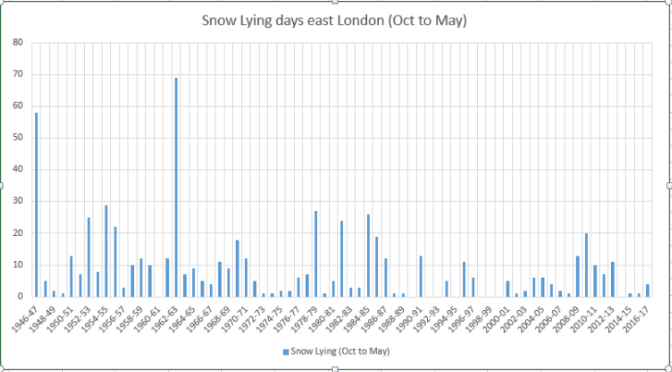
Winter 2024/25, considering the DJF mean, sits 68th out of 79 winters back to 1946/47.
It was the 13th snowless winter in the series . The only ‘top 10’ winter for snowfall of the past 30 years was 2009/10!
Snow is a very rare commodity in lowland Great Britain – even rarer in the Home Counties, and in our part of east London. Pulling back the curtains on a cold winter’s morning to be greeted by a fresh fall of deep, crisp and even snow is something most children experience and hold dear for life. The slush, ice and chaos that inevitably follows all too quickly is forgotten.
My memories of winters in the 1970s and 1980s is that they were far snowier and colder than they are today. But were they *always* cold and snowy? I decided to have a look back through the archives to find out. My first stop was the Met Office’s now defunct Snow Survey of Great Britain. This excellent compilation of reports logged by observers nationwide was printed annually as part of British Rainfall. But through lack of interest and cuts printing ceased after the 1991-92 season. Data continued to be collected though the modern version of the survey uses satellite technology to estimate daily UK snow depths – the Met Office website says that this is far less subjective than an individual nipping out at 9am every morning to ‘stick in a ruler’ and, those within sight of high ground, to observe where the snow line is. This does a disservice to the hundreds of observers who down the years diligently logged all their information as objectively as possible. But on to the data…
Regional data was not included in the survey until the 1965-66 season. Though Wanstead isn’t listed I have taken an estimate from data supplied from stations at Eastcote (53m), East Barnet (70m), Charlton Park (46m), Twickenham (13m), Teddington (9m). Because this area is influenced by Thames streamer snowfall that blows in off the North Sea and is funnelled upriver I have also considered readings from Epping (107m), Rayleigh (73m) and Southend (27m). Indeed, in some years Wanstead’s snowfall is much more similar to Rayleigh and Southend than it is to Greenwich and Teddington. Though my site is only 18m it seems to catch the snow much better than surrounding areas – probably to do with the fact that Aldersbrook is surrounded by greenery. People walking down from Wanstead village often remark that Wanstead Park is far snowier than the village a couple of dozen metres or so higher. Before 1965 I have used data from Woburn, Bedfordshire, which at 89m and 40 miles away as the crow flies, is the closest station in that long running series.
The mean temperature of a winter can look cold but it doesn’t always tell the full story. You can have a winter dominated by high pressure over the near continent making things very dry. But the anticyclones that ridge from Central Europe to the Azores can leave us in the ‘warm’ part of the high – and often lead to days of anticyclonic gloom; cold grey, dank and boring weather with little sunshine. On paper a season can look cold but in reality totally unremarkable; it is the number of days with ‘snow lying’ that people remember. For snow to settle it needs to be cold! For this reason I haven’t bothered with ‘snow falling’ data as it can snow at 4C in very dry air – yet nothing settles. Most weather geeks find ‘snow falling’ the most frustrating when it doesn’t stick. So on to the results.
The Top 20 winters in Wanstead, using ‘snow lying’ and ‘mean temperature’ in stats. Click here to view all 79 winters back to 1946/47
Once I worked out the ‘snow lying’ days I decided to devise a winter index by dividing ‘snow lying’ by seasonal mean temperature. Because the results using Celsius were problematic in that 1962/63 becomes very skewed upwards I decided to use Kelvin.
The results are quite surprising. Coming out top, not surprisingly, is 1962-63 with an index of 25.2 and 69 days of snow lying. Second is 1946-47 with an index of 21.1. Third is 1981-82 with an index of 10.5 – surprisingly ahead of 1978/79, the first winter in the series that I can recall; I remember returning home from school one night in December 1978 and the snow being as deep as the twelve-inch step to our house.
The index of 25.2 for the 1962/63 winter and 21.1 for 1946/47 – over double the amount of 1981/82 – shows how ‘off the scale’ those two winters really were. My father, who doesn’t share my enthusiasm for the weather, can distinctly recall the severe conditions of 1962/63. He said the roads were so thick with snow that when the thaw finally arrived in March he’d become so used to driving on snow that he crashed through somebody’s front garden wall, after losing control of his Mini on surface water sat on the ice.
More recent winters, which pale by comparison, rank surprisingly highly. The 2009/10 winter comes in at Number 10, higher than the legendary 1986/87, where the coldest day in recent times was recorded in London, which came in at Number 12. It should be noted that January 1987, when on the 12th the temperature did not rise above -5.5C all day, was sandwiched by a mild December and February.
Just by looking at winters with a mean of, say, 5C doesn’t tell you much about snowfall. When you look at 1985-86 (mean 4.1C) there were 22 days of snow lying at 9am – yet 2005/06 was colder (3.9C) and only 3 mornings saw snow lying – though that winter was particularly dry – the 13th driest in the series.
The median for ‘snow lying’ days in this series is six. The rolling median of the past 30 years, however, is only 2 so, with this in mind, if it does snow you should get out there and make the most of it.
You can view over 70 years of winters in this area, all ranked using my winter index here.
*It should be noted that a day of ‘snow lying’ only qualifies if there is more than 50% cover at the observation time of 9am. This means that it could snow 1cm at 10am – if that snow thaws by 9am the next day it won’t count. Though 8 winters appear snowless it is possible that these winters did see temporary coverings
Will it be a white Christmas this year? It’s the question most forecasters get asked year after year as the big day looms less than a month away.
The snow probably won’t arrive until after Christmas this year
It always fascinates me why Christmas and snow are so closely associated with each other when the odds, especially in London, are so stacked against it happening.
Perhaps it is the Christmas card scenes of Dickensian winters that get people yearning for the white stuff. Indeed, the image of snow covered cobbled streets can probably be blamed on Charles Dickens. The backdrop of A Christmas Carol, and a host of other books, were written when winters, and Yuletide, were generally much colder than they are now. Perhaps it was also the cold Decembers, which came during notably cold years as he was coming of age, that sowed the seed of his impressions of life in London. The Central England Temperature (CET) for December 1829 and 1830 were 1.4C and 1.8C respectively. To give you perspective the average mean temperature for the Wanstead region in December is 5.6C. Of course we had a taste of what a Dickensian December was like three years ago in 2010 when the average mean temperature was 1.5C. Though bear in mind the mean for 2010 was 10.5C – way above the 8.2C and 8.7C mean temps of 1829 and 1830!
Christmas toys of yesteryear also took every opportunity to perpetuate the snow myth
But back to this Christmas… First of all, what do we mean by a white Christmas? The definition used most widely – notably by the bookies – is for a single snowflake, even if it lands in the midst of heavy rain, to be observed falling in the 24 hours of 25 December at a specified location recognised by the Met Office. Interestingly, the Met Office uses weather observations from Gravesend-Broadness, some 12 miles away, to show current conditions in Wanstead. A lot, however, could be said by us weather anoraks about the different microclimates between here and south of the Thames.
Technically, there has not been a white Christmas in Wanstead for over 30 years. In 2010, we could still see the Christmas card Victorian snow scene in small patches of our gardens, but these were leftovers of a previous dump, so it doesn’t count. Frustratingly, there has been snow on several Boxing Days in Wanstead (1995 and 1996) and in the weeks running up to Christmas, but not on Christmas day itself. The most typical Wanstead Christmas day weather is mild and dry, although it has rained on 12 of the last 33 Christmas days.
So why does it often snow either side of Christmas but not on the actual day? For Wanstead, Christmas is at the beginning of the period when it’s likely to snow. Looking at climate history, wintry weather is more likely between January and March than December.
On average, snow or sleet falls in the UK 5 days in December, compared with 7.6 days in January, 6.8 days in February and 6 days in March. White Christmases were more frequent in the 18th and 19th centuries, even more so before the change of calendar in 1752, which effectively brought Christmas back by 12 days. Climate change has also brought higher average temperatures over land and sea and this generally reduces the chances of a white Christmas.
For snow to fall we need moisture in the atmosphere. Snowflakes start their lives as ice crystals thousands of feet up, and when these tiny ice crystals collide they stick together in clouds to become snowflakes. If enough ice crystals stick together, they’ll become heavy enough to fall to the ground.
Precipitation falls as snow when the air temperature is below 2°C. It is a myth that it needs to be below zero to snow. In fact, in this country, the heaviest snowfalls tend to occur when the air temperature is between zero and 2°C. The falling snow does begin to melt as soon as the temperature rises above freezing, but as the melting process begins, the air around the snowflake is cooled. If the temperature is warmer than 2 °C then the snowflake will melt and fall as sleet rather than snow, and if it’s warmer still, it will be rain.
It sounds a simple combination, but getting precipitation on the days when there are temperatures low enough for snow are few and far between.
Christmas day in Wanstead, on the balance of probability and from previous patterns, is most likely to be a green and mostly cloudy but dry one. Some brightness is possible with temperature peaking at around 10°C. You can read my full methodology on why I think this may happen here.
Though my attempt to find the probability of a White Christmas effectively rules one out, there is still an outside chance that one could happen.
At this time of year the UK can effectively become a battleground between cold polar continental air to the north or east and moisture-laden mild tropical maritime air to the south and west. Where these air masses meet, snow is possible, but a lot depends on which air mass wins the battle. When battleground situations occur, in one location it can be snowing, but just 20 miles or so down the road it can be raining. This is because there is a fine line between the boundary of the warm and cold air.
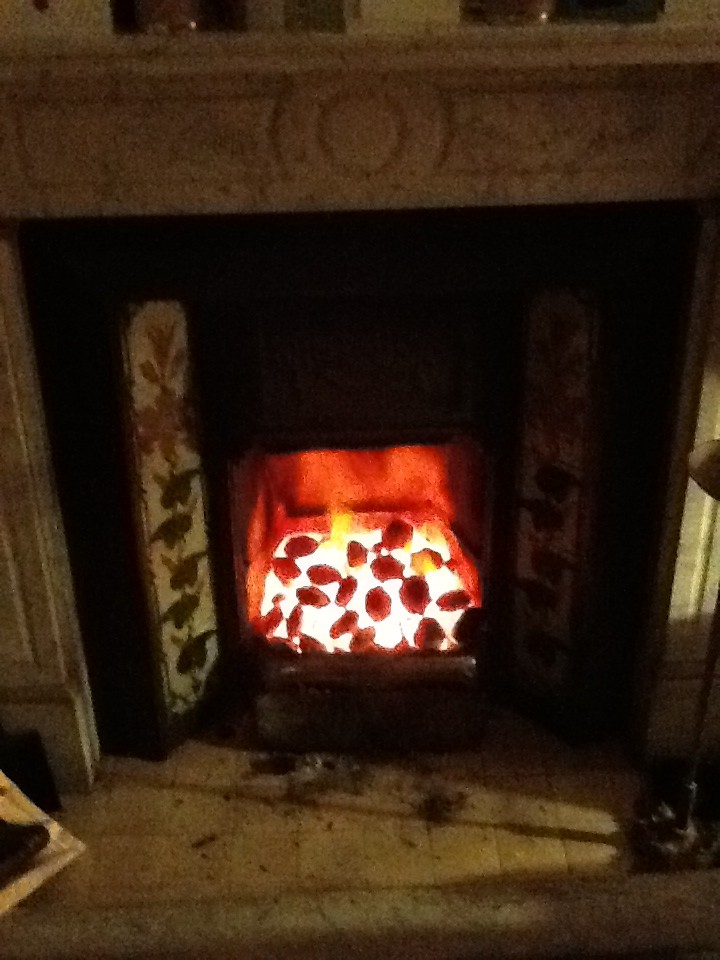
There’s nothing like an open coal fire. It’s even better when it is cold enough outside to have one
In years gone by, Wanstead and the surrounding area has often ended up in the cold air mass or the warm air mass. In these situations dry and mild or dry and cold weather is often the result. Of course, in a cold air mass situation there is always the chance of showery activity of the North Sea. The weather so far this winter has not been anything out of the ordinary, so I’m afraid there is nothing to suggest a white Christmas is likely.
If it does turn very cold on December 24, pray for clouds to appear and we could be in with a chance. But at the end of the day we still need that vital combination of temperature and moisture. Snow, like Christmas in that sense, requires some magic.
November was colder than average with a mean temperature of 6.7C (1.2C below the 30-year average) – ranking it 69th in the series since 1881. Rainfall of 56.5mm was 99% of average – ranking it 61st in the series.
The month was just 0.04C cooler than last November – with 93% of the rain that fell in November 2012.










 Just
Just







You must be logged in to post a comment.