A blog that tries to make sense of how the UK's national climate translates into local weather for Wanstead and the surrounding regions of east London and west Essex.
Check out my twitter feed @wanstead_meteo for local weather forecasts, stats, records and phenomena for the east London areas of Wanstead, Aldersbrook, Leytonstone and Stratford. And anything else weather
November was colder than average with a mean temperature of 6.7C (1.2C below the 30-year average) – ranking it 69th in the series since 1881. Rainfall of 56.5mm was 99% of average – ranking it 61st in the series.
The month was just 0.04C cooler than last November – with 93% of the rain that fell in November 2012.
Much has been printed in the tabloids over the past month or so that we are in for a severe winter. Not a week goes by without the Daily Express splashing that the ‘Worst winter EVER is on the way’. Just this morning the same rag told us that three months of ‘exceptionally cold’ weather are due. On closer inspection the story elaborated the scene with quotes from James Madden of Exacta Weather, one of the ‘experts’ feeding these fantastical stories.
The Temple, Wanstead Park, always looks that much more stunning with a covering of snow
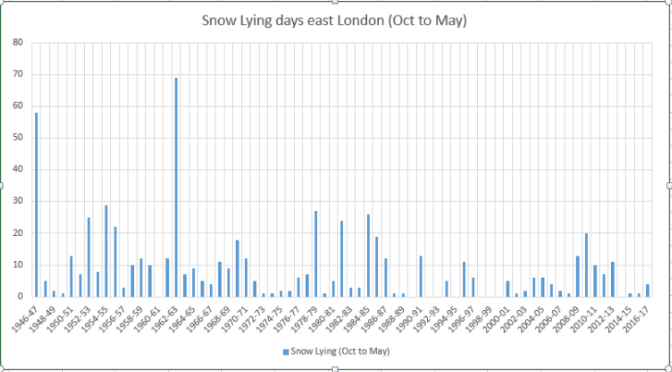
Quite how Mr Madden and other experts arrive at these forecasts is a bit of a mystery. The mystery has deepened further since I decided to crunch a few numbers and try to predict what is in store for the months ahead. Looking at data for this area stretching back over 130 years to 1881 I decided to calculate a seasonal average and arrived at a final figure using singularities – basically looking at the weather patterns we’ve had during October and November.
Many professionals would scoff at this method of pattern-matching, so I’ve incorporated a couple of other ‘now’ factors and taken on board current variables such as sea surface temperatures in the Atlantic and Pacific.
The figure I arrived at, taken as an average of the closest matching autumn periods, is a mean temperature of 4C with rainfall totalling 133mm over the months of December, January and February – that’s about a degree colder than average and 90% of average rainfall. The probability of a winter with a mean temperature of between 4C and 5C is 37% – the most likely outcome. With this in mind a winter in the form of 1986-87 is possible – though whether we would see the same extremes of temperature and snowfall that we experienced in January 1987 is open to question.
The Met Office, with all their computing power and expertise, seem to be hinting at something similar – ie slightly colder than normal. The opening couple of weeks to my forecast seem quite plausible, looking at tonight’s models. Look at the similarity in the synoptic charts for December 8th here.
Shoulder of Mutton pond, Wanstead Park
Over the last few years the snow lovers among us have been spoiled after a run of very mild winters during the late Nineties and early Noughties that prompted climate expert Dr David Viner to utter the immortal words that one day “children just aren’t going to know what snow is”. It was only a matter of a few years before the words from the senior research scientist at the University of East Anglia seemed a bit hollow.
Mark Twain, born this day in 1835 , once uttered the famous phrase: “Climate is what we expect; weather is what we get” – there is always a chance we could suddenly lurch back to milder winters. This winter could spring a surprise, be it very cold or very mild. But judging what’s happened over the last 130-odd years – a 1962/63 or a balmy 1989/90 look very unlikely.
* Forecasting models use probability on any given outcome. Millions of observations are fed into the Met Office database (and other countries’ weather agencies) every day. Supercomputers then crunch through this data to give probable outcomes. With the volatility of the atmosphere it is not surprising that certainty of any outcome often falls away rapidly. Forecasting has improved greatly in the last 20 years – though anything the models churn out beyond three to five days should be handled with caution. Long range models can give *some* idea of general trends for the months ahead – but changing just one variable can vastly alter an outcome at the end of the run.
* *Over the past few months I have been collating data for the area around Wanstead. This data is freely available from the excellent Met Office library and is emailed via Excel spreadsheet. Rainfall stats include a near-complete daily archive, stretching from 1961 to 2003, from City of London Cemetery . Sadly the rainfall station, along with many others, ceased to supply the Met Office after cuts were made shortly after the turn of century. Prior to 1961 I have used monthly figures taken at the Greenwich Royal Observatory stretching back to 1881. Though this is 6 miles away the difference in temperature between the two areas would be miniscule compared with rainfall data and so can be used. I use my own stats for the period after 2003.
The Wanstead Weather live Twitter feed is one year old today. That’s over 8,700 tweets of hourly weather updates. In that time there’s been 59 air frosts, 632mm of rain, 165 rain days, 27 days with snow falling, 13 days with snow lying – a total of 14cm falling.
Highest max was 34C on July 22nd, lowest min was -7C on January 16th. A windrun of 25,741 miles shows that the anemometer has turned enough revolutions to have circumnavigated the globe, albeit at an average speed of 2.9mph.
It’s usually around this time of year that this area experiences its first air frosts – but a warm, wet October caused by an active Atlantic and a jet stream sitting close to us has meant that classic radiative cooling nights have been in very short supply. There’s been a couple of chilly nights – down to 2.6C on October 30th and November 5th – but to record an air frost the thermometer must read below 0 Celsius (32Fahrenheit).
The first frost last year was recorded on November 6th. Much hoar was seen around the shady banks of Shoulder of Mutton pond in Wanstead Park
Last year, Wanstead recorded its first air frost on November 6th (-1C). Looking back through the records to 1980 the earliest frost was October 17, 1992, and the latest was January 6th, 2004. Interestingly it appears that having frost in October can signal a mild winter to come!. The median for the first frost is November 16th – 18th. Forecasts for this week suggest we could be scraping the windscreens for the first time on Saturday, thanks to high pressure building in from the Atlantic and calming things down.
Indeed, the models today suggest there is a chance of a block forming in the Atlantic which effectively stops depressions from whistling in from the west, unlocking the door for cooler weather from the north or east. It’s a long way off in meteorological terms though.
Here is a list of first air frosts in Wanstead…
The ECMWF model shows high pressure ridging in from the Azores at the end of the week
I’m now starting to publish my monthly stats on this blog. This month was warmer than average with a mean temperature of 13C (1.2C above the 30-year average) – making it the 10th warmest in the series since 1881. Rainfall of 83mm was 127% of average.
Wanstead Flats has put on some spectacular Guy Fawkes’ nights over the years. I didn’t realise quite how many years until I stumbled upon this old British Pathe clip which shows nurses at Wanstead Children’s Home building a huge bonfire for the children in 1934.
The footage shows the nurses struggling to get the Guy atop the bonfire, using numerous ladders, while the children, including 12 sat in an old perambulator, look on. I don’t have the stats for what the day was weatherwise locally but the climate station at St James’s Park recorded a dull day with a high of 8.3C after an overnight low of 3.9C. That November was drier than average.
The Aldersbrooke Childrens Home for Waifs & Strays is still there in Brading Crescent on the Aldersbrook Estate, although the five lodges have been converted to flats.
The former Aldersbrook Children’s Home is still there in Brading Crescent but has been converted to flats
A bit of history…
In 1907, the West Ham Guardians purchased the Aldersbrook site. In 1911, five receiving homes were completed. The homes were called lodges and were: Elizabeth Fry Joseph Lister, Tom Hood, Edward North Buxton and William Morris
In 1913, a workshop, for training of the older boys and girls was opened. Skills learnt were in tailoring, carpentry, laundry work and needlework, under skilled industrial trainers.
In 1930, on the 1st April, the ownership of Aldersbrook homes and the leases of the Scattered Homes, were under the 1929 Local Government Act, and by agreement with the Essex County Council and the West Ham Corporation, vested in the East Ham Corporation who are required to continue to receive destitute children from the Essex County Council and West Ham, formally comprised in the West Ham Union area.
On 27th May 1933, the Aldersbrook Children’s Homes new nursery was opened. The County Borough of East Ham owned it. Alderman T.W.Burden, Chairman of the Public Assistance Committee, opened it. The Mayor of East Ham, Alderman G.H.Manser J.P, proposed a vote of thanks, which was seconded by Alderman C.W.Brading J.P, and supported by Alderman Mrs Taylor (East Ham) and Councillor G.Doherty, of West Ham. After the official opening, the older children (14 to 16 years old) of the homes put on the play “David Garrick”.
The superintendent of the home was W.T.P. Steele, and the matron was E.M.Steele. S.R.N. The building was described as being divided into three sections – ground floor, babies under twelve months and toddlers one to three years, first floor staff. Accommodation is given for ninety infants under three years. Wards are provided for these age groups were newly admitted children will be housed for three weeks before being sent to the general rooms. Two ranges of isolation rooms are also provided where “suspects” can be nursed to reduce the risk of infection. The south end of the building is allotted to the youngest or cot babies and comprising of long dormitory with sun rooms at the end, designed to catch the winter sun.
The programme went on to describe the building as being the most modern of children’s institutions. The building has a veranda at the front. The first floor has 21 separate staff bedrooms. The building had an oil fired heating system and flooring with fire resistant Terazzo material whilst the children’s play room and dormitories are protected by rubber flooring. The lighting and power points are controlled by locking device to prevent the children switching them on and off. The building was built by Messrs Hammond & Barr Ltd Chelsea.
The Nursery is now gone and the Aldersbrook estate covers the area, although the recreation Hall, the lodges (See photo) and the porters lodge are still there.
Is Guy Fawkes’ Night going to turn into a damp squib this year? The forecasts don’t look good – our best hope is for a brief ridge to briefly quieten things down before the next frontal system trundles in from the Atlantic.
What was a very wet week last year led to the cancellation of the public display on Wanstead Flats – with 10.2mm of rain on the Saturday flooding the already sodden land. The forecast for this year doesn’t look much better with 16mm of rain due between Friday and dusk on Sunday.
The cloud cover / rainfall chart for 6pm Tuesday shows that the front may have cleared through by the time the bonfires are lit. At this range, though, it is a big if
But what about the actual 5th of November? Monday looks very wet for this region with yet another frontal system sweeping across the south. Up to an inch of rain could fall before dusk on Tuesday driven along by a stiff westerly wind. The only positive, if you can call it that, is it will be very mild. Temperatures will only fall to around 14C which is very warm for a night in early November.
It wasn’t always like this – ask most people of a certain age what the weather was like on Bonfire Night in their youth and most will answer ‘calm, cold and frosty’ – the bonfire providing a source of warmth as well as somewhere to roast the chestnuts and toast the marshmallows. But were frosty nights on Guy Fawkes in the 1980s that common? I decided to have a look back through the archives and find out.
The FAX for November 5 shows an occluded front right over our region at 12noon. This may have cleared through by 6pm
Only 4 nights in the Eighties could really be described as approaching frosty – they were 1980, 1981, 1989 and 1988 which was the coldest Guy Fawkes’ of the past 30 odd years with the temperature falling to 0.4C. All the other years had minimums of between 5-10C. One thing that is noticeable is how dry November 5 was in the 1980s – just 2 years had any measurable amounts of rain; 1986 (0.5mm) and 1984 (3mm). Nineties Bonfire Nights were even warmer – nearly 1.5C warmer on average – the coldest years being 1991 and 1998 with 2C.
Noughties Bonfire Nights were a continuation on the Nineties – mild though over half were dry affairs. The overall average over the last 30 years is quite surprising – 12C during the day and only falling to just over 6C at night. Taking the average of the last five years the minimum rises to nearly 8.5C! The odds of it raining heavily on Bonfire Night, meanwhile, average out about 1 in 5. Raining lightly the odds increase to a 40% chance.
And as for that wished-for frosty night? Forget it. It seems memories of perfectly frosty Bonfire Nights are about as elusive as the Dickens-style winter snow images that are still so common on Christmas cards.
Much comparison has been made of Monday morning’s storm which claimed the lives of four people and 1987. The origin of both storms was down to a combination of a jet streak interacting with a pool of warm air low down. Both storms followed a similar development but clearly 1987 was more optimum. The 1987 storm was slower and further to the west when it developed. This morning’s storm was too much in the jet stream and raced on with less development.
Both the 2013 storm, left, and the 1987 storm followed a similar track as shown on these satellite pictures
From the forecasts made at the end of last week into the weekend it was about what I expected in terms of intensity – though I thought the peak of the max gusts (47.2mph at 0653) would have been shorter. Rainfall from the event was unremarkable – just 17.5mm which started falling around 9pm on Sunday and stopped around 5am. Totals north of Watford were far greater. This rainfall radar image at 0645 was taken within 10 minutes of the highest gust in Wanstead.
Rainfall radar image at 0645 – less than 10 minutes before the highest gust in Wanstead. Notice the curl of the cloud – this is where the sting jet gets its name as it looks like a scorpion’s tail. Thanks to MeteoX
Stations similar to here in Woodford Wells and Laindon all reported maximum gusts of 47-53mph, though with these being sheltered gardens the reality was probably higher – perhaps severe gale force 9 was reached at the storm’s peak here. Andrewsfield, near Braintree, North Essex, recorded 79mph. An animation of the storm’s track clearly shows the path of the sting jet. The Met Office have also released a satellite sequence of events. Of course the storm is no comparison with the Great Storm of October 1987, where a gust of 122 mph was recorded in Gorleston, Norfolk, but this morning’s storm was probably in the top 5 of storms since – and the most potent since the Burns’ Day storm of January 1990.
The tree damage in Wanstead has been worse than I would have expected with a few down on Christchurch Green. My own back yard in Aldersbrook seems to have got off lightly though a small flowering cherry on the corner of Dover Road succumbed. On closure inspection the inside of the trunk was spongy – testament to the fungus that I’d noted had been growing on it recently. Elsewhere, in Wanstead Park, some trees were sadly lost. Friends of Wanstead Park give a brief account of the damage here.
After it left Suffolk the storm raced across the North Sea, still deepening all the while, and caused havoc in Belgium and the Netherlands. Much has been said about the UK media’s obsession with the storm which chiefly affected the south east but Belgian and Dutch news outlets also focussed on the weather. In Brussels people were virtually blown along the street. Falling trees blocked canals in Amsterdam where a cyclist narrowly escaped being hit by a falling tree. There were no reports of deaths across the Channel and some watersports fanatics took full advantage of the wild conditions. The storm, which at one point developed an ‘eye‘, continued its destruction across Germany where this home was almost totally destroyed.
This car had a lucky escapeThe synoptic situation at 0600z on October 28, 2013Top 30 windiest places for 0600 UTC, on Friday, October 16, 1987top 30 windiest places at 0600 UTC on Monday, October 28, 2013
Southwesterly winds have returned with a vengeance this week after being mostly absent for large parts of this year. The airmass to our west is pumping very mild and balmy air from a warmer than normal north Atlantic, bringing a mix of blustery winds and rain. It has also seen the return of the constant whine of planes on the flightpath into Heathrow, to enable the preferred method of landing into the wind.
Heathrow flightpath when the wind blows from the west
As they reach the Wanstead area the jets turn, approximately 6,000ft up, for their final approach into the UK’s only hub airport.
On a Monday the din begins with the overnight arrivals from the Far East. Today the 04:50 BA flight from Hong Kong, was delayed, giving residents under the flightpath a 10 minute reprieve until 5am when another BA flight, from Singapore, began its final approach. On a clear day 44 flights land every hour at Heathrow, or one plane every 1.36 minutes. And this figure is without the air traffic flying into and out of City.
.
The flightpath taken during an easterly wind diverts flights to the north and south of London
The congested flightpath during a westerly landing regime is in sharp comparison to an easterly landing regime – when the final turns occur over more rural areas. To give you some idea of what that looks like here is a time-lapse video of the jets landing
As noise goes Wanstead gets off lightly in comparison with places like Hounslow. Though the dB are vastly reduced over our part of town the noise is very noticeable on quiet streets first thing in the morning. A recent study suggested that there is a link between aircraft noise and increased risk of heart disease.
Heathrow and many business leaders want a third runway at Heathrow which is currently running to near capacity. They argue that without extra capacity the UK economy will greatly suffer. The owner of Heathrow argue that their case is the cheapest and quickest way to fix the UK’s capacity problem. Constructing a third runway is estimated to cost £18bn and would open between 2025 and 2029.
The London Mayor, Boris Johnson, on the other hand, wants a new hub to be built in the Thames estuary, at an estimated cost of £96bn. He is vehemently against expanding Heathrow, which exposes 250,000 west Londoners to extreme noise, and would like it closed.
The strength of Heathrow Airport Holdings’ case stems from how it is likely to be the cheapest and quickest way to fix Britain’s hub capacity crunch. Building a third runway could cost up to £18bn and would open between 2025 and 2029.
Contrast that with the estimated £96bn bill and 2029 opening target for a proposed new hub in the Thames estuary, although Boris Johnson, London’s mayor, says the net cost to the taxpayer would be £25bn once the new airport was privatised. Mr Johnson is a vociferous opponent of expanding Heathrow, which is Europe’s noisiest airport with almost 250,000 west London residents exposed to jet din. He wants it closed down.
Many commentators say his favoured solution of an estuary airport is pie in the sky – but with China keen to spend money on infrastructure in other countries you have to wonder ‘Why not!’. Hong Kong solved their own capacity problems at Kai Tak with the construction of an airport on reclaimed land at Chep Lap Kok off Lantau Island. The facility is designed by Lord Foster who has also designed a blueprint for the Thames estuary.
Not a week goes by without alternative plans to solve London’s capacity crunch being put forward – from Heathrow’s third runway to an option of second runways at Gatwick and Stansted. What many don’t seem to be talking about is the option of developing Manston in Kent.
As someone who has visited the area frequently over the past few years there seems to have been a disproportionate amount spent on infrastructure to what would normally pass for improvements to a region.
Roads around the airport have been dualled (not to alleviate any current traffic problems). Many Holiday Inn-type hotels seem to be springing up – always a sign that big money is about to move in. The HS1 fast train line has vastly speeded up travel times to the area – it wouldn’t cost much to extend a loop right in to what is now Kent International Airport / Manston). There’s also the redundant Pfizer site – which is linked to the airport via the new dual carriageway. Rumours around the fate of this site include a business park and new Hollywood studio.
The existing runway is one of the longest in Europe – it used to be on Nasa’s list of emergency landing sites for the Space Shuttle because of its huge length.
I think the airport is already host to a lot of air freight – judging by the number of 747 cargo planes you see landing. Other factors in Manston’s favour is the approach to the runway. Obviously it would be grim for anyone living in the coastal towns there in terms of noise – but it’s millions less than residential areas around Heathrow.
The area is also in dire need of job opportunities and is among the most deprived in the south-east.
Whatever is agreed it is a decision that is bound to be unpopular.
On looking at NOAA’s sea surface temperature anomaly in the North Atlantic tonight there seems to be a lot of orange (warmer than usual) off the coast of Ireland across the pond to the US.
A lot of energy therefore has to be displaced before we can start thinking about any sustained cold weather – and is a big part of the reason why the Atlantic has kicked back into life. The jet stream is centred over usExpect a succession of depressions, driven along by a brisk jet stream (currently right over us blowing at over 100knts) to whistle across us in the next 10 to 14 days bringing very mild temperatures together with a mix of rain, blustery winds and sunshine. Any HP ridges will probably be short-lived – though equally any rainfall should be average. In these situations most of the rain falls over western parts of the British Isles.
So, in summary, a changeable spell is coming up – just like autumn should be
You must be logged in to post a comment.