Tag Archives: wanstead

Thunderstorm: May 29th 2018

Posts about thunderstorms are usually few and far between – the average number of thunderstorms in this part of the UK in a summer month (July) is just 3.5.

So experiencing four in four days must be very rare; the record for thunderstorms in a month is 12 in June 1982 though I’ve no idea how many of these were on consecutive days.

While the storms over the weekend were all about lightning this one was all about rain and loud thunder. Tuesday, May 29th, started cloudy and dull with some light rain. I was expecting some rain but it lingered and became heavier at 11.30am before turning torrential at 1pm, going against forecasts from BBC and Met Office – the trough was a lot further north than modelled. I pointed this out to the UKMO to be told that a yellow warning was in place for the whole SE region.

29th rain
The bulk of the rain fell between 1pm and 2pm
Screen Shot 2018-05-30 at 01.13.12
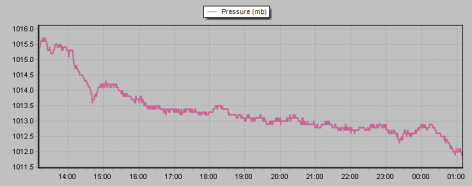
A marked drop in pressure coincided with a bright flash of lightning that was almost instantly followed by thunder that was as loud as cannon fire

Some 26.5mm fell in just over two hours bringing lots of surface water and flash floods around Leyton and Walthamstow. At 1pm, while driving in this area, a bright flash was quickly followed by cannon-like thunder. A further fall in the early hours brought the 09-09 total rainfall to 29.8mm, the 5th greatest May fall since 1959.

With the storm the previous evening the 48hr rainfall total was 40mm!

In the neighbouring borough of Barking and Dagenham it was reported that lightning struck a chimney which caused a fire in a terraced house in Rush Green at 2pm.

Local media pick up the story here, here and here.

image
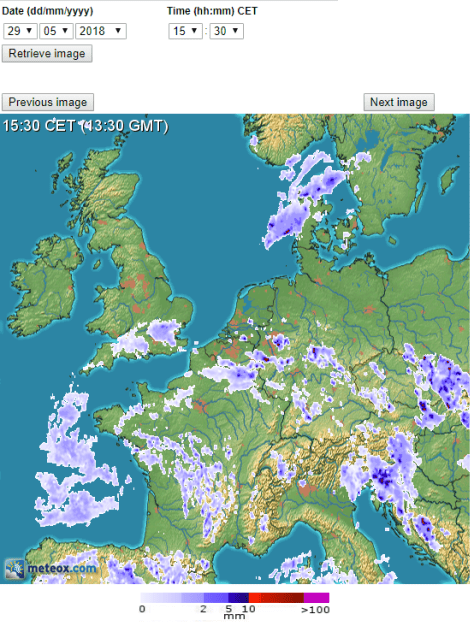
The position of the storm around the time of the loudest thunder
South acess
South Access Road in Walthamstow suffered flash flooding as drains failed to cope with the volume of rainfall
trough
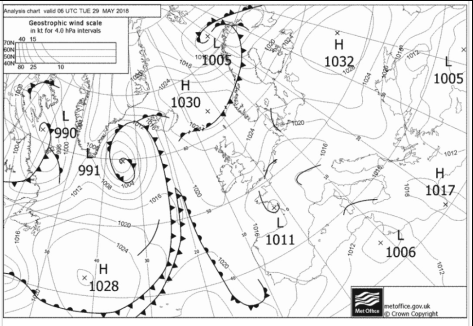
The trough on this FAX chart suggested the heaviest rain would be slightly further south than it was

rain1315

warn
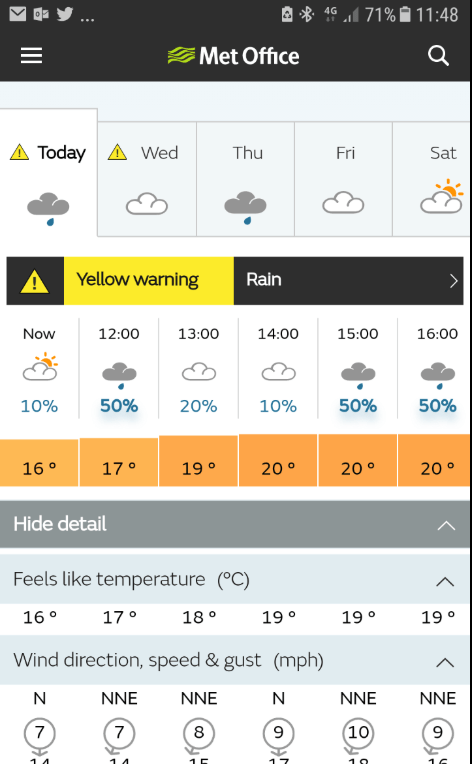
The Met Office forecast for Tuesday shows how useless auto generated apps can be, the 10-20% risk of rain between 1300-1400 contradicts the yellow warning
cum
Posted by Simon Cardy: “The large mature Cumulonimbus clouds over SE England (outlined purple on the map) are producing frequent lightning, very loud thunder and heavy rain. (credit: EUMETSAT).”


Bank holiday sunshine. And thunderstorms

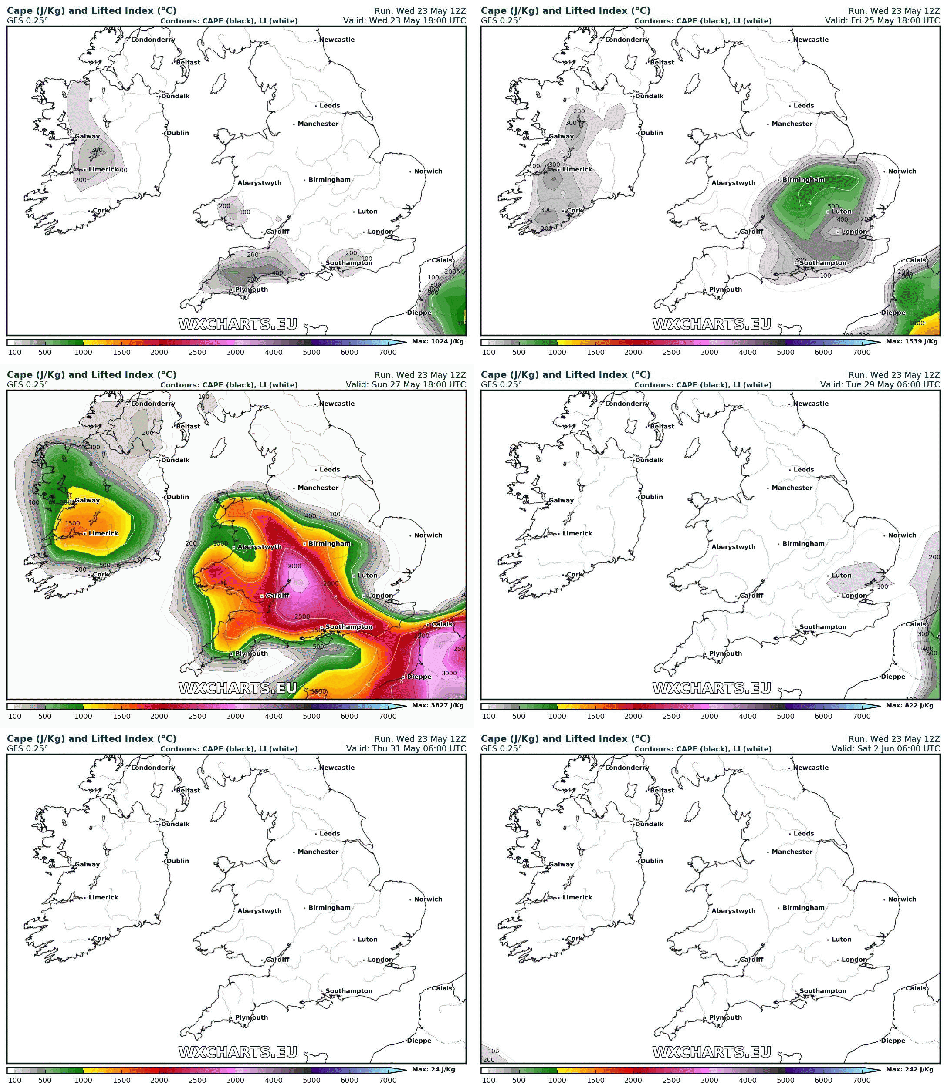
The coming bank holiday weekend is looking very warm, possibly hot on Monday. And with the heat comes the inevitable thunderstorms.

Looking at the CAPE forecast on @wxcharts the risk on Saturday looks like staying to the west of London. The best chance for east London looks like after noon on Sunday and Monday. There is no guarantee of thunderstorms here – some places could get hammered while just down the road it could stay dry – the potential is there.

Meteorologists will be keeping a close eye on Herstmonceux and Trappes ascents in the coming days.

An explanation of CAPE can be found here.

cape

More anomalous warmth for late May Bank Holiday?

Weather models are hinting that this coming bank holiday weekend could be very warm indeed, with one WX Charts animation suggesting that a positive anomaly of 12C could be possible on Monday.

A date record looks a formality and, unless there’s a downgrade, new monthly high temperature records at stations across the south-east look a possibility.

While it looks very warm it is too early to start talking about heatwaves. And, considering the pattern since late February, with hot and cold alternating weekly, a brief return to much cooler conditions at the beginning of June can’t be ruled out.

The British record high temperature for May is 32.8C, reached on two occasions:

Camden Square, London May 22nd 1922. The same station recorded this value again on May 29th 1944, along with Regents Park, Horsham and Tunbridge Wells.

The national date record for the 28th, according to TORRO, is 30.6C at Camden Square.

Locally the highest temperature recorded in this area in May is 32.1C on May 27th 2005. The date record I recorded is 26.5C in 2012.


GIF

More hot air on bank holiday records

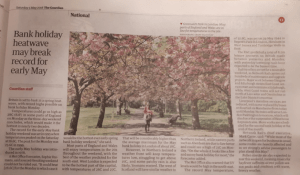
The media are up to their old tricks of flagging up their usual ‘hottest ever’ line; this time the May Day bank holiday.

Screen Shot 2018-05-05 at 02.53.09
Today’s Guardian

Today’s Guardian informs readers that Monday could be the warmest ever May Day bank holiday, the quite unremarkable record high of 23.9C was set in 1999.

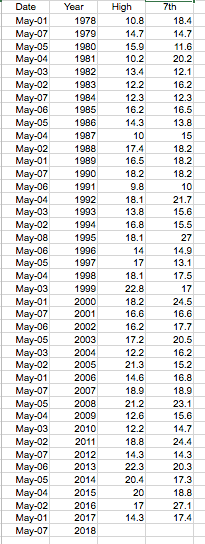
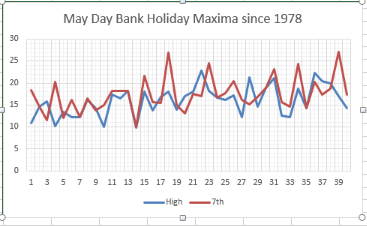
A closer look, however, reveals that dates of the holiday, which only began in 1978, are always moving. Like Easter the date shifts and can fall on any day between the 1st to the 8th. Only six early May bank holidays have occurred on the 7th. It is therefore difficult to compare like with like.

A more correct approach is to compare date records which, for the 7th since 1978, the highest is 27.1C in 2016. The highest temperature for the 7th going back 60 years is 28.5C in 1976.

Screen Shot 2018-05-05 at 12.07.22

Screen Shot 2018-05-06 at 18.37.01


April 2018: four seasons in one month

I normally headline these monthly reviews by referring to the most notable weather but this April, often a fairly non-descript mid-spring affair, offered pretty much every type of weather. bluebells

The mean temperature finished 11.7C, 1.9C above average and the warmest for four years.

Rainfall was 55mm, 129 per cent of average and the wettest for 6 years.

Sunshine was just 110 hours, the dullest for 40 years and the 16th dullest since 1881.

Hidden in the positive monthly anomaly was the warmest April day in a local record going back to 1959: 29.1C on the 19th – a figure that represents a positive anomaly of 15.5C and occurring at the start of the warmest April heatwave since 2011. It was remarkable that such an anomaly happened so close to a record negative anomaly the previous month.

Yet, just over a week later, temperatures lurched cold again with one of coldest last days of April on record. Though the 24hr record wasn’t broken the noon-6pm record going back 60 years was beaten.

The wettest day occurred on the 9th with 10mm falling.

Air frosts: 0, Ground frosts: 1

sunset 22nd

18th warmest

29.1

rainapril30
April 30th provided a timely reminder after the heatwave to ne’er cast a clout till May is out. A low pressure system in the North Sea brought a thoroughly miserable day though even more rain fell across the Channel.
april30
It was a month with some amazing sunsets. This one, on April 30th, happened just as the sky cleared before dusk


‘So much for global warming…’

Since notably cold weather struck at the end of February I’ve lost count of the number of times I’ve heard this phrase uttered by the public and some sections of the press.

Top 20 cold
Top 20 cold anomalies

The ‘Beast from the East’ (versions 1.0 and 2.0) really captured the imagination in an age where everything has to have a label slapped on it; any message that these cold spells are ‘weather’ and not ‘climate’ seems to get lost.

Both spells, indeed the general pattern of our late winter weather, were driven by the stratospheric sudden warming event that lead to a split polar vortex in February – leading to a very cold end to the month and a mean temperature anomaly of -2.5C, the greatest monthly anomaly since March 2013.

To put it into perspective, however, it was nothing like some of the anomalies that occurred in the early 19th century: January 1814, for example, saw a monthly anomaly of -8.2C and coincided with the last occasion a frost fair was held on the Thames. Januaries back then were generally very cold, the 1801-1831 average monthly mean was -3C, that’s 8C colder than the most recent 1981-2010 average!

So climate now is much warmer but that is not to say that anomalously cold months can’t happen. February 1986 saw an anomaly of -5.6C, the 13th= greatest cold anomaly in my local dataset going back to 1797.

top 20 warm
Top 20 warm anomalies

The cold December of 2010 recorded an anomaly of -4.2C, 76th= greatest cold anomaly, while anomalies of -4.1C recorded in January 1979 and March 2013 were 77th=.

With the warming climate it is no surprise that most warm months happened very recently. The balmy month of December 2015  saw a positive anomaly of 5.4C.

The ‘Beast from the East 2.0’ was caused by a narrow tongue of extremely cold air from Russia scoring a direct hit on the UK. The odds of this happening must have been low but it is an example of how, when the synoptics of the atmosphere line up perfectly, anything is possible.

And it is an example how even in a warming climate the UK can still be subject to anomalous cold and warmth at any time of the year.

As the author Mark Twain reportedly once said: “The climate is what you expect; the weather is what you get.”

gfs
The upper air anomaly of the ‘Beast from the East 2.0’. 
anom
This graphic shows positive and negative monthly anomalies since 1797 against a generally warming climate

Because the above graphic is crowded I created one of anomalies since 1970. The upward trend is the same.

1970

march 1st

Repeat of March 24th 2013 only 10C colder

The weather this coming weekend reminds me of a March weekend in 2013 when large parts of the south-east woke up to a covering of snow.

Conditions in Wanstead were very knife-edge, the cover being very slushy. I remember going for a bike ride on that Sunday morning. We left Aldersbrook in sleet, the cover grew thicker as we pedalled into Essex. By the time we reached High Beach near Epping there was 8cm of fresh cover. Conditions on the 2-hour plus ride were inclement to say the least – the temperature didn’t rise above 0C!

This weekend we have a similar set-up, only this time the upper air at 5,000ft is a good 10C colder – no knife-edges this time and, if the streamer gets going, many places should see 10cm of cover. Don’t put away that sledge just yet!


Beast MkII or just a late March cold spell?

After the severe spell at the end of February that lasted into this month there’s lots of excitement / dread (*delete as appropriate) that the synoptic conditions that brought very cold air from our east is about to return.

The latest run on the GFS model shows that very cold air (-10C at 5,000ft) could be over us by next Sunday, with the ECM 12Z operational looking particular cold. ec

Snow this late in the year is very rare in the London area though, if the conditions are right, a blizzard is not impossible, as happened during the spring of 1952 when a two-day blizzard at the end of March brought drifts up to 6ft deep in the Chilterns.

Much more likely will be severe, possibly record breaking frosts. The coldest March night since 1959 across the London area occurred on the 3rd in 1965 with -7.4C recorded at Heathrow. Central London fell to -5C on the same night.

A look back at cold spells in March reveals that while snow was very scarce in London and the Home Counties it can be common on high ground from the Peak District northwards.

A history of March cold

1812: Luke Howard in The Climate of London noted that “great inclemency of the weather” on the 21st March disrupted mail deliveries between the north of Scotland and  Carlisle. The road between Appleby and Brough was impassable because of snow and between Sheffield and Manchester and Bradford and Halifax the snow had drifted from “two to three yards deep”.

Mail deliveries were also disrupted across South Wales.
In Plymouth a “a most tremendous gale from SW the whole of last night and this morning” brought flooding.
Howard’s account would confirm a classic battleground scenario of mild Atlantic air from the south pushing against cold Polar continental air in the north.
His own records from Stratford show a couple of cold days from the 16th, highs never lower than 2C, the coldest night on the 24th, being -4.4C. On the 20th he mentions snow in the morning followed by rain.
Wanstead mean: 4.9C (-2.8C) rainfall: 74.4mm (183%)

The following accounts of cold spells in March are recorded on the site London Weather.

1962: The first ‘spring’ month was colder than any month during the preceding winter. Frosty nights were much more frequent than normal, and sleet or snow fell on 10 days, although amounts were often trivial . On the 5th, the maximum temperature was only 2.2 C. Towards the end of the month, north to northeast winds were replaced by somewhat, cloudier milder, and moister south-westerlies. Atlantic fronts brought rain bands, and on the 29th nearly 10mm was measured.
Wanstead mean: 3.3C (-4.4C) rainfall: 36.5mm (90%) sun: 95.4hrs (88%)

1964: The first week of March was mostly cold with wintry showers and a fresh northeast wind. The temperature on the 7th only reached 2.3C. The second week was changeable and milder, and the high on the 13th was near 14C., but on the 15th, rain turned to sleet and gave a total of 26mm as cold air slowly encroached from the east. Nearly 15mm of rain fell on the 19th as milder air returned, but the rest of the month stayed mostly rather cold and changeable.
Wanstead mean: 4.9C (-2.8C) rainfall: 80.4mm (90%) sun: 63.5hrs (58%)

1969: The first week was mainly dry, and although dull and cold at first, it became fairly sunny and milder but with severe frosts. Overnight on the 6th/7th the minimum temperature was close to minus 8C. During the second week it became dull and wet, but after a cold start temperatures rose above average. Cold north-easterlies returned on the 16th with a high of only 3C., and cloudy, rather cold, and often wet, weather persisted until westerlies returned on the 29th.
Wanstead mean: 4.6C (-3.1C) rainfall: 53.2mm (131%) sun: 55.8hrs (51%)

1979: The first 12 days of March were changeable and windy with temperatures mostly above average. A wave depression formed on a cold front and produced 23mm of rain on the 13th, and as this depression became slow moving to the east of the country the rain turned to sleet and snow on the 14th, and continued into the 15th and 16th with highs near 3C. After mid month, the weather became less unsettled and milder, and the high on the 25th was near 15C.
Wanstead mean: 5.8C (-1.9C) rainfall: 96.5mm (237%) sun: 100.5hrs (92%)

1985: After a changeable start to the month, pressure built, and it became mostly dry, although often rather cloudy, with temperatures close to normal. On the 15th, showery rain turned to snow during the morning, and several cold and unsettled days followed. Sleet or snow fell on 5 days, and on the 21st the temperature failed to rise above 5C. Sharp frosts occurred, and although it then became less cold, the 26th was a miserable day with 11m of rain falling.
Wanstead mean: 5.9C (-1.8C) rainfall: 44.1mm (108%) sun: 100.5hrs (87.4%)

Winter 2017/18 forecast review

At the beginning of December the opening par for my forecast for winter read:

The mean temperature for winter 2017/18 is looking average overall with average precipitation. While that doesn’t sound exciting for anyone looking for colder weather and snow I think the figures mask frequent 3 or 4 day-long cold snaps from the Arctic interspersed with milder interludes from Atlantic incursions; typical characteristics of a pattern driven by the troposphere. For anything longer term we have to hope for a warming of the stratosphere, a sudden stratospheric warming over the Arctic, that downwells into the troposphere, reversing the general westerly circulation. We are overdue an ‘SSW’ event but, even if one were to happen, its effects wouldn’t be felt until much later in the winter.

Figures generated using QBO statistics in the run up to December were identical to the outcome of 5C. It is figures generated using ENSO statistics, however, that produced the best results considering December, January and February alone.

It would seem that the winter was most influenced by the ENSO variable up until February when the effects of the SSW were enough to overcome it?results


Winter 2017/18: 27th out of 72

A few years ago I devised a winter index to try to decipher how modern winters ranked against legendary seasons, such as 1947 and 1963.

With the media hyping conditions last week, which were severe in many parts of the country, it is very difficult for many to gauge just how conditions compare with previous winters.

My findings show that this winter so far stands 27th. It is possible that further snowfall that results in lying snow at 9am between now and April will boost the position higher though, given recent years, this would seem unlikely.

index

Last week’s cold spell, while containing some impressive statistics, is put into perspective when it is compared with other severe spells since 1960. A decent cold spell but no record breaker in the form of a 1962/63.

Perhaps it is the advent of social media, the plethora of constant updates of the latest feet-deep snowdrifts and instant tales of heroism in the face of icy adversity, that has made this cold spell seem far more severe than it actually was in the minds of many; February / March 2018 was the first truly social media-driven cold spell.