Tag Archives: wanstead

30 years on: the January 1987 cold spell

I remember the January 1987 spell like it was yesterday. I’d arranged to stay with my aunt and uncle in a rural part of south Essex. The forecast by Ian McCaskill on the Friday night was for a cold weekend with possible snow flurries near the coast. ‘That’ll do’, I thought.

13jan1987
The upper air on 13th January 1987 was extremely cold. I don’t think it has been as cold since

I caught a mid-morning train from Romford on the Saturday morning. As I disembarked at Rayleigh I was shocked by how cold it seemed to have turned. The wait at the bus stop was made worse as my uncle was delayed in picking me up; a black leather jacket I was wearing at the time was totally inadequate.

No matter, though, as I was soon warmed up on reaching my aunt’s house, helped further by hearty home cooking. Saturday was spent driving round rural Essex: my uncle knew a few farmers and was a keen rambler. We walked a circuit around Hanningfield reservoir.

I think we watched Back to the Future that night. By the time I went to bed I remember there was a dusting of snow on the ground. For some reason I kept waking up, each time looking outside to see the build-up of snow.
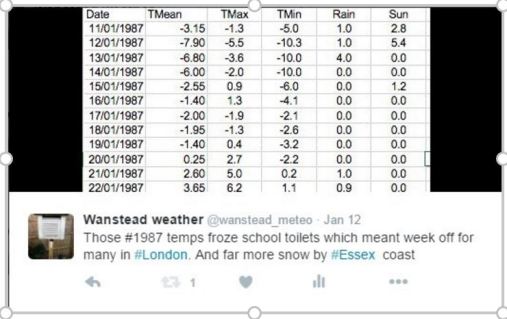
snipThere was around four inches by morning and, after breakfast, I went with my uncle for a drive around the same rural spots as Saturday. The reservoir was beginning to ice over and I remember my uncle reading a Fahrenheit thermometer and saying that it was “seven degrees of frost”.

When I left Rayleigh that evening the snow was falling thick and fast and the train seemed to be travelling slower than usual. When it failed to move from Shenfield station after 10 minutes I knew something was up; the guard announced that the wheels had frozen to the tracks. Everyone disembarked and caught another. After leaving Shenfield I noticed that the snow cover gradually decreased, with just an icing-sugar like covering in Romford.

My dismay at having left a winter wonderland in Rayleigh disappeared on waking up on the Monday morning and seeing a good few inches had fallen.

BBC Breakfast presenters gravely told us how bad things were. The Isle of Sheppey was cut off and train services were severely affected – I didn’t go to school once that week because the toilets were frozen. For once the conditions, reflected in this footage from Thames News, matched the hype.

meto
Courtesy of the Met Office

Many people, including members of the Climatological Oberservers Link, also have vivid memories of the freeze.

East London: Ben Bacarisse was living in Mile End in 1987. He said:  “I was living on the 15th floor of a tower block at the time. The prolonged cold caused the main water riser into the block to freeze so no one in nearly 400 flats (there were a pair of blocks) had running
water.  It turned out to be possible to tap into the larger street main
with a stand-pipe. screen-shot-2017-01-08-at-13-35-00

Presumably the constant use kept it running though
I’d have thought it would have to be removed at night.  I don’t recall
how long that lasted but it was more than a couple of days.”

Home Counties: George Booth, who was living in Epping, Essex, at the time, explained how the weather affected him: “On the Monday (12/1/87) I accompanied a group of young scholars to the Science Museum. Despite the cold and snow they were happy to walk to the station (and they behaved themselves). It was a strange sight to see
Exhibition Road covered in that thick brownish frozen dust which occurs
when temperatures are presumably too low for treatment to be effective.
Not so good news for the school roof, however. It eventually had to be
replaced after a water tank/pipe burst after a thaw.”

warblertsGeorge, who ran a weather station in Epping, added: “On 12/1/87 the maximum temperature in Epping was -8.0c and the minimum was -10.0C. The ‘snow depth gradient’ was very steep NW-SE with SE Essex/E London and N Kent receiving much greater falls than places like Epping. However, it was the severe frost that caused many
problems, particularly in older buildings.”

Dave Cornwell, a retired scientist, from Laindon, Essex, said: “I was working as an operational scientist at a sewage treatment plant in Rainham , Essex. (London Borough of Havering, (just east of London). I remember it well because for the first time anyone could remember the sewage was freezing on entering the works through the screening bars, bearing in mind that sewage is flowing underground and starting off quite warm, usually in winter arriving at about 10-12C.

gavs“It was a major engineering problem because the heat was being conducted away by the metal bars and ice building up and blocking the flow. This could potentially have caused backing up of millions of gallons of raw sewage. A smart engineer made some improvised electrical heaters to fit on the bars and we hired massive tarpaulins to put on the north side to try and cut down the wind chill. It worked a bit till the weather turned. I remember taking the temperature at 9.30 am and seem to recall it was  -9.0C.”
top-10
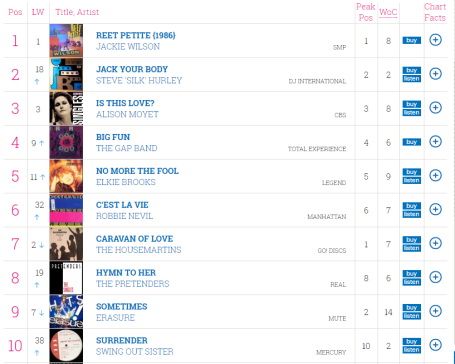
The record cold spell also saw Steve ‘Silk’ Hurley’s Jack Your Body enter the charts at Number 2, a track that more or less launched the UK dance music scene

John Hall, from Cranleigh, Surrey, said: “We had a little snow on the Monday, I think it was, but it didn’t amount to much. We had to wait for overnight Tuesday/Wednesday for serious snow, but then it certainly made up for lost time. On
Wednesday morning, the gritters  must have done a remarkable job on the
roads, as traffic was moving – if slowly – on the B road that runs
through Cranleigh, and I was able to make the 8-mile journey to
Guildford Station.

“But at the station, a railwayman was standing by the entrance
telling everyone: ‘There are no trains. We don’t know when there will be
any trains. We advise you to go home.’ I managed to get a bus back to
Cranleigh, by which time the snow had just about stopped.

“I didn’t measure the depth of the snow, but my subjective impression that Wednesday morning was that it was almost a foot (30 cm) deep.  The wind wasn’t strong enough to cause too much drifting that day, but the following day it became pretty strong, and there was considerable drifting of the powdery snow, with some susceptible local roads becoming blocked. In this southern lowland region I can’t remember another such instance of this ‘delayed drifting’.”
Tudor Hughes, had the added altitude (165m) of Warlingham, Surrey, that made the cold spell even more memorable. “It was just about the most outstanding weather event for me. The 12th was a sunny day with a light NE’ly and a few inches of lying snow and the temperature just wouldn’t rise.
“After a min of -12°C it got up to -9.2°C (12-hr max) which I think is a COL record though obviously not a UK one.  The 24-hr max was -8.9°C, agreeing with the reading from Coulsdon (Ian Currie).
“In the evening some smoky-looking stratus appeared and snow fell from cloud so thin that the moon was visible.  It snowed intermittently for a further 2 days until the level depth was 39 cm.  At the top of the North Downs (Tatsfield) the depth was about 3 times that.”
Tudor added: “The temperature was below -5°C for about 40 hours and below 0°C for eleven days.  I whacked up the heating and opened the loft door.  A burst pipe and frozen tank is the last thing you want.
“The extraordinary thing about January 12th was the lapse rate.  This was no cold inversion – the higher you were the colder it was.  I reckon the maximum at the top of the Downs (877 ft) was -10°C.  There was some relatively warmer air above 700 mb but even so the 1000-500 mb thickness was 498 dam.  Not quite the purple line but well inside the brown one.”
Unlike some cold spells the severe weather was not restricted to the SE corner of England.

The South West: Len Wood, from Wembury, southwest Devon, said: “Even here on the coast this was the coldest spell I experienced since moving here in 1983. We had four successive ice days and my record min of -10.1C was recorded which still stands.

“With quite a biting easterly wind it was hard to keep our bungalow warm.
Cold was coming up through the floors so I blocked the air bricks and we covered the floors with anything we had handy, old carpet, blankets…

“I remember another effect of the extreme cold was to make all the leaves turn black on the privet hedge down the length of our garden. They subsequently fell off. The hedge did recover the next summer though.”

There is a study of the heavy coastal snowfall of January 11-13 by W.S.Pike here.

capture

Some more charts from Smartie on the Google Group Weather and Climate…

2m temperature and snow depth at 12 UTC 12 January 1987 from a downscaled simulation of 10-13 Jan 1987. The ERA Interim reanalysis was used as initial and boundary conditions. Contours of physical snow depth start at 2.5 cm every 2.5cm.

chart-1

chart 2.PNG

The main convergence zones appear quite well resolved at DX ~12km

chart-3

This is the first downscaling grid. It has the latest ‘scale-aware’ convection scheme from WRF (Multi-scale Kain-Fritsch). The deep and shallow components should both be active (haven’t confirmed this).

Hourly output from this is used to initialise nested 6 and 2km grids. On the 6km grid the deep convection should be almost off and shallow convection still active.chart-4

On the 2km grid there is no Cu scheme ie. it’s ‘convection permitting’ in the jargon.

The plots can be compared with the letter by Lumb (Weather, 1988,, V43, 31).

chart-5


Wanstead weather: 2016 review

This year finished as the 14th warmest on record – some 0.5C warmer than the 1981-2010 average – though 0.2C cooler than 2015.

monthly-mean
Only four months of 2016 were below average temperature-wise


Six months of 2016 were roughly average – the means being within +/-0.7 every month, bringing the mean temperature to 11.7C.

Rainfall was less remarkable with the year being a little drier than average. The total of 561mm (93% of 1981-2010 average) puts it as the 122nd wettest since 1797, just 8mm wetter than 2015.

It was also a slightly duller than average year with 1,390 hours of sunshine recorded. That’s 93 per cent of average, the 92nd sunniest since 1881 – the least amount of sunshine for 12 years.

weather-stats-2016


For a review of each month, click January, February, March, April, May, June, July, August, September, October, November, December

To view full stats follow this link:http://1drv.ms/1kiTuzv

monthly-rain

monthly-sun

new-rain

Christmas 1810: stormy then very cold

Earthquakes in Italy and early season snow cover in Siberia have been well documented in 2016.

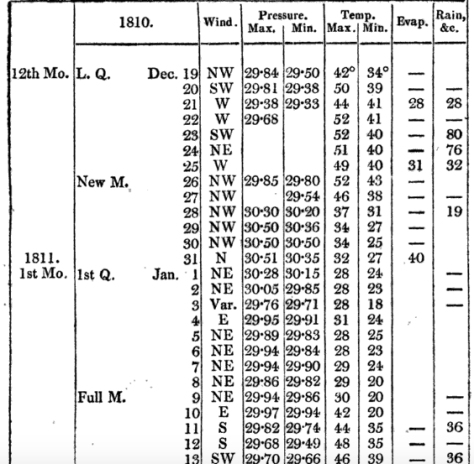
They were also mentioned by Luke Howard in his publication The Climate of London in 1810.

screen-shot-2016-12-16-at-18-57-08

He also mentions winter thunderstorms over the Yuletide period, from Christmas Eve to Boxing Day – the amount of rain overflowing the Thames.

24th: Very windy night with heavy rain. 25th: Wind high all day with rain frequent lightning in the evening from SE. 26th: Wind very boisterous early in the morning day fine the rain of the last three or four days being impeded in its passage to the Thames by the spring tides overflowed the banks and filled the marshes.

Within two days of this wild and wet spell, complete with strong north-westerlies, the wind swung north and then north-easterly to usher in 1811 with a 12-day cold spell.

screen-shot-2016-12-17-at-20-55-36

The conditions of the cold spell were not severe, the coldest night was -8C, it was a pretty standard cold spell for the time and one that the south-east used to experience with fair regularity in the early to mid 1980s.

screen-shot-2016-12-17-at-20-48-37

Models currently show a (fairly) narrow chance of a stormy Christmas period. It would be interesting if it were followed with a cold spell in January – just like the ones we used to get in 1980s.

* The Booty website also contains the following on that notable month…
What is thought to be Britain’s strongest tornado occurred in December 1810. A category of “T8” (on a ten-point scale) occurred on the 14th at Old Portsmouth. The TORRO website says it:  “tracked from Old Portsmouth to Southsea Common causing immense damage – although no deaths, it is believed. Some houses completely levelled and many others were so badly damaged that they had to be demolished; chimneys were blown down and the lead on a bank roof was ‘rolled up like a piece of canvas and blown from its situation’.”

November 2016: record sunshine, cool

November 2016 was the sunniest in a record going back to 1881. Some 91 hours were recorded, 156 per cent above average and a complete contrast to last November which was the dullest for 47 years.

frost
The temperature in the early hours of the 30th fell to -6.1C, colder than any night last winter and the coldest since January 2013

The mean temperature for the month finished 6.4C, that’s 1.5C below the 1981-2010 average ; 4C cooler than last year and the coldest November since 2010. The warmest day occurred on the 15th with 15.9C recorded. The first air frosts of autumn were recorded. The lowest temperature occurred on the 29th when the spirit fell to -6.1C.

Rainfall was 135 per cent of average with 80.1mm recorded. The wettest day was on the 19th when 23.5mm of rain fell.

The sunniest days were on the 2nd, 13th and 25th when eight hours of sunshine were recorded.

Air frosts: 4, Ground frosts: 19

stingjet
The dolphin-shape of this radar image shows Storm Angus before it hit the south coast. The system stayed far enough south of us not to cause any damage in London

What has December got in store weatherwise? The models suggest the high pressure that has been anchored over us, bringing cold nights, will pull away to the continent. This will allow an ever milder but mostly dry source of air off the Atlantic through to mid month. Days will grow milder while frost and fog will feature less at night.

Beyond the grasp of the models my long range outlook method suggests an cold month is most likely at 43 per cent probability. Average comes in at 29 per cent probability while rather mild and rather cold are both 14 per cent probabilities.

Rainfall looks finely balanced. Wetter and dryer than average both come in at 43% probability while average is 14 per cent. Given the influence of high pressure at the beginning of the month I’m inclined to think it will be a drier than average month.

So, to sum up, we’re looking at a mean of 4.4C, rainfall: 55mm, sunshine: 39hrs.

My forecast last month was good: predicted mean 6.8C (result 6.4C). Rainfall: 55mm (result 80mm). Sunshine was way off, however – predicted total: 41hrs (result 91hrs)

I have also published a winter forecast covering the London area that you can find here.

Here follows the full weather diary for November…Full stats for the month here:http://1drv.ms/1rSfT7Y

1st: Cloudy and mild all day. Patchy drizzle at times.
2nd: Sunny, cold start after first ground frost of the autumn.
3rd: Sunny, cold start with cirrostratus and cumulus drifting around. Cloud thickened through the afternoon with some light rain around 9pm.
4th: Cloudy, dull start up to 11am. Rain pushed in and lasted for much of afternoon, clearing in evening.
5th: Cloudy, cold and damp start. Some brightness though with a cold wind.
6th: Sunny, cold start, tending to cloud in. Rain after 3pm. Feeling cold but too windy for a frost overnight.
7th: Sunny, cold and very breezy to start, the cloud tending to fill in through the day. Clearer overnight though too much cloud and occasional air prevented an air frost.
8th: Sunny and cold start. Cloud thickened during the day to bring rain after dark at 8pm that then fell through the night – the biggest fall since Brexit day.
9th: Light rain slowly clearing to cloud.
1oth: Cloudy start with light rain showers around 10.30am then cloudy. Some sunny intervals in the afternoon. Milder.
11th: Bright start with cloud decreasing through the morning to leave a pleasant and clear afternoon.
12th: Miserable and rainy to start, this lasting past 11.15am. Drizzle thereafter into 6pm.
13th: Sunny start though cloud tended to fill in through the day. Damp overnight with patchy drizzle.
14th: Cloudy and damp start with some breeze. Brief brightness at noon but patchy drizzle moved in around 4pm.
15th: Cloudy and miserable though very mild.
16th: Sunny start and very mild though cloud tended to fill in during the day making the sunshine milky.
17th: Bright, breezy start, the breeze increasing until a squall blew through at 2.40pm then sunny spells. front
18th: Bright start with milky sunshine then tending to cloud over. Feeling cold.
19th: Bright sunshine though cold to start. Patchy altocumulus developed through the day, leaving it to become bright, the strength of the sun diminishing. Rain started around 6pm and fell through night with varying intensity.
20th: Dull and cloudy start with rain returning at 10am. Cloudy afternoon with rain returning late evening and through the night, some heavier bursts.
21st: Cloudy with showers past noon. Heavier showers moved in mid afternoon and fell into the evening.
22nd: Cloudy with a few very light showers around. Breezy.
23rd: Cloudy and breezy. Feeling mild.
24th: Cloudy and mostly dull with brief brightness at noon.
25th: Sunny with just a few cumulus around.
26th: Sunny start but low cloud blotted out the sun around midday then cloudy and cool.
27th: Cloudy and mild.
28th Sunny all day with just a few cumulus floating around.
29th: Sunny all day with frost persisting on grass in shade.
30th: Sunny and very frosty start. Frost persisting on the grass all day with a very cold start to the night. A veil of cloud crossed the region late evening, lifting the temperature above freezing, before clearing before dawn

Late autumn to bring chilly shock

The Met Office’s latest outlook for a relatively high chance of cold weather in the early part of winter has set the internet abuzz with talk that the UK is about to experience its coldest winter in years.

The 3-month outlook, produced by the agency for contingency planners, states:

Lower-than-average temperatures are more probable than higher-than-average values. Overall, the probability that the UK-mean temperature for November-December-January will fall into the coldest of our five categories is 30% and the probability that it will fall into the warmest of our five categories is 10% (the 1981-2010 probability for each of these categories is 20%).

THe ‘30% chance’ for temperatures to be in the coldest of five categories is more significant than it would appear: in this three-year period of mild winters that figure usually hovers far lower.

meto7112016
The continent is not yet cold enough to get excited about this synoptic chart for Monday, November 7th

The forecast has drawn obvious comparisons with their 2009 ‘barbecue summer’ f0recast but the GloSea5 model has made infinite advances on the old one.

The Met Office’s method, which includes a combination of data such as QBO, ENSO and ground based observations also agrees with my own method of finding local October singularities back to 1797. This month I found that an average or cold November is most likely: average and cold are both 30 per cent probability. Rather cold and severe are both 20%! There appears no chance of anything mild.

So, we can look forward to ‘a reduction in the normal westerly flow across the UK from the Atlantic, with a greater frequency of northerly or easterly winds’.

But what does this mean for the London area? If the near continent is not cold enough northerly and easterly winds could just bring a succession of cold rain in the form of showers off the North Sea with a higher than average frequency of frosty nights: nothing out of the ordinary for a slightly cooler than average November.

To try and second guess proceedings into December I decided to plot all year singularities to find when the cold spells would most likely fall and how severe they could be.

The results for November look unexciting: the coldest day is likely to be around the 19th with a maximum of 6.9C. The best chance for something cold looks to be in December, around 6th to the 11th – but there again highs of 3C or 4C would mean that any snow would be short lived. There appears to be a warm up in time to scotch hopes of a white Christmas before another cool down toward new year.

So, in conclusion, late autumn / early winter is likely to be a lot colder than the past three years. It is perhaps this fact, together with frosty mornings being common, that will make the season feel colder than it actually is.

I will be publishing my usual winter forecast on December 1st.

maximum
The coldest day in November is likely to be around the 19th


October 2016: average temps, dry

October 2016 was yet another dry month, a pattern that has emerged since the middle of June. Just 52 per cent of the October average was recorded.

sunny
October saw many pleasantly sunny days

The monthly mean finished 11.5C, 0.3C above average and ending a three-month run of warm temperatures.

Some 105 hours of sunshine were recorded, 98 per cent of average

Air frosts: 0, Ground frosts: 0

So what has November got in store weatherwise? The models on the 1st suggest an anticyclone anchored to our west over the Atlantic will bring a regime of, at times, chilly northerly winds and the potential for rainfall, much probably in the form of showers, driven by low pressure in the North Sea. Where skies clear at night there will be potential for the first air frosts of the autumn.

Beyond the grasp of the models my long range outlook method suggests an average or cold month is most likely: average and cold are both 30 per cent probability. Rather cold and severe are both 20%! There appears no chance of anything mild.

Rainfall appears that it will be skewed toward something above average at 40 per cent, though average and below average are both 30 per cent.

Sunshine looks average at 57 per cent probability.

So, to sum up, we’re looking at a mean of 6.8C, rainfall: 55mm, sunshine: 41hrs.

holes
Numerous holes dug by squirrels appeared in October. The squirrels have no more an idea than we do whether winter will be cold

Here follows the full weather diary for October…Full stats for the month here:http://1drv.ms/1rSfT7Y

1st: Rainy start with showery bursts to 11.25am then through afternoon mostly cloudy.
2nd: Sunny but chilly, feeling very autumnal. Clearing into the evening with a cold night to follow.
3rd: Sunny, gin clear all day until 2.08pm.
4th: Another sunny albeit slightly hazy start then patchy cumulus. Warm in the sunshine even with a easterly breeze.
5th: Sunny start though breezy and with quite a few cumulus around. Cloud streets observed at 10.30am, the cloud tending to decrease and completely melt away by 4pm.
6th: Sunny start but with much cloudier spells at times. Warm in the shelter.
7th: Cloudy all day, the cloud thick enough at lunch time for drizzle that damped the ground.
8th: Cloudy with bursts of light drizzle in the morning, some brightness. A heavy shower at 2pm was brief then cloudy. Clear and cold overnight.
9th: Sunny until 2pm with patchy cumulus – a really glorious morning. Sunny spells in afternoon with cold night to follow.
10th: Sunny with just patchy cirrus first thing. Thick patches of alto-cumulus drifted across from time to time. Cold overnight.
11th: Sunny with patchy cumulus which melted away through the day. Showers after dark, one at 2330z.
12th: Cloudy and damp start. Short, sharp shower at noon then mostly cloudy.
13th: Rainy , wet start thanks to a streamer of moderate to heavy showers.
14th: Cloudy am but with lots of sunshine mid-morning before clouding over again though staying bright.
15th: Bright start but with lots of cloud pushing in and light burst of drizzle at noon. Cloud thickened before rain moved in after 5pm and fell intermittently through the night.
16th: Damp start as the remnants of the overnight rain cleared away, then becoming brighter at 11.15am. Sunny spells for a time before turning cloudier with some very sharp showers on yet another convergence line.
17th: Cloudy start but soon brightening up with some pleasant sunny spells. Heavy burst of rainfall at 5.30pm with more showers at midnight and early hours.
18th: Cloudy though quickly turning bright and breezy with long sunny spells after clearance of the cold front.
19th: Bright start though more cloud around than sun all day. Feeling colder than of late.
20th: Bright and breezy with variable cloud and sunny spells. A short shower at 2pm damped the ground. Clear spells overnight made it chilly. A shower at 9.30am.
21st: Cloudy and chily start.
22nd: Cloudy and cold start, brief clearance at 11am then sunny spells.
23rd: Sunny and clear to start though cold. Sunny spells into the afternoon. Cloudy overnight.
24th: Cloudy and cool during the day and overnight.
25th: Dull and cloudy with only limited brightness. Clear early evening with temp falling before it turned misty. Cloud pushed in raising the temperature.
26th: Cloudy start and turning very dull before bright spells spread in at noon.
27th: Cloudy though getting brighter through the morning with a brief clearance at noon, then bright and sunny intervals.
28th: Sunny and very mild to start. Sunny spells through the day.
29th: Cloudy start with bright intervals after midday. Clear spells after dark with fog forming after 11pm which gave a foggy start.
30th: Foggy start then cloudy and miserable.
31st: Fog to start then clearing at 11am. Gorgeous sunny day thereafter.

Months of snow on way? It’s too early to tell

Sections of the tabloid media have been going into overdrive these past couple of weeks with tales that the UK will soon be in the grip of an Arctic freeze – one headline in the Daily Express boasted that parts of the UK were in for FOUR MONTHS OF SNOW.

excess
The Daily Express ‘forecast’ was published at the end of September

These stories are nothing new though they seem to be published earlier and earlier in the autumn. By the time we reach November – once the traditional time when winter forecasts started appearing – the tabloids have already turned their attentions to spring. Much of it is just ‘clickbait’ – a means for publishers to prove their stories are being read to keep their advertisers happy, a symptom of an industry in financial dire straits.

There will be snow somewhere in the UK during the next five months but predicting heavy snowfall in a given area, such as London, is impossible. But given the outrageous claims at such a long way from the start of the season on December 1st I decided to have a look to see if there is anything wintry on the horizon.

I started by comparing a range of historic datasets, including quasi-biennial oscillation (QBO) and el niño–southern oscillation (ENSO), against monthly mean temperature and rainfall anomalies. Because ENSO data only goes back to 1950 the findings are obviously far more restricted than my winter forecast method which uses local data going back to 1797.

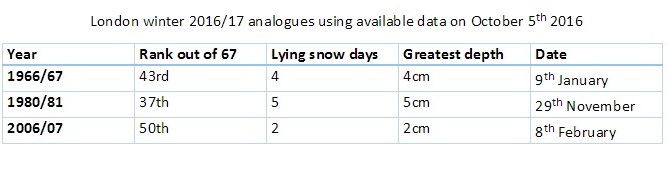
The results of my data trawl are underwhelming. The best fit years were as follows:

analogues

For anyone who likes snow the above is not encouraging, however, given the past year which has seen several daily and monthly records shattered, including a record warm December, who’s to say that recent warm temperatures will suddenly swing the other way.

The above table would also suggest that the coming winter will be colder and snowier than the previous three – but that gives little away given how mild the past three winters have been.

scand
October 2016 has seen a strong blocking high become established over Scandinavia, the earliest this has happened since 1881.

A study of mean temperature anomalies in London since 1950 suggest that sudden swings, both positive and negative, are becoming more likely. Last month was the fifth month in a row that I recorded a positive anomaly – the longer this goes on the more likely it is the mean could turn negative – though bear in mind that I have recorded 12 months in a row of positive anomalies, from February 2011 until January 2012.

Current weather also suggests that something maybe afoot with the earliest establishment of a strong anticyclone over Norway (the fabled Scandinavian high) since 1881! This weather pattern gives the south-east its best chance of snow with the feed of cold air often coming all the way from Siberia. Time and again, however, I’ve seen these patterns break down in November just as everyone starts talking about an imminent severe winter. There is more than an element of truth to the saying:

Ice in November to bear a duck, rest of winter will be slush and muck

In conclusion, while the early figures look bleak for snow in the low-lying south-east, it is still far too early to tell if the coming winter will be mild or cold.


September 2016: very warm, very dry

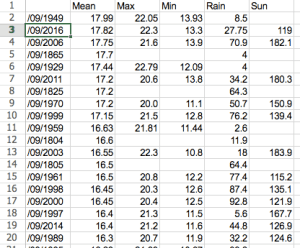
Last month was the second warmest September in a local record going back to 1797! The monthly mean finished 17.8C, 2.4C above average. Despite being an ‘autumn’ month September was actually a full degree warmer than June!

screen-shot-2016-10-01-at-11-55-19
September 2016 was the second warmest in a local record back to 1797, though we’re talking by fewer than tenths of a degree.

The hottest September day since 1959 was recorded on the 13th when 33.1C was reached, the sixth equal hottest in the local daily record back to 1848.

The month also saw the warmest minimum recorded since 1959 when the mercury failed to fall below 18.7C on the 6th.

It was another very dry month, the third much drier than average month in a row: just 27.7mm fell, 24 per cent of average, making it the driest September since since 2007 and the 12th driest in the local record.

Like August, the month only falls down in terms of impressiveness when sunshine hours are considered. Some 119 hours were recorded, that’s 85 per cent of average, making it the dullest September for 15 years.

Air frosts: 0, Ground frosts: 0

So what has September got in store weatherwise? The models on the 1st suggest that a large Scandinavian high will become established to our NE bringing lots of settled weather and showers on coasts. There’s obviously the chance of trough disruption as the month progresses if the anticyclone’s influence declines.

Beyond the grasp of the models my usual long range outlook method falls down this month due to September’s warmth and dryness – there is nothing within  +/- 10% of September’s statistics. I would guess, however, that we are looking at another drier than average month with frost becoming a risk as the month progresses where skies clear. There is also the chance of more pleasant autumn days where skies are clear during the day.

My September outlook for temperature was poor. I predicted a mean of 15.3C (outcome: 17.8C). It was much, much drier than I thought: 300mm (outcome: 27.7mm). Sunshine was poor: 140 hours (outcome: 119 hours).

Here follows the full weather diary for September…Full stats for the month here:http://1drv.ms/1rSfT7Y

1st: Sunny start but cloud gradually increased until it was overcast by 6pm. Clear spells overnight but warmer than previous nights.
2nd: Cloudy though some brighter intervals.
3rd: Sunny start, cloud began to pile in at 12.30pm with rain arriving at 5.30pm, this fell through the evening with some showers in the early hours.
4th: Bright, breezy start but rapidly turning cloudy and dull. Some rain overnight.
5th: Light rain and dull to start – this quickly clearing to cloud by 3pm. Things remained cloudy with a muggy night.
6th: Cloudy, dull and muggy start after warmest September night on record. Another warm night though muggy.screen-shot-2016-10-01-at-12-22-03
7th: Cloudy to 11am though sun breaking through as drier air arrived. Feeling humid.
8th: Sunny start but with plenty of cumulus, this quickly decreasing to leave clear sky.
9th: Cloudy morning though sky seemed to periodically clear of low cumulus before becoming overcast and very breezy in the afternoon. Some rain overnight and just before obs time.
10th: Cloudy start with patchy light rain, this briefly turning  heavy at 1pm  before turning occasionally moderate. Dreadful afternoon after recently. Clearing overnight to leave a sunny start.
11th: A glorious sunny day with only the odd patch of cirrus.
12th: Bright start with some sunshine, clouding over with a few splodges of rain with warm front. Then sunny and very warm.
13th: Sunny start with a few cirrus and castalanus around. Breezy at times with the thermals. The warmest September day since 1959 and 6th equal warmest since 1848.screen-shot-2016-10-01-at-12-13-54
14th: Sunny start with a few cirrus. A few patches of alto-cumulus later. Very warm but not as hot as yesterday. Warm, pleasant evening.
15th: Sunny with a few wispy cumulus, clearing to hot sunshine. Some alto-cumulus developed at 2pm and towering cumulus could be seen in distance. Thunderstorms reporting to NW of London. Cloudy and warm overnight with eight peals of thunder in the early hours and heavy rain.
16th: Light to moderate rain through the morning, petering out at 1.30pm.
17th: Cloudy, cool and breezy all day, at times dull.
18th: Cloudy all day, a bit warmer than the previous two days.
19th: Cloudy start though with sun breaking through briefly at 11am until 1pm then cloudy again. Rain at 1am that didn’t last long enough to register.
20th: Cloudy and fairly calm – a nothing day with odd very light drizzle.
21st: Bright start with cloud breaking to long spells of sunshine before more cloud moved in. Warmer than of late.
22nd: Cloudy but  sun broke through giving pleasant afternoon and cool overnight.
23rd: Sunny, gin clear and cold start. Just a few fair weather cumulus through the day.
24th: Sunny start with cloud decreasing. Very warm in sun but cloud and breeze built through the day. Overnight light rain between 6am and 9am.
25th: Bright start after overnight light rain.
26th: Bright start with a few cloud breaks here and there. Heavy shower at 12.15pm with further threat of rain but stayed dry.
27th: Bright start with signs of a cold front moving in from south then cloudy.
28th: Sunny start with patchy cirrus, this tending to thicken at lunchtime to turn mostly overcast with humidity increasing. Breeze also picked up with reappearance of sun mid afternoon. Cloudy, very mild and breezy rest of the day.
29th: Cold front and brief heavy rain swept in at 10.03am. Then intermittent falls until 11.23am.
30th: Sunny, gin-clear start, patchy cumulus bubbling up at 10.30am. Cloud grew thicker around 12 noon with brief shower at 1pm. Then sunny spells and cloudier periods. Another shower just after nightfall then clear. Cloud moved in after 2am with another shower. Early sunshine  gave way to moderate showers around 9.45am.

A mostly quiet and dry autumn on the way?

I don’t usually bother trying to forecast autumn or spring given that there is far less interest in them than winter and summer. However, given the heightened interest in this year’s hurricane season and emboldened, perhaps foolishly, by my reasonably correct summer forecast I decided to have a look at the stats and see if I can find any signs where autumn in east London may be headed.

Using the methsummer simsod for my seasonal forecasts resulted in a shortlist of 26 summers that were similar to 2016.

Because the NOAA ENSO index only goes back to the 1950 I decided to disregard all years prior to this date to try to make any results more reliable. This narrowed down the list to 11 years.

With these considered I then searched for years that had a similar ENSO index to June (0.1 – neutral) with a tendency to turn negative (La Nina). This narrowed the field further to three years: 1999, 1992 and 1964. However, the only year that is showing signs of being similar with regard to where the ENSO index is forecast to be heading is 1964.

Although, so far, there has been an uptick in hurricane activity similar to 1964 there is, of course, the added consideration that Saharan dust is playing a part in impeding the formation of these tropical storms in the Gulf of Mexico – something the weather models seem to struggle to get a grip on.

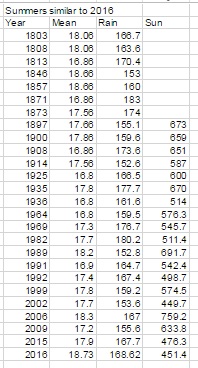
With this in mind perhaps there will also be lower than usual instances of these storms crossing the Atlantic to affect the UK: hence a quiet autumn though, on a national scale, interpersed with the odd interest from the Atlantic. weather notes 1964In London, perhaps we can expect something very similar to what is listed on the excellent website: http://www.london-weather.eu/article.103.html
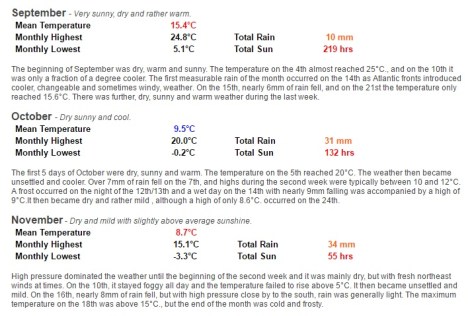
autumn 1964


Summer 2016 review

Summer 2016 turned out to be a very decent season overall, the mean temperature of 18.7C (1.1C above average) made it the sixth warmest summer since 1797.summertop20

While it wasn’t quite up there with the hot summers of 1976 and 2003 it still produced some notable records. The stormy beginning to June effectively ended with the Brexit vote, a period of 24 hours that coincided with the highest daily rainfall this area has seen since at least 1959.

The multi-cell thunderstorm in the early hours of June 23rd produced 60.8mm of rainfall, nearly half of the month’s total which became the third wettest June in a record going back to 1797. The high rainfall was in complete contrast to July and August and helped skew the overall figure: 168.6mm is 114 per cent over average summer rainfall.

sunWith so much rainfall overall sunshine was affected with only 451 hours recorded, just 80 per cent of what can be expected in an average summer.


July produced another record, this time the highest overnight minimum recorded since 1959. The minimum of 21.1C was recorded during the early hours of the 20th – coming hours after the hottest day of the year: 33.5C – the 14th hottest day on record.

The warm and very dry theme continued into the final month of summer with the warmest August for 12 years, the 10th warmest and 12th driest since 1797.

My summer forecast, when the monthly probabilities are considered, was broadly correct though I didn’t estimate correctly just how warm it would be.

Mean forecast: 16.7C (outcome 18.7C)
Rainfall forecast: 166mm (outcome 168.6mm)
Sunshine forecast: 546hrs (451.4hrs)

summer2016mean

summer 2016 rain

summer 2016 sun