The dry nature of spring this year has scuppered a large part of my usual method of trying to predict the summer season.
With El Nino forecast to be neutral I decided to once again rely on pattern matching of meteorological data from this area for March, April and May stretching back to 1797.
The mean for the spring season, the second warmest on record, was 11.9C with 88.6mm of rain and 430.3 hours of sunshine.
If you take into account all years that were within +/- 10 per cent of these figures, for rainfall some 12 ‘best fit’ years emerge. I normally go on to reduce the list further by considering mean temperature but, this year, no figures would remain!
The list of 12 summers, ranging from 1807 through to 2005, saw all manner of summers, including 1808 when early July heat gave way to fierce thunderstorms with hail the size of tennis balls recorded. Only one was a real corker, 1906, but most were fairly nondescript.
As an average this summer could be expressed as: Mean: 17.2C (just below average) Rainfall: 141mm (about average).
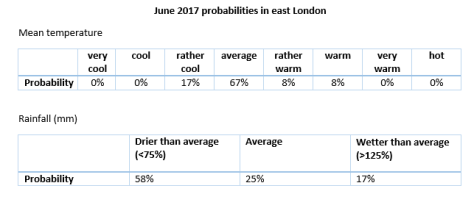
Or, expressed in probabilities, I concluded the following:
From the above you could deduce that the next three months will be around average, with average rainfall.
To try to give some idea of what month will have the best weather I’ve broken down the summer into June, July and August probabilities.
Looking at June, considering the unsettled outlook after the weekend, I would guess that a few very warm, thundery spells are possible– though much of any precipitation will stay to our west.
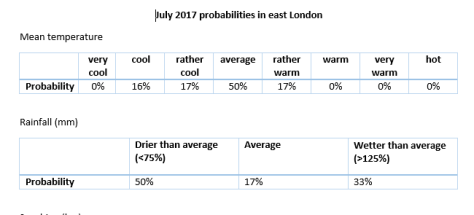
On to July. After an average June I wonder if the ‘return of the westerlies’ will happen just in time to affect this month?
The above chart would suggest that July will be classically average overall. Fine, not too hot spells, with occasional depressions bringing cooler weather and showers.
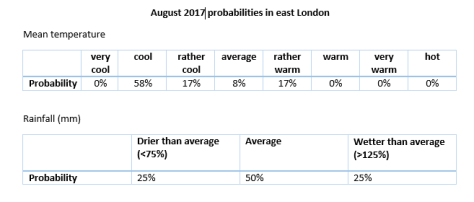
On to August. Apart from last year this month has been a real disappointment the previous few years. Looking at the probabilities would suggest that August will be the most disappointing month.
Looking at the above probabilities there seems a fair chance of something cooler than average.
There’s not really much to go on. I note the Met Office is going for ‘warmer than average’ but a look at their methodology and the coming season doesn’t look that exciting.
* Taking into account the fact that temperatures in London are up to 0.66C warmer than they were 100 years ago I have added 0.66C to mean temperatures before 1915.
** Obviously, in the event of a series of direct hits from thunderstorms, my rainfall estimate could be hopelessly short – a symptom of abundant solar energy at this time of year which creates a ‘noisy’ atmosphere compared with winter.
*** The 1981-2010 average mean for summer in this region is 17.6C, with 144.9mm of rain and 564 hours of sunshine
The Alpine snowfall season finished just below average in the Splügen area of the Swiss Alps. Abnormally warm weather after decent snowfalls in February and March curtailed the season; mean temperatures finished over a degree warmer than average between November and April.
The figures make depressing reading for anyone who enjoys winter sports and come after a study suggested that bare Alpine slopes could become a much more common sight in the future.
I first visited this area of the Alps in 1981, returning most February half-terms, apart from 1989 when the snows failed to arrive until after Easter. The season that hastened the installation of artificial snowmaking in resorts across Europe has always left me wondering just how much snowfall has varied.
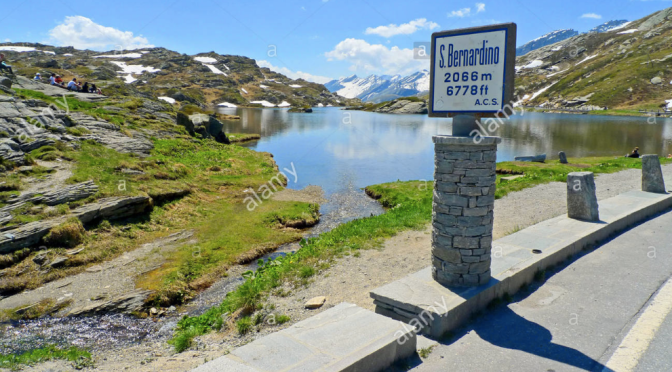
Using San Bernardino, a village at 1636m in the southwest of Grisons canton, I had a look at temperature and rainfall data back to 1999 to see what patterns were present. The figures confirm that some years see metres fall while others have barely enough to cover the pistes.
Temperatures, meanwhile, show a general upward tick from 2005-06.
While the above graphs show typical variability they don’t reveal much about month to month conditions.
Closer scrutiny of the data shows that early season dumps of over 30cm, the kind that really get the snow bases going and keep the earth below chilled for a long season, are becoming rarer. Indeed, apart from a blip in 2013/14 there have been no big early season dumps since 2009/10. The seasons are taking much longer to get going.
As the second graph shows big dumps of snow are happening later in the season. If there is not already a decent snow base these snowfalls can thaw much faster because spring sunshine has already warmed the ground.
Another way of trying to find how the climate has changed is to look at how many ‘ice days’ there were in a given period – ice days are when the maximum temperature reaches -0.1C or lower over 24hrs.
The graph below shows the past three years have been fairly constant though this season’s total of 83 is 37 days fewer than the highest total in the series, 2005-06 which clocked up 119 days.
I’ve visited many resorts in the Alps which, obviously, will be affected differently by the changing climate – the range of microclimates in the Alps is staggering.
In conclusion, considering the data and my experience, I’d say that though the Alps have definitely warmed the variability and ebb and flow of the climate means it is impossible to say with confidence that by the end of this century the slopes won’t be covered in the white stuff.
I chose San Bernardino because it is fairly central in the entire Alpine range and is also the most local SYNOP station I can find to the Valtellina range that I have been visiting most years since 1981. Any climatologists reading this would point out that my data range does not stretch back the necessary 30 years to make a judgment on the stats. If anyone can point me to a site that offers data back to 1980 I would happily update my figures and graphs.
My trip this year to Madesimo, 8 miles as the crow flies from San Bernardino, was timed just right for a dump of snow in February that followed weeks of dry weather.
Temperature inversions were seen in February (above). Snow was only deep enough to descend Madesimo’s Canelone run, reached by the Groppera lift to 3,000m once February snows had arrived
The area has enjoyed some epic snowfalls over the years including 2013/14 when many found themselves snowed-in following a 2m dump of snow. The first of many snowfalls during what was an epic season.
The driest April since 2011 was also the seventh driest in a local record going back to 1797. Just 4.3mm fell, nearly half of which was recorded on the final day.
An ‘absolute drought’ that began in March coincided with the month; a run of 26 days with a daily total of <0.2mm! Dry early springs seem to be becoming a pattern in this area with eight of the last 11 Aprils being notably dry.
Though the mean temperature for April finished a fraction above average – 10.6C is 0.8C above average – it was a month of two halves. The month started warm with the temperature peaking at 25.4C on the 9th – Sunday of what was a warm weekend in London.
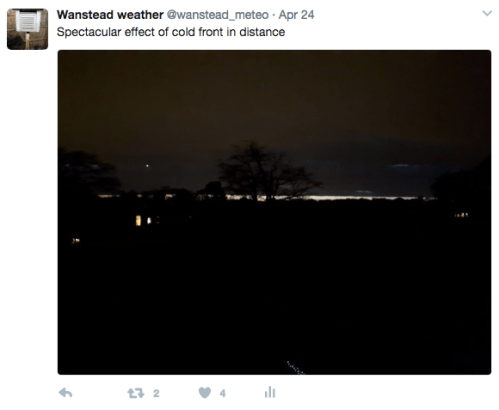
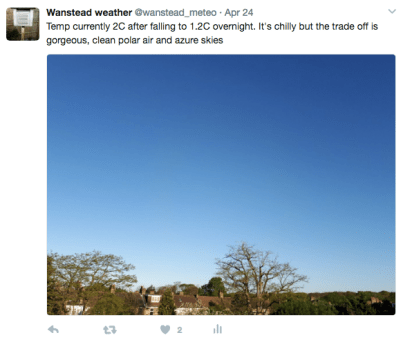
A polar low on 24th brought an unseasonably cold end to the month with cold days and night frost. Thunder was recorded on 26th and was accompanied by <5mm hail.
The total sunshine hours were just above average: 178.4 hours is 111% of the 1981-2010 average.
The wettest day occurred on the 30th with 2mm.
Air frosts: 1, Ground frosts: 7
Looking ahead, I think May will be another slightly milder than avrage month and continuing much drier than average.
Here follows the full weather diary for April. To view full stats follow this link:http://1drv.ms/1kiTuzv
1st: Cloudy into the late morning before some cloud breaks appeared. Brief shower and some warm sunshine but cooler than lately. Cold in early evening and cloud breaks overnight.
2nd: Sunny with variable cumulus. Variable cloud through the day and chilly overnight
Sunny with bubbly cumulus. 3rd: Cloudy but with bright breaks and blue sky in distance.
4th: Sunny and pleasant early with bubbly cumulus – this lasted all day.
5th: Sunny with just a few cumulus.
6th: Sunny with just a few wispy cumulus floating around, slight haze.
7th: Sunny and gin clear.
8th: Sunny spells with a few cumulus. Much cooler.
9th: Sunny with some cirrus and cumulus.
10th: Sunny though with lots of cloud at times.
11th: Sunny start then clouded over then sunnier again with cloudier periods.
12th: Early sunny spells, the cloud thickening by 11.30pm to leave a mostly cloudy afternoon. 13th: Cloudy though high base made it seem bright. Feeling chilly. A shower overnight.
14th: Bright start though with plenty of cloud around. Clear spells overnight.
15th: Sunny early though cloud increasing – a very light shower at 2.15pm.
16th: Cloudy, dull and cool. Some brightness at 2pm but then cloud thickened and breeze freshened to leave a cold afternoon.
17th: Sunny with variable cloud – clear overnight with ground frost.
18th: Sunny with broken cloud to start.
19th: Sunny start but clouded over, then sunny intervals.
20th: Cloud and mild all day.
21st: Very light drizzle to start then heavy cloud. Drizzle turned to light rain in Beckton but dry in Aldersbrook.
22nd: Bright start with broken cloud.
23rd: Bright early with patchy cirrus and altocumulus then completely cloudy and chilly. 24th: Some spots of rain around before moderate shower arrived at 5pm with 0.54mm falling.
25th: Sunny, clear start in polar air before cloud bubbled up around 10.30am. Then sunny spells – dew point stayed around or below freezing all day.
26th: Overcast and chilly with a cold breeze.
27th: Sunny, frosty start but cloud quickly bubbling up. Felt chilly.
28th: Mostly cloudy with the odd sunny spell
29th: Bright start but quickly turning cloudy
30th: Sunny early but gradually clouded over with rain at 1am. This stopped around 2am with small fall before 9am.
Lack of rainfall and a broken pump have been cited by City of London Corporation as the main reason for the shocking levels of the ponds through the park.
The Ornamental Water by the Grotto is virtually dry. Images courtesy of Ralph Potter
The plight of the water courses has been well documented of late; a press release from the Corporation explains the catalogue of issues hampering efforts to address the problem. Closer scrutiny of these reasons, however, suggest that too much is being blamed on the weather.
A study of local rainfall back to 1981 suggests that though the ground water replenishing season (October 1st – April 24th) has been dry it is by no means out of the ordinary.
As you can see from the graph the rainfall here has gone up and down like a yo-yo and 2016-17 is only the fourth driest period: 1991-92, 1995-96, 1996-97 and 2011-12 were drier.
The Corporation’s press release states: “2015-16 was a helpfully wet period for us…”
Wrong. 2015-16 was average. And if you consider annual rainfall 2015 saw 92 per cent of average rainfall recorded; 2016 was 93 per cent – placing 58th and 66th in driest years since 1797. Nothing out of the ordinary.
“2016-17 has, however, been an especially dry period with below average rainfall since Spring 2016.”
Wrong. See above detail. There have been three drier periods since 1981. And since March 2016, only half of the months have been notably dry, a period that included the third wettest June since 1797.
“January to March 2017 has seen roughly 50% less rainfall than average”
Wrong. January to March rainfall was 94% of the 1981-2010 average
April has been dry, and could be among the top 5 driest back to 1797, but it seems the Corporation are trying to blame nature instead of years of neglect on their part.
The past months have seen much of Heronry Pond dry out. Image by Ralph Potter
The situation is in stark contrast to CoL’s other open space, Hampstead Heath, which has recently seen the completion of a £23m project to make safe the ponds there. CoL has deep pockets yet they have dithered for years over spending £25,000 to renovate the Coronation Bridge – and offer the people of Ilford a route into the park.
Figures released by CoL show it has only invested £1.23m in Wanstead Park over the last five years, compared with £50m spent in Hampstead Heath.
We are constantly told that problems in the park are ‘in hand’ yet progress on anything is painfully slow – and action to repair the pump has sadly come too late for much of the wildlife on Heronry Pond.
People from far and wide use Wanstead Park – they really deserve better!
You can view City of London Corporation’s press release here
The mean temperature in March 2017 was the mildest in a local record going back to 1797.
A complete absence of air frost was mirrored in the mean which finished 10.5C, 2.8C above average and 0.3C higher than the previous record set in 1997.
The record temperature was probably down to notably mild air masses through the month as the total sunshine hours were about average, 107.2 hours is 99% of the 1981-2010 average.
The warmest day occured on the 30th with a high of 21.6°C in Wanstead, the warmest March day for 5 years.
Rainfall was very sparse, just 21.3mm were recorded, that’s 52% of average – a pattern that seems to be becoming more frequent; four of the last six Marches have been notably dry.
Sunshine was average. Over 107.2 hours were recorded, 99% of what we can expect to see during an average March.
The wettest day occurred on the 22nd with 5.8mm.
Air frosts: 0, Ground frosts: 1
Here follows the full weather diary for March. To view full stats follow this link:http://1drv.ms/1kiTuzv
1st: Sunny start, the sky gradually filling in with light rain at 3pm and into the evening. A windy night.
2nd: Sunny and blustery start, clouding over with some light rain in afternoon / evening. Drier overnight before area of light rain moved in at 0730z.
3rd: Cloudy start with light rain late morning. Feeling cold.
4th: Cold and cloudy with brief showers in the afternoon and overnight.
5th: Light rain at 9am and during the morning, briefly clearing at 10.30am before heavy showers moved in through the afternoon. Some warm sunny intervals in between. Showers into the evening until 10pm.
6th: Sunny start with just a few clouds around.
7th: Bright start with decreasing cloud to leave sunny late morning. Variable cloud through the afternoon. Rain at 00.50 until 0144.
8th: Light rain between 9 and 11am then showery though mostly light. Mild.
9th Sunny start though tending to cloud in late afternoon. Feeling mild.
10th: Cloudy with a burst of light rain at 10.30am.
11th: Bright, hazy start and feeling mild. Very quiet weather – pleasant in the garden.
12th: Cloudy with drizzle early afternoon
13th: Sunny start with a few cirrus, cloud gradually increasing but staying mostly sunny.
14th: Cloudy, mild and boring start – boring and cloudy all day.
15th: Misty start, quickly clearing to leave a glorious sunny day and pleasant.
16th: Sunny and clear up to 12 noon, then haze and cumulus pushing in and gradually thickening up. Light drizzle between midnight and early hours as cold front pushed through.
17th: Sunny but hazy start, this haze thickening through the morning. Feeling noticeably colder with patchy drizzle – felt quite inclement in the evening.
18th: Bright and breezy start. Then mostly cloudy with odd patch of drizzle.
19th: Cloudy, breezy with odd drizzle patch. Sunny intervals late morning and into the afternoon before clouding over in evening. Moderate rain at 1am.
20th: Cloudy and breezy start. Heavy showers spreading in with brief stair rods at 3pm, then clear and much cooler overnight.
21st: Sunny with well scattered cumulus.
22nd: Cloudy, dull and feeling cold in the wind. Showery rain, this turning heavier into the evening and to 1am.
23rd: Cloudy and breezy, some sun mid afternoon which felt warm.
24th: Cloudy, chilly and windy morning.
25th: Sunny and clear but with bracing easterly wind – pleasant outside the wind in the sun.
26th: Sunny and much more pleasant than yesterday with lighter wind.
27th: Cloudy and cold to start, the cloud breaking to long sunny periods that led to a pleasant afternoon. Cloudier overnight with cloudy, chilly dawn.
28th: Sunny, gin clear start. Cloud began building after noon with sun becoming ever more scarce. Light rain late evening and overnight.
29th: Cloudy and mild
30th: Sunny, though hazy start with lots of alto cumulus
31st: Cloudy and dull with brief drizzle at 9.30am. Cloud slightly less heavy at noon.
The period after the vernal equinox in 1952 was anything but springlike.
This chart shows the Synoptic setup at 1800h on 29th, the peak of the blizzard with F5 – F6 easterly winds, courtesy of the Met Office
A cold easterly airflow on March 29th and 30th 1952 affecting the southern half of England brought heavy snow whipped into drifts up to 6ft deep in parts of the Chilterns.
According to the Royal Meteorological Society’s weather log the snow varied from 3 to 6 inches and reached 10 inches at Northolt.
Squally winds, which gusted to 60 mph, blocked 330 main roads across the south. In places the temperature on the 29th remained below freezing all day – the snowstorm was probably the worst to affect southern England in late March since 1916.
The wintry weather followed a dry and fairly non-descript winter and must have been quite a shock at the end of what had been a fairly mild March.
Bernard Burton, of Wokingham, has a clear recollection of the event: “I remember the day very well as the Oxford/Cambridge boat race was held that afternoon. I was 14 at the time, and my brother-in-law gave me a ticket for a place on a launch to watch the race.
“My home was in Tooting at the time, and I took the bus to Westminster pier to catch the launch. I recall sitting upstairs on the bus with a thick layer of snow covering the front facing windows, but the roads and pavements were mainly slushy.”
Bernard, who runs Wokingham Weather, added: “I then spent one of the most miserable afternoons I can recall. There was a ‘lounge’ on the boat, which was warm, but was also full of diesel fumes and was very noisy. I alternately stood outside on the deck until the cold got too much, or went below for warmth until the fumes got the better of me.
“I recall bleak views of London with snow on roofs, in a poor grey afternoon light, but I think it was mainly dry at that time, although there may have been slight sleety rain.
“The boat race itself was a close one, but the crowds that usually lined the banks of the river were absent, just a few hardy stragglers, and by the time of the race I had a headache, probably brought on by the fumes. For my part, I couldn’t wait to get back to Westminster and back home to thaw out.”
John Hall, who was three at the time, said: ” I, sadly, don’t have any memory of it at all. That’s in spite of the fact that we apparently moved house from Cranleigh to Effingham (about 15 miles away) on the day of the blizzard.
“According to my father it snowed all day but the following day – which he reckoned was the 1st of April – the weather was glorious and all the snow was gone by noon. I don’t think his memory is quite in accordance with the facts, but of course that’s common with memories of past weather.”
The snow didn’t last long. March 31st saw temps rise to 5C; much of the snow had melted in the strong spring sunshine by April 1st. By the 3rd an Atlantic ridge of high pressure had moved in, raising temperatures to over 10C.
Stats for Kew suggest there was 21cm of level snow
1952 produced two more weather shocks. On August 15th and 16th over 220mm of rain fell on the hills above Lynmouth, Devon, leading to flash flooding of the village and the loss of 34 lives.
Months later, a large anticyclone during the last of five days of December produced the notorious ‘pea souper’ fog that contributed to the death of thousands of Londoners. This fog, initially freezing, became very dense and was directly responsible for the Clean Air Act enabled in 1956.
You can find an analysis of the unfolding pattern that produced the blizzard here. And here’s Xmetman’s take on the event.
A cold spell that saw a thin temporary covering of snow wasn’t enough to stop February 2017 from finishing mild. The mean temperature of 6.9C was 1.6C above the 1981-2010 average, the mildest February for three years.
The 20th saw the warmest February day in 13 years recorded, the 17.5C reached was marginally cooler than the 17.9C recorded on February 4th 2004.
Rainfall of 31.5mm was 80% of average – the driest February for 4 years. It was a dull month, some 44.6 hours of sunshine were recorded, just 61% of average, the dullest for 5 years.
The wettest day occurred on the 26th with 9.2mm.
Air frosts: 2
Ground frosts: 8
Snow falling: 4
So what has March got in store weatherwise? My long range forecasting method suggests the most likely scenario to be something rather cold waverage to slightly below rainfall
My February outlook for temperature, rainfall and sunshine was poor again.
Here follows the full weather diary for February. To view full stats follow this link:http://1drv.ms/1kiTuzv
1st: Cloudy with light rain late morning. Remaining cloudy into the afternoon and overnight with further light shower before obs time.
2nd: Cloudy and becoming breezy. Some intermittently light rain then cloudy. Broken cloud overnight.
3rd: Bright start with sunny spells developing – feeling warm in the sun. Cloud built up afternoon with rain at 4pm and 6pm. Rain at 8am.
4th: Light rain to start then bright spells late morning. Feeling chilly.
5th: Misty start and foggy out toward Epping. Some bright spells though mostly cold and cloudy. Broken cloud overnight with frozen dew at dawn.
6th: Sunny start with just a few wispy cirrus around. Clouding over after noon with rain in evening, heaviest at 8.45pm with bursts through the night. Min temp was at 9am yesterday.
7th: Cloudy, calm and damp start. Then clearing in afternoon for some mild sunny spells.
8th: Cloudy start and feeling really cold. Thick stratus cloud remained overnight – snow grains seen just before obs time.
9th: Cloudy and dull, snow grains seen. Mostly drizzle through the day.
10th: Dull and raw with occasional drizzle, sleet and snow grains falling all day and through the night – temporary dustings.
11th: Very light snow falling at 9am.
12th: Light snow at 9am with 1cm settling at Stanstead. Then cloudy and cold all day.
13th: Sunny start with sunny spells, clearance at noon.
14th: Cloudy start with complete clearance at noon. Then variable cirro cumulus.
15th: Cloudy start and cloudy all day with some rain.
16th: Cloudy start breaking to sunny intervals afternoon.
17th: Cloudy start breaking to sunny spells at 10.30am, long sunny spells and mostly clear overnight.
18th: Cloudy start with complete clearance after noon – cloudier spells overnight.
19th: Bright start but clouded over. Some drizzle at dusk.
20th: Cloudy start but sunny spells developing mid morning. Date record broken and warmest February day for 13 years.
21st: Cloudy and mild all day. Breeze picking up in the evening and into the night.
22nd: Cloudy and breezy start, the wind increasing through the day with occasional light drizzle. Some squally winds overnight.
23rd: Cloudy but with cold front clearance coming through at obs time – sunny spells thereafter but with squally winds – these increasing through the day with damage reported and trees down – a woman killed in Wolverhampton from flying debris.
24th: Sunny periods and feeling warm though shade felt cold. Early ground frost before cloud moved in – burst of rain in early hours.
25th: Cloudy and miserable with some rain in the late afternoon.
26th: Cloudy and miserable all day.
27th: Cloudy start but moderate to heavy prolonged showers moving in from 11pm. A miserable day with limited brightness.
28th: Sunny, gin clear start but with cirrus building frost west. Rain at 2.45pm, sporadic through the rest of the afternoon / evening.
Sunshine was a dominant feature of January 2017 in east London thanks to a long-lasting anticyclone centred over the near continent that established a feed of stable, dry air.
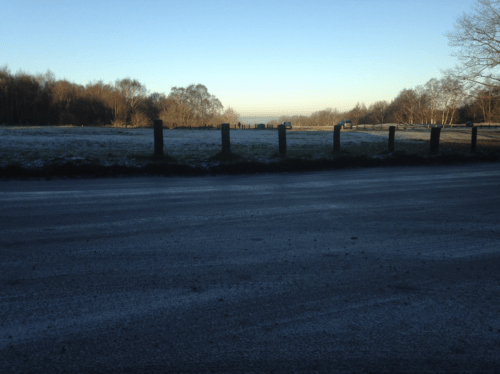
A frosty morning in Wanstead Park
It was a cold month, the mean temperature of 3.4C (1.8C below the 1981-2010 average) made it the coldest for seven years, marginally colder than the snowy January in 2013.
Though many days were dry it was also a wetter than average month with 71.5mm of precipitation recorded (134% of average) and the wettest for three years.
There were 73.8 hours of sunshine (147% of average) – the 10th equal sunniest January since 1797.
Cumulonimbus and hail were observed on 28th
The wettest day was on the 11th /12th when rain and snow associated with a LP centre that dived south-east dumped 19.7mm. This turned to snow though by 9am only 0.5cm lay in my garden. The warmest day occurred on the 11th with 10.9C recorded. The coldest maxima occurred just before obs time on the 26th when 0.6C was reached, narrowly missing an ice day. The lowest temperature occurred in the early hours of the 21st when -6.7C was recorded, the coldest minimum since January 2013.
The sunniest days were on the 18th, 20th and 21st when eight hours of sunshine were recorded.
Snow fell on 4 days and lay on 1 day. Air frosts: 14, Ground frosts: 19
Ice on the Heronry pond was quite thick at one point
So what has February got in store. Models on the 1st suggest that after a stormy start the weather will settle down with high pressure re-establishing itself on the continent. Operational runs suggest the position of this high will again draw in very cold upper air, heralding another cold spell that this time could be more unstable with snow – thanks to the position of the anticyclone being further north than it was in January. There are also suggestions that a sudden stratospheric warming event currently underway may also disrupt the polar vortex which *could* lead to any cold around mid-month being prolonged. It is a big if, however, and it is impossible to know the final position of any anticyclone: resultant weather could be fairly cold and benign or severe and snowy.
Just one morning had ‘snow lying’ at 9am on 12th
My method of prediction for the month as a whole gives very little information because January was unusually wet for a cold month. After this weekend’s unsettled spell perhaps February will continue in the same vein as January: 1-2C colder than normal but predominantly dry.
So, to sum up, we’re looking at a mean of 4C, rainfall: 15mm, sunshine: 60hrs.
My forecast last month was poor: predicted mean 4.4C (result 3.4C). Rainfall: 55mm (result 71.5 mm). Sunshine: 39hrs (result 73.8hrs)
Here follows the full weather diary for January…Full stats for the month here:http://1drv.ms/1rSfT7Y
1st: Cloudy start with rain pushing in from 1.30pm. A precipitous fall in temp about 2.15pm.
2nd: Sunny all day with just a few cumulus. Cold and frosty overnight.
3rd: Sunny, hazy start – the cloud building to 10.30am. Afternoon and evening felt cold.
4th: Cloudy and mild start. Brightness increased through the day though colder air arrived around dusk.
5th: Sunny, frosty start with a few clouds from time to time. The frost persisted all day on the grass.
6th: Sunny and cold start, frost lifted at 11am to leave mild-feeling early afternoon. Cloud thickened with rain arriving just before 4pm and lasting a couple of hours. Temp increased through the night.
7th: Cloudy and mild start.
8th: Cloudy and very misty on road to High Beach. Some bright spells from 10.30am. Clouding in again in the afternoon but mild.
9th: Cloudy, damp start with rain spreading in at midday then sporadically into the afternoon. Clear spells overnight.
10th: Cloudy start with odd brightness near noon.
11th: Sunny sart with just a few cumulus, this cumulus increased from time to time.
12th: Cloudy and cooler start. Started spitting at 11am before main rain arrived at noon – then rained through the afternoon and temp dropped. Reports of snow in Hampshire at 1650z. Snow in Aldersbrook at 6pm which gave a covering of icy snow and slush which lasted through until 9am on grass and cars. Just over 50% of grass covered.
13th: Bright start, snow flurries spreading in at 9.30am with heavier burst at 10.10am – snow lasted till around noon then was just cloudy – no further accumulation. Cold overnight though too much breeze for air frost.
14th: Cloudy start with some drizzle at noon. Clearing afternoon with early ground frost before turning cloudy at 1am with rain in the early hours.
15th: Light rain to start and falling on and off until 3pm.
16th: Light rain to start which went on into the morning thanks to a conveyor belt of rain – the result of being on the boundary of two air masses.
17th: Bright start with cloud and light frost, the cloud clearing with cold front off the continent. Cold, crisp afternoon followed with frost soon after dark.
18th: Sunny, very cold start with jet contrails across the sky. Sunny all day thereafter with frost after dark – not as cold as previous night – minimum was at 9am previous day.
19th: Sunny start with a few cirrus around that made for a spectacular dawn. Temp warmed up quicker than previous day with frost lifting. Cold again overnight though agitation of the lower layers prevented temp falling further than 4.1C.
20th: Sunny, very cold start with frost.
21st: Sunny, very cold start with sunshine all day, Frost lingering all day in the shade – the ground now rock hard. Coldest night since January 2013.
22nd: Sunny, very cold start with heavy frost. The frost lingered all day in the shade. Turning misty at dusk with dense patches of freezing fog developing. Another moderate frost with a 18-06 low of -4.8C.
23rd: Foggy start with dense, freezing patches on Wanstead Flats. Thinner in the village though still noticeable. The fog was present into Rush Green.
24th: Misty start with remnants of thick fog patches seen on the Flats. Thereafter sunny and pleasant in the sunshine.
25th: Foggy start though some lifted but still left misty morning. Feeling cold as wind increased. Some flurries of snow at 8.30am.
26th: Cloudy and cold, feeling raw in the wind with flurries of snow that settled on pavements in Wanstead. Cold and raw through the day with odd clear interval – temp rose to 0.2C just before dusk so no ice day. Sky cleared overnight with frost before cloud rolled in with odd flake of snow.
27th: Bright but with cloud thickening at 9.30am with moderate shower, then brighter. Sharp shower at 1510 with <5mm hail and fell at 20mm/hr. Some spectacular cumulonimbus.
28th: Cloudy start though with some brightness until 11am.
29th: Cloudy, quiet weather all day.
30th: Cloudy, uninspiring day. Some light rain at 2am.
31st: Cloudy with rain looking likely. Rain arrived in evening and fell intermittently through the night and after dawn.
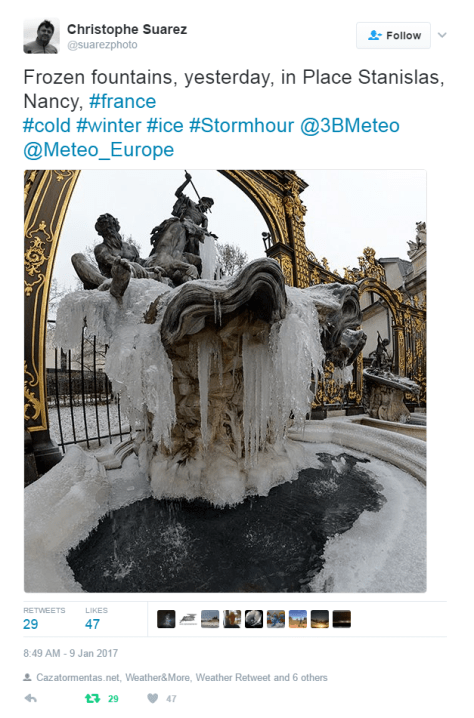
There were some notable weather tweets from around the UK.
It was also a month of extremes in Europe and elsewhere. Here are a few examples I tweeted throughout January.
Mammoth has recorded over 20ft of snow during January
December 2016 was the driest 12th month in over 80 years and the 5th driest in a record going back to 1797.
Christmas day was the second warmest on record in London
The total fall of 8.3mm is just 16 per cent of what normally falls in December, marginally more than December 1933. The mean temperature of 6.1C was 0.5C above average, though 4C colder than the record December last year.
There were 51hrs of sunshine, that’s 125 per cent of average.
The wettest day was on the 10th when 5.2mm of rain fell. The warmest day occurred on the 9th with 14.2C recorded. The lowest temperature occurred on the 28th when the spirit fell to -4C.
The sunniest days were on the 4th and 29th when seven hours of sunshine were recorded.
Air frosts: 8, Ground frosts: 14
Fog, frost and black ice all featured during December
Though January has started on the chilly side in the short term the weather will turn mild. Beyond that there is a suggestion that the weather could turn on the colder side of average with some models suggesting a cold snap with snow around mid-month.
My usual method of prediction to the end of the month has been scotched by the very dry December. The only years that were similar were both far colder than last month – the usual pattern of a dry month being cold or very cold was broken.
With the unprecedented warmth at the North Pole, last year’s odd behaviour of the QBO and a weak polar vortex we are in unprecedented territory in terms of what could happen later in January. My hunch, though, suggests the month will end up average to rather cold with little precipitation. Any cold spell with probably be the short-lived variety with a couple of inches of snow that lasts three days.
So, to sum up, we’re looking at a mean of 4.4C, rainfall: 55mm, sunshine: 39hrs.
In view of the above my forecast last month was very poor: predicted mean 4.4C (result 6.1C). Rainfall: 55mm (result 8mm). Sunshine: 39hrs (result 51hrs)
I have also published a winter forecast covering the London area that you can find here.
Here follows the full weather diary for December…Full stats for the month here:http://1drv.ms/1rSfT7Y
1st: Sunny start though the frost lifted readily into low cloud and mist to leave a chilly afternoon.
2nd: Cloudy, quiet and cool weather all day.
3rd: Cloudy and quiet all day. Feeling cold.
4th: Sunny , frosty start. Quickly warming up to leave sunny, cloudless afternoon.
5th: Sunny start, then patchy cloud – this thickening before becoming foggy overnight.
6th: Misty start after fog overnight. Cloudy most of the day though there was a brief clearance around midday.
7th: Cloudy most of the day though there was occasional brightness.
8th: Dull day though with a little limited brightness early afternoon.
9th: Cloudy but wth more brightness than yesterday. Very mild. Cloud thickened with light rain around 11am. This gradually grew heavier as the day progressed and was moderate overnight.
10th: Bright start and feeling mild, then cloudier and damp.
11th: Cloudy and dull all day.
12th: Dull all day with light rain early and late. Clearer spells overnight but overcast again by dawn.
13th: Dull with bits and pieces of drizzle up to 11.20am.
14th: Bright start with lots of cirrus and altocumulus – this gradually cleared to leave a warm and pleasant afternoon.
15th: Dull and cloudy with limited brightness.
16th: Dull and cloudy start.
17th: Foggy and dull all day.
18th: Misty start with fog above 90m on cycle ride. Then dull and grey all day. Mild.
19th: Dull and cloudy all day – some spots of drizzle.
2oth: Sunny start but clouded over late morning. Cloudy thereafter with some drizzle overnight.
21st: Cloudy start then sunny. Cloud returned and turned dull and dreary in the afternoon with odd drizzle.
22nd: Bright, misty start
23rd: Cloudy start with breeze beginning to build as a result of Storm Barbera.
24th: Cloudy and dull all day. Very mild. Temp increasing overnight with approach of warm front .
25th: Cloudy, breezy start. Remained dull all day though brightness was seen over the Thames and North Downs, disrupting the SW’ly flow.
26th: Sunny, hazy start and turning colder.
27th: Sunny, frosty start, the air pressure record of 2012 has been broken.
28th: Foggy start, the fog persisting to late morning before sun broke through leaving a chilly afternoon. Frost returned quickly after dark, a clear night.
29th: Sunny and very cold and frosty start. Frost returning after dark with fog forming in the early hours.
30th: Foggy and dull all day, the fog thickening up at nightfall. Approaching cloud lifted the fog and temperature.
31st: Dull and overcast to start – this sticking around all day.
I remember the January 1987 spell like it was yesterday. I’d arranged to stay with my aunt and uncle in a rural part of south Essex. The forecast by Ian McCaskill on the Friday night was for a cold weekend with possible snow flurries near the coast. ‘That’ll do’, I thought.
The upper air on 13th January 1987 was extremely cold. I don’t think it has been as cold since
I caught a mid-morning train from Romford on the Saturday morning. As I disembarked at Rayleigh I was shocked by how cold it seemed to have turned. The wait at the bus stop was made worse as my uncle was delayed in picking me up; a black leather jacket I was wearing at the time was totally inadequate.
No matter, though, as I was soon warmed up on reaching my aunt’s house, helped further by hearty home cooking. Saturday was spent driving round rural Essex: my uncle knew a few farmers and was a keen rambler. We walked a circuit around Hanningfield reservoir.
I think we watched Back to the Future that night. By the time I went to bed I remember there was a dusting of snow on the ground. For some reason I kept waking up, each time looking outside to see the build-up of snow.
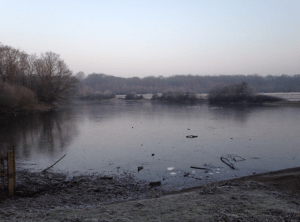
There was around four inches by morning and, after breakfast, I went with my uncle for a drive around the same rural spots as Saturday. The reservoir was beginning to ice over and I remember my uncle reading a Fahrenheit thermometer and saying that it was “seven degrees of frost”.
When I left Rayleigh that evening the snow was falling thick and fast and the train seemed to be travelling slower than usual. When it failed to move from Shenfield station after 10 minutes I knew something was up; the guard announced that the wheels had frozen to the tracks. Everyone disembarked and caught another. After leaving Shenfield I noticed that the snow cover gradually decreased, with just an icing-sugar like covering in Romford.
My dismay at having left a winter wonderland in Rayleigh disappeared on waking up on the Monday morning and seeing a good few inches had fallen.
BBC Breakfast presenters gravely told us how bad things were. The Isle of Sheppey was cut off and train services were severely affected – I didn’t go to school once that week because the toilets were frozen. For once the conditions, reflected in this footage from Thames News, matched the hype.
East London: Ben Bacarisse was living in Mile End in 1987. He said: “I was living on the 15th floor of a tower block at the time. The prolonged cold caused the main water riser into the block to freeze so no one in nearly 400 flats (there were a pair of blocks) had running
water. It turned out to be possible to tap into the larger street main
with a stand-pipe.
Presumably the constant use kept it running though
I’d have thought it would have to be removed at night. I don’t recall
how long that lasted but it was more than a couple of days.”
Home Counties: George Booth, who was living in Epping, Essex, at the time, explained how the weather affected him: “On the Monday (12/1/87) I accompanied a group of young scholars to the Science Museum. Despite the cold and snow they were happy to walk to the station (and they behaved themselves). It was a strange sight to see
Exhibition Road covered in that thick brownish frozen dust which occurs
when temperatures are presumably too low for treatment to be effective.
Not so good news for the school roof, however. It eventually had to be
replaced after a water tank/pipe burst after a thaw.”
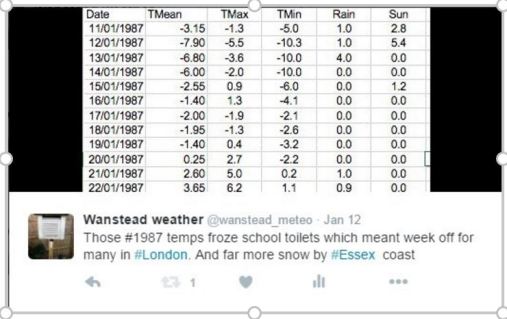
George, who ran a weather station in Epping, added: “On 12/1/87 the maximum temperature in Epping was -8.0c and the minimum was -10.0C. The ‘snow depth gradient’ was very steep NW-SE with SE Essex/E London and N Kent receiving much greater falls than places like Epping. However, it was the severe frost that caused many
problems, particularly in older buildings.”
Dave Cornwell, a retired scientist, from Laindon, Essex, said: “I was working as an operational scientist at a sewage treatment plant in Rainham , Essex. (London Borough of Havering, (just east of London). I remember it well because for the first time anyone could remember the sewage was freezing on entering the works through the screening bars, bearing in mind that sewage is flowing underground and starting off quite warm, usually in winter arriving at about 10-12C.
“It was a major engineering problem because the heat was being conducted away by the metal bars and ice building up and blocking the flow. This could potentially have caused backing up of millions of gallons of raw sewage. A smart engineer made some improvised electrical heaters to fit on the bars and we hired massive tarpaulins to put on the north side to try and cut down the wind chill. It worked a bit till the weather turned. I remember taking the temperature at 9.30 am and seem to recall it was -9.0C.”
The record cold spell also saw Steve ‘Silk’ Hurley’s Jack Your Body enter the charts at Number 2, a track that more or less launched the UK dance music scene
John Hall, from Cranleigh, Surrey, said: “We had a little snow on the Monday, I think it was, but it didn’t amount to much. We had to wait for overnight Tuesday/Wednesday for serious snow, but then it certainly made up for lost time. On
Wednesday morning, the gritters must have done a remarkable job on the
roads, as traffic was moving – if slowly – on the B road that runs
through Cranleigh, and I was able to make the 8-mile journey to
Guildford Station.
“But at the station, a railwayman was standing by the entrance
telling everyone: ‘There are no trains. We don’t know when there will be
any trains. We advise you to go home.’ I managed to get a bus back to
Cranleigh, by which time the snow had just about stopped.
“I didn’t measure the depth of the snow, but my subjective impression that Wednesday morning was that it was almost a foot (30 cm) deep. The wind wasn’t strong enough to cause too much drifting that day, but the following day it became pretty strong, and there was considerable drifting of the powdery snow, with some susceptible local roads becoming blocked. In this southern lowland region I can’t remember another such instance of this ‘delayed drifting’.”
Tudor Hughes, had the added altitude (165m) of Warlingham, Surrey, that made the cold spell even more memorable. “It was just about the most outstanding weather event for me. The 12th was a sunny day with a light NE’ly and a few inches of lying snow and the temperature just wouldn’t rise.
“After a min of -12°C it got up to -9.2°C (12-hr max) which I think is a COL record though obviously not a UK one. The 24-hr max was -8.9°C, agreeing with the reading from Coulsdon (Ian Currie).
“In the evening some smoky-looking stratus appeared and snow fell from cloud so thin that the moon was visible. It snowed intermittently for a further 2 days until the level depth was 39 cm. At the top of the North Downs (Tatsfield) the depth was about 3 times that.”
Tudor added: “The temperature was below -5°C for about 40 hours and below 0°C for eleven days. I whacked up the heating and opened the loft door. A burst pipe and frozen tank is the last thing you want.
“The extraordinary thing about January 12th was the lapse rate. This was no cold inversion – the higher you were the colder it was. I reckon the maximum at the top of the Downs (877 ft) was -10°C. There was some relatively warmer air above 700 mb but even so the 1000-500 mb thickness was 498 dam. Not quite the purple line but well inside the brown one.”
Unlike some cold spells the severe weather was not restricted to the SE corner of England.
The South West: Len Wood, from Wembury, southwest Devon, said: “Even here on the coast this was the coldest spell I experienced since moving here in 1983. We had four successive ice days and my record min of -10.1C was recorded which still stands.
“With quite a biting easterly wind it was hard to keep our bungalow warm.
Cold was coming up through the floors so I blocked the air bricks and we covered the floors with anything we had handy, old carpet, blankets…
“I remember another effect of the extreme cold was to make all the leaves turn black on the privet hedge down the length of our garden. They subsequently fell off. The hedge did recover the next summer though.”
There is a study of the heavy coastal snowfall of January 11-13 by W.S.Pike here.
Some more charts from Smartie on the Google Group Weather and Climate…
2m temperature and snow depth at 12 UTC 12 January 1987 from a downscaled simulation of 10-13 Jan 1987. The ERA Interim reanalysis was used as initial and boundary conditions. Contours of physical snow depth start at 2.5 cm every 2.5cm.
The main convergence zones appear quite well resolved at DX ~12km
This is the first downscaling grid. It has the latest ‘scale-aware’ convection scheme from WRF (Multi-scale Kain-Fritsch). The deep and shallow components should both be active (haven’t confirmed this).
Hourly output from this is used to initialise nested 6 and 2km grids. On the 6km grid the deep convection should be almost off and shallow convection still active.
On the 2km grid there is no Cu scheme ie. it’s ‘convection permitting’ in the jargon.
The plots can be compared with the letter by Lumb (Weather, 1988,, V43, 31).




 3rd: Cloudy but with bright breaks and blue sky in distance.
 13th: Cloudy though high base made it seem bright. Feeling chilly. A shower overnight.








 There was around four inches by morning and, after breakfast, I went with my uncle for a drive around the same rural spots as Saturday. The reservoir was beginning to ice over and I remember my uncle reading a Fahrenheit thermometer and saying that it was “seven degrees of frost”.

 George, who ran a
  “It was a major engineering problem because the heat was being conducted away by the metal bars and ice building up and blocking the flow. This could potentially have caused backing up of millions of gallons of raw sewage. A smart engineer made some improvised electrical heaters to fit on the bars and we hired massive tarpaulins to put on the north side to try and cut down the wind chill. It worked a bit till the weather turned. I remember taking the temperature at 9.30 am and seem to recall it was -9.0C.”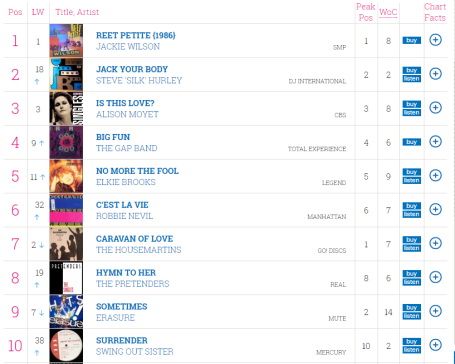


 Wanstead Meteo
You must be logged in to post a comment.