The 8th and 9th of August 2017 has produced probably the most miserable weather of this summer.
A rainfall event that began just after 8am on the 9th deposited nearly 36mm of rain in the Wanstead area over 14 hours.
The 09-09 total of 33.7mm made it the fourth greatest daily August rainfall since 1960.
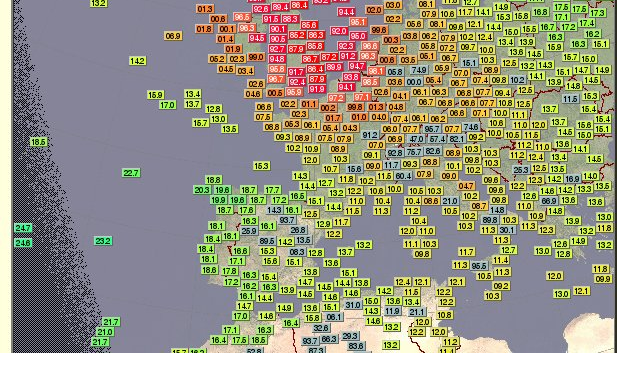
The heaviest rain fell in a fairly narrow band, as shown by the official 24hr totals on ogimet.com. The low pressure system also produced a lot of rain for the east coast in the previous 24hrs with Bridlington recording over 56mm.
The rain brings the summer total to 207.7mm, just 0.6mm short of the amount recorded in 1997. Though it has been wet it is still a long way short of the wettest summer on record: some 391mm were recorded here in 1903.
In terms of temperature it has been a chilly start to August; the mean temp currently stands 1.2C below the whole month average. Considering CET it has been the coldest start to the month for 30 years.
July 2017 was the wettest since 1960. Some 92.3mm of rain were recorded which is 212 per cent of the 1981-2010 average.
Although the opening third of the month saw a continuation of the June heatwave temperatures gradually returned to normal values to leave the mean for the month at 19.2C, that’s 0.7C above average.
With all the rain sunshine totals were down. Some 167 hours were recorded, that’s 87% of average.
Though the rainfall total was impressive it is well short of the record of 164.2mm set in 1834, and is only 35th in the list going back to 1797.
Summary for July 2017
Temperature (°C):
Mean (1 minute) 18.9
Mean (min+max) 19.2
Mean Minimum 14.7
Mean Maximum 23.7
Minimum 9.4 day 12
Maximum 30.5 day 07
Highest Minimum 18.3 day 06
Lowest Maximum 19.0 day 24
Air frosts 0
Rainfall (mm):
Total for month 92.3
Wettest day 30.8 day 11
High rain rate 56.4 day 29
Rain days 10
Dry days 21
Wind (mph):
Highest Gust 17.4 day 27
Average Speed 2.9
Wind Run 2163.5 miles
Gale days 0
Pressure (mb):
Maximum 1024.2 day 16
Minimum 996.8 day 31
Total hours of sunshine 167
In terms of the rest of the summer a look at the ECMWF control run out to 10 days suggests an unsettled start to August with the jetstream centred right over the top of the UK. Things may improve as the Azores high attempts to exert more influence – so perhaps more in the way of sunshine than of late. In terms of heatwaves it is impossible to tell at this range.
Here follows the full weather diary for July. To view full stats follow this link:http://1drv.ms/1kiTuzv
1st: Cloudy but with sunny spells developing, these growing longer in length by evening.
2nd: Sunny with just a few light cumulus.
3rd: Sunny start though with plenty of cloud around, this tending to thicken after lunch with odd spot of rain.
4th: Sunny and very warm early then tended to cloud over before sun returned in the late afternoon and evening. Some very unstable low to mid level cloud.
5th: Sunny with just a few cirro-cumulus. Feeling very warm with cloud bubbling up in the evening, however forecast storms failed to materialise.
6th: Sunny with cirrus and dotted cumulus. This tended to thicken late morning though sun stayed out and became hot and humid.
7th: Sunny with lots of high-level cirrus and cumulus most of the day.
8th: Bright but mostly cloudy start, the cloud tending to vary through the day. Sunny after 4pm. Warm overnight.
9th: Bright but mostly cloudy start, the cloud tending to break and vary through the day.
10th: A mostly sunny morning and lunchtime until 2pm when it clouded over.
11th: Cloudy with some bright breaks at first. Cloud thickening with rain by noon, this falling sporadically before getting going after 5pm and stopping by 3am.
12th: Cloudy, damp and close start.
13th: Sunny with variable cloud until noon when there were just bright spells.
14th: Cloudy but with a few breaks around mid morning. Turning cloudy again before sunny spells in the evening.
15th: Cloudy with some sporadic rain as warm front blew through and close. Very limited brightness.
16th: Cloudy with some bright spells. Feeling warm and humid.
17th:Sunny with just a few cirrus drifting around. Feeling hot, cloud thickened from the west in the late afternoon.
18th: Sunny with variable cirrus and cirro cumulus through the day. Feeling very warm. Storms began building with supercell to west of London and over Chilterns.
19th: Cloudy, dull start and very humid with heavy mist – the cloud tended to lift to give sunny spells in the afternoon.
20th: Drizzle after shower before obs time, then showers through to 1pm.
21st: Cloudy start but with sunny spells developing. Clouded over in evening with intermittent heavy rain at 11pm and through the early hours.
22nd: Cloudy but with sunny intervals developing around noon. Heavy showers developing with thunder at 2.30pm and 3.07pm.
23rd: Bright with variable cloud
24th: Cloudy with light, showery rain from northerly airstream that originated in the Med.
25th: Cloudy with light rain just after obs time.
26th: Cloudy with occasionally rain. Feeling warm and a late clearance. Breezy and chilly overnight.
27th: Cloudy but bright and sunny spells developing. A very heavy shower at 1pm.
28th: Bright start but clouding over.
29th: Sunny start with cloud increasing after noon to leave overcast before patchy rain moved in. This falling more heavily at 5pm before clearing to further showers. More rain overnight before a strong squall arrived at 2.45am and lasted an hour with further bursts of rain through the night – two claps of thunder and lightening during squall.
30th: Sunny with variable cloud through the day. Very warm in the sunshine
31st: Sunny with variable cloud throughout the day.
I’ve seen this phrase uttered more than once over the past couple of days thanks to high temperatures and humidity. But ask anyone to define a hot day and you’ll get a different answer every time.
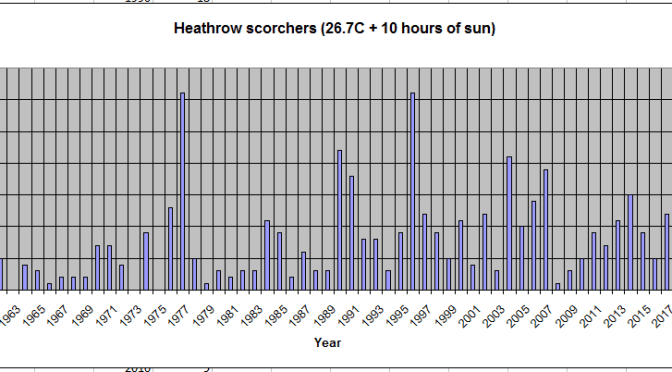
Growing up in the 1970s / 80s redtop newspapers would use the phrase once the mercury was nudging 80F (26.7C). But to ‘scorch’ you need sunshine, preferably at least 10 hours of it. Considering statistics from the Heathrow airport climate station in west London there have been 463 scorchers since 1959, the most recent happening on July 5th with 29.5C recorded and 13.9 hours of sunshine. There have now been 9 scorchers this year, already matching the number that were recorded in 2014 and only 3 short of last year.
But even with last month’s heatwave this year has some way to go, however, to match the amount measured in 1976 and 1995: 31 days!
June 2017 has been a month of real contrasts. A thundery deluge on the 2nd was followed by conditions typically brought by the European monsoon.
24hr rainfall totals
Warm weather followed in the second week before a full-blown heatwave arrived bringing the hottest June spell since 1976.
The mean temperature for the month finished at 18.9C, that’s 2.8C above average. It was the second warmest June in a local record going back to 1797. Though it was only 0.4C cooler than 1976 it was also much wetter than that very dry month.
Though it appeared a wet month, over two-thirds of the recorded rain fell in two episodes.
Sunshine for the month was 202.3hrs, 114% of average.
In terms of the rest of the summer you would be forgiven for thinking that we have already had more than our fair share of good weather. One way of looking at it is to count the number of days the mercury rises above 25C with 10 hrs of sunshine. Since May that has happened on 13 occasions – far higher than anything in the past four years.
It will be interesting to see if July and August, normally the months where we get most of our summery weather are as good as June.
Summary for June 2017
Temperature (°C):
Mean (min+max) 18.9
Mean Minimum 13.8
Mean Maximum 23.9
Minimum 9.9 day 12
Maximum 31.5 day 21
Highest Minimum 21.1 day 21
Lowest Maximum 16.7 day 28
Air frosts 0
Rainfall (mm):
Total for month 71.1 (138.9%)
Wettest day 31.2 day 02
High rain rate 108.4 day 02
Rain days 8
Dry days 22
Wind (mph):
Highest Gust 27.3 day 05
Average Speed 3.5
Wind Run 2550.5 miles
Gale days 1
Pressure (mb):
Maximum 1025.0 day 16
Minimum 984.2 day 05
Total hours of sunshine 202.3
Here follows the full weather diary for June. To view full stats follow this link:http://1drv.ms/1kiTuzv
1st: Sunny with scattered cumulus through the morning, the cloud thicker during the day.
2nd: Cloudy start though brightening up with long sunny spells. Cloud bubbled up and a heavy thunderstorm moved in at 3.15pm and lasted an hour. Sunny again by 6pm.
3rd: Bright start with decreasing cloud.
4th: Sunny start though cloud bubbling up late morning into early afternoon. Cloudy and breezy with a few spots of rain at dusk.
5th: Cloudy and very breezy start. Bright at times.
6th: Rain and very windy to start with gale force 9 in Channel. Rain lasted into the early afternoon before clearing to bright spells. Odd shower overnight but remained blustery with a few trees down. Flowering cherry fell at mum’s at 6.30pm.
7th: Sunny with long sunny spells. An area of rain after dark then overcast through the night.
8th: Cloudy and breezy, a shower at noon and some bright spells at 1pm.
9th: Sunny though breezy with lots of cloud. Spots of rain in the wind.
10th: Sunny and warm start with lots of sunshine. Very breezy.
11h: Sunny and feeling very humid but breezy. Alternating between very warm sunshine and cloud. Very brief few drops of rain at dusk then mostly cloudy night.
12th: Sunny periods throughout the day. Cloudier at times. Clear overnight with warm, sunny start.
13th: Sunny, clear start and feeling warm early.
14th: Sunny most of the day with odd cumulus. Very warm though turning a bit fresher overnight.
15th: Sunny morning though with more cloud than yesterday. A fresh breeze developing.
16th: Sunny with variable cloud. Warm.
17th: Sunny though lots of hazy cumulus.
18th: Sunny though much cloud amid the humidity. Felt airless with only limited breeze. Oppressive overnight.
19th: Sunny with cloud decreasing
20th: Bright start though cloud breaking at 11am to leave clear afternoon with just a couple of cumulus.
21st: Sunny and hot all day with patchy cirrus. Warmest June day since 1976 at Heathrow 33.9C. Warm overnight but more of a breeze. Sunny early.
22nd: Very brief rain shower at obs time then sunny intervals. Cooler but still humid. Very breezy overnight.
23rd: Long sunny spells with hazy cumulus. Although cooler still hot in the sunshine. Cooler overnight and breezy.
24th: Mostly cloudy though bright. A sharp shower in the evening.
25th: Bright though mostly cloudy. A couple of bursts of drizzle but then sunny spells late evening.
26th: Sunny with lots of cirrus, cirrocumlus and a fallstreak hole in the sky. Warm but low humidity.
27th Sunny start though sun becoming scarce. Patchy light rain at 10.30am and thunder then a heavy shower at 3.45pm. Rain in the evening that lasted into the early hours.
28th: Cloudy and very dull at times with very light drizzle. Humid.
29th: Cloudy though bright with some sunny intervals.
30th Sunny though with lots of cloud. Decreasing cloud in the afternoon and a pleasant evening.
Heatwave hype has been building over the past few days and, for once, the media has been justified in its coverage of the current spell.
Temperatures over the past few days have been enough for the Met Office to trigger its Heath-Health Watch whereby the mean temperature (an average of the maximum and minimum) for two consecutive days reaches 23.5C.
A couple of years ago I compiled a list of heatwaves for this area back to 1852 where the mean temperature reaches at least 23.5C three days running. This spell, the only other June heatwave (the other being 1976!), only just scrapes into the list.
Although it felt hot this spell, in terms of Premier League quality, was more Middlesbrough than Chelsea.
Forecasters say today is likely to be the hottest June day for 40 years though I’d be surprised if we exceed the 34.2C recorded on June 27th 2011. It would be the fifth day running that 30C has been reached in this area, enough to fulfil the World Meteorological Organisation’s (WMO) definition of a heatwave.
Whatever happens today the fact that the heat has been produced by a tropical maritime airmass is remarkable. With France and Spain recording some very high temperatures of late the same pattern in July and August could put more records at risk of being broken.
This week marks the 41st anniversary of the start of probably the finest British summer in history, but anyone hoping that yet another parallel with the 1970s is about to come true should take a look at the latest model runs.
The latest GFS operational run suggests a much cooler, more unsettled end to June – a polar opposite of 1976…
Widespread heavy rain and gales across the UK have made the start of summer feel very unseasonal. But the conditions, which follow an extended period of mostly dry weather, are very typical for early June.
The pattern for June over the past 10 years reveals the month often starts unsettled before drying up in the final week
The ‘NW European monsoon’ is one of the most reliable ‘singularities’ on the annual weather calendar. Though it sounds very unscientific that the atmosphere can remember how it behaved on a certain date in previous years much statistical work over the past 170 years highlight tendencies for unusual weather at particular times of the year. These tendencies were first identified by the German climatologist, A.Schmauss, in 1938.
While the pattern isn’t set in stone statistics show that the probability of the euro monsoon occurring between June 1st and 21st is 77 per cent.
The GFS operational run suggests an unsettled outlook
24hr rainfall totals
Depression across the UK
One of the most notable inclement spells of weather in June happened during the D-Day landings in 1944.
0100 June 5 1944
12 June 6 2017
With the changes in ice at the North and South Poles, together with the massive positive temperature anomalies last winter, it would be thought logical that this would have some bearing on the general pattern this year. But polar ice is only one variable to consider when trying to predict the world’s climate.
The dry nature of spring this year has scuppered a large part of my usual method of trying to predict the summer season.
With El Nino forecast to be neutral I decided to once again rely on pattern matching of meteorological data from this area for March, April and May stretching back to 1797.
The mean for the spring season, the second warmest on record, was 11.9C with 88.6mm of rain and 430.3 hours of sunshine.
If you take into account all years that were within +/- 10 per cent of these figures, for rainfall some 12 ‘best fit’ years emerge. I normally go on to reduce the list further by considering mean temperature but, this year, no figures would remain!
The list of 12 summers, ranging from 1807 through to 2005, saw all manner of summers, including 1808 when early July heat gave way to fierce thunderstorms with hail the size of tennis balls recorded. Only one was a real corker, 1906, but most were fairly nondescript.
As an average this summer could be expressed as: Mean: 17.2C (just below average) Rainfall: 141mm (about average).
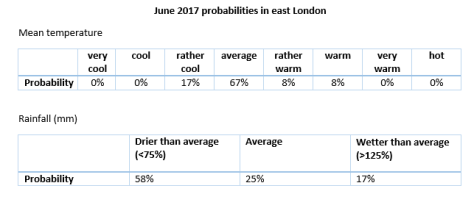
Or, expressed in probabilities, I concluded the following:
From the above you could deduce that the next three months will be around average, with average rainfall.
To try to give some idea of what month will have the best weather I’ve broken down the summer into June, July and August probabilities.
Looking at June, considering the unsettled outlook after the weekend, I would guess that a few very warm, thundery spells are possible– though much of any precipitation will stay to our west.
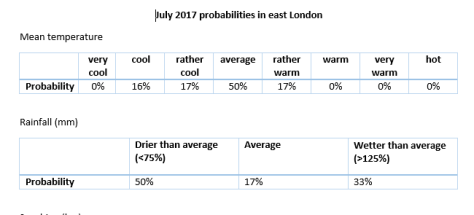
On to July. After an average June I wonder if the ‘return of the westerlies’ will happen just in time to affect this month?
The above chart would suggest that July will be classically average overall. Fine, not too hot spells, with occasional depressions bringing cooler weather and showers.
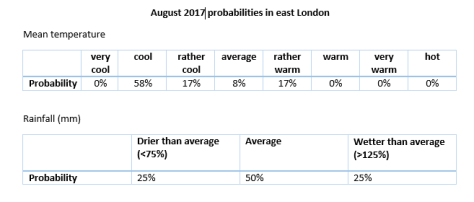
On to August. Apart from last year this month has been a real disappointment the previous few years. Looking at the probabilities would suggest that August will be the most disappointing month.
Looking at the above probabilities there seems a fair chance of something cooler than average.
There’s not really much to go on. I note the Met Office is going for ‘warmer than average’ but a look at their methodology and the coming season doesn’t look that exciting.
* Taking into account the fact that temperatures in London are up to 0.66C warmer than they were 100 years ago I have added 0.66C to mean temperatures before 1915.
** Obviously, in the event of a series of direct hits from thunderstorms, my rainfall estimate could be hopelessly short – a symptom of abundant solar energy at this time of year which creates a ‘noisy’ atmosphere compared with winter.
*** The 1981-2010 average mean for summer in this region is 17.6C, with 144.9mm of rain and 564 hours of sunshine
Lack of rainfall and a broken pump have been cited by City of London Corporation as the main reason for the shocking levels of the ponds through the park.
The Ornamental Water by the Grotto is virtually dry. Images courtesy of Ralph Potter
The plight of the water courses has been well documented of late; a press release from the Corporation explains the catalogue of issues hampering efforts to address the problem. Closer scrutiny of these reasons, however, suggest that too much is being blamed on the weather.
A study of local rainfall back to 1981 suggests that though the ground water replenishing season (October 1st – April 24th) has been dry it is by no means out of the ordinary.
As you can see from the graph the rainfall here has gone up and down like a yo-yo and 2016-17 is only the fourth driest period: 1991-92, 1995-96, 1996-97 and 2011-12 were drier.
The Corporation’s press release states: “2015-16 was a helpfully wet period for us…”
Wrong. 2015-16 was average. And if you consider annual rainfall 2015 saw 92 per cent of average rainfall recorded; 2016 was 93 per cent – placing 58th and 66th in driest years since 1797. Nothing out of the ordinary.
“2016-17 has, however, been an especially dry period with below average rainfall since Spring 2016.”
Wrong. See above detail. There have been three drier periods since 1981. And since March 2016, only half of the months have been notably dry, a period that included the third wettest June since 1797.
“January to March 2017 has seen roughly 50% less rainfall than average”
Wrong. January to March rainfall was 94% of the 1981-2010 average
April has been dry, and could be among the top 5 driest back to 1797, but it seems the Corporation are trying to blame nature instead of years of neglect on their part.
The past months have seen much of Heronry Pond dry out. Image by Ralph Potter
The situation is in stark contrast to CoL’s other open space, Hampstead Heath, which has recently seen the completion of a £23m project to make safe the ponds there. CoL has deep pockets yet they have dithered for years over spending £25,000 to renovate the Coronation Bridge – and offer the people of Ilford a route into the park.
Figures released by CoL show it has only invested £1.23m in Wanstead Park over the last five years, compared with £50m spent in Hampstead Heath.
We are constantly told that problems in the park are ‘in hand’ yet progress on anything is painfully slow – and action to repair the pump has sadly come too late for much of the wildlife on Heronry Pond.
People from far and wide use Wanstead Park – they really deserve better!
You can view City of London Corporation’s press release here
The mean temperature in March 2017 was the mildest in a local record going back to 1797.
A complete absence of air frost was mirrored in the mean which finished 10.5C, 2.8C above average and 0.3C higher than the previous record set in 1997.
The record temperature was probably down to notably mild air masses through the month as the total sunshine hours were about average, 107.2 hours is 99% of the 1981-2010 average.
The warmest day occured on the 30th with a high of 21.6°C in Wanstead, the warmest March day for 5 years.
Rainfall was very sparse, just 21.3mm were recorded, that’s 52% of average – a pattern that seems to be becoming more frequent; four of the last six Marches have been notably dry.
Sunshine was average. Over 107.2 hours were recorded, 99% of what we can expect to see during an average March.
The wettest day occurred on the 22nd with 5.8mm.
Air frosts: 0, Ground frosts: 1
Here follows the full weather diary for March. To view full stats follow this link:http://1drv.ms/1kiTuzv
1st: Sunny start, the sky gradually filling in with light rain at 3pm and into the evening. A windy night.
2nd: Sunny and blustery start, clouding over with some light rain in afternoon / evening. Drier overnight before area of light rain moved in at 0730z.
3rd: Cloudy start with light rain late morning. Feeling cold.
4th: Cold and cloudy with brief showers in the afternoon and overnight.
5th: Light rain at 9am and during the morning, briefly clearing at 10.30am before heavy showers moved in through the afternoon. Some warm sunny intervals in between. Showers into the evening until 10pm.
6th: Sunny start with just a few clouds around.
7th: Bright start with decreasing cloud to leave sunny late morning. Variable cloud through the afternoon. Rain at 00.50 until 0144.
8th: Light rain between 9 and 11am then showery though mostly light. Mild.
9th Sunny start though tending to cloud in late afternoon. Feeling mild.
10th: Cloudy with a burst of light rain at 10.30am.
11th: Bright, hazy start and feeling mild. Very quiet weather – pleasant in the garden.
12th: Cloudy with drizzle early afternoon
13th: Sunny start with a few cirrus, cloud gradually increasing but staying mostly sunny.
14th: Cloudy, mild and boring start – boring and cloudy all day.
15th: Misty start, quickly clearing to leave a glorious sunny day and pleasant.
16th: Sunny and clear up to 12 noon, then haze and cumulus pushing in and gradually thickening up. Light drizzle between midnight and early hours as cold front pushed through.
17th: Sunny but hazy start, this haze thickening through the morning. Feeling noticeably colder with patchy drizzle – felt quite inclement in the evening.
18th: Bright and breezy start. Then mostly cloudy with odd patch of drizzle.
19th: Cloudy, breezy with odd drizzle patch. Sunny intervals late morning and into the afternoon before clouding over in evening. Moderate rain at 1am.
20th: Cloudy and breezy start. Heavy showers spreading in with brief stair rods at 3pm, then clear and much cooler overnight.
21st: Sunny with well scattered cumulus.
22nd: Cloudy, dull and feeling cold in the wind. Showery rain, this turning heavier into the evening and to 1am.
23rd: Cloudy and breezy, some sun mid afternoon which felt warm.
24th: Cloudy, chilly and windy morning.
25th: Sunny and clear but with bracing easterly wind – pleasant outside the wind in the sun.
26th: Sunny and much more pleasant than yesterday with lighter wind.
27th: Cloudy and cold to start, the cloud breaking to long sunny periods that led to a pleasant afternoon. Cloudier overnight with cloudy, chilly dawn.
28th: Sunny, gin clear start. Cloud began building after noon with sun becoming ever more scarce. Light rain late evening and overnight.
29th: Cloudy and mild
30th: Sunny, though hazy start with lots of alto cumulus
31st: Cloudy and dull with brief drizzle at 9.30am. Cloud slightly less heavy at noon.
The period after the vernal equinox in 1952 was anything but springlike.
This chart shows the Synoptic setup at 1800h on 29th, the peak of the blizzard with F5 – F6 easterly winds, courtesy of the Met Office
A cold easterly airflow on March 29th and 30th 1952 affecting the southern half of England brought heavy snow whipped into drifts up to 6ft deep in parts of the Chilterns.
According to the Royal Meteorological Society’s weather log the snow varied from 3 to 6 inches and reached 10 inches at Northolt.
Squally winds, which gusted to 60 mph, blocked 330 main roads across the south. In places the temperature on the 29th remained below freezing all day – the snowstorm was probably the worst to affect southern England in late March since 1916.
The wintry weather followed a dry and fairly non-descript winter and must have been quite a shock at the end of what had been a fairly mild March.
Bernard Burton, of Wokingham, has a clear recollection of the event: “I remember the day very well as the Oxford/Cambridge boat race was held that afternoon. I was 14 at the time, and my brother-in-law gave me a ticket for a place on a launch to watch the race.
“My home was in Tooting at the time, and I took the bus to Westminster pier to catch the launch. I recall sitting upstairs on the bus with a thick layer of snow covering the front facing windows, but the roads and pavements were mainly slushy.”
Bernard, who runs Wokingham Weather, added: “I then spent one of the most miserable afternoons I can recall. There was a ‘lounge’ on the boat, which was warm, but was also full of diesel fumes and was very noisy. I alternately stood outside on the deck until the cold got too much, or went below for warmth until the fumes got the better of me.
“I recall bleak views of London with snow on roofs, in a poor grey afternoon light, but I think it was mainly dry at that time, although there may have been slight sleety rain.
“The boat race itself was a close one, but the crowds that usually lined the banks of the river were absent, just a few hardy stragglers, and by the time of the race I had a headache, probably brought on by the fumes. For my part, I couldn’t wait to get back to Westminster and back home to thaw out.”
John Hall, who was three at the time, said: ” I, sadly, don’t have any memory of it at all. That’s in spite of the fact that we apparently moved house from Cranleigh to Effingham (about 15 miles away) on the day of the blizzard.
“According to my father it snowed all day but the following day – which he reckoned was the 1st of April – the weather was glorious and all the snow was gone by noon. I don’t think his memory is quite in accordance with the facts, but of course that’s common with memories of past weather.”
The snow didn’t last long. March 31st saw temps rise to 5C; much of the snow had melted in the strong spring sunshine by April 1st. By the 3rd an Atlantic ridge of high pressure had moved in, raising temperatures to over 10C.
Stats for Kew suggest there was 21cm of level snow
1952 produced two more weather shocks. On August 15th and 16th over 220mm of rain fell on the hills above Lynmouth, Devon, leading to flash flooding of the village and the loss of 34 lives.
Months later, a large anticyclone during the last of five days of December produced the notorious ‘pea souper’ fog that contributed to the death of thousands of Londoners. This fog, initially freezing, became very dense and was directly responsible for the Clean Air Act enabled in 1956.
You can find an analysis of the unfolding pattern that produced the blizzard here. And here’s Xmetman’s take on the event.
You must be logged in to post a comment.