Tag Archives: snow

200 years ago: the last Thames Frost Fair

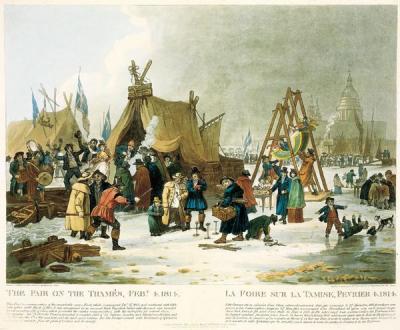
The Frost Fair of 1814 on the River Thames in London. Painting by Luke Clenell, entitled The Fair on the Thames, February 4th 1814

It is 200 years ago this month that London enjoyed its last frost fair.

Weeks of hard frost from the day after Boxing Day was enough to freeze the river between the old London Bridge and Blackfriars, enabling dozens of opportunist London traders to set up stalls and booths selling souvenirs, drinks and food.

Unlicensed gambling, drinking and dancing was the order of the day for those brave enough to venture on to the ice. A sheep was roasted on the ice with the public charged to look at it, and charged again for a slice of “Lapland mutton”. At one point an elephant was led across the ice at Blackfriars.

The ice was however, not very stable. Boatmen deprived of an income charged visitors a penny to cross planks to get on to the ice. They were on hand to rescue two women who fell through, although a plumber carrying lead was not so lucky.

Though changes to the flow of the Thames has vastly reduced any chance of a frost fair being repeated I’ve often wondered what the day to day climate would have to be like to freeze the Thames as it did in 1814.

Luke Howard’s Climate of London provided a starting point. His pioneering measurements of the atmosphere taken outside his laboratory by the River Lea in Stratford, though not as accurate as today’s readings, provide an excellent insight into just how cold the season was.

Winter 1813/14 and 1962/63
This line chart shows that the winters of 1813/14 and 1962/63 bore some resemblance

I was surprised to find that the stats compare well with the winter of 1962/63 – the coldest winter in recent memory. Obviously Howard’s readings would not have been as accurate as today’s – his thermometers were initially suspended in a laurel bush to shield solar radiation – but they would still have been close.

I have converted his readings  in Fahrenheit to Celsius and plotted them on a spreadsheet here. As well as records of temperature, wind, rain and moon phase Howard also included any notable weather events in his diaries from both home and abroad.

The winter of 1813/14 started mild. On December 16th he noted that “bees quit the hive in unusual numbers for the season”. During the following days up to Christmas Day wind and rain alternated with misty, occasionally frosty, mornings – probably not unlike some of the weather we experienced last month.

However, Boxing Day brought a big change: “Since the 26th we have had a succession of thick fogs with a calm air or at most a breeze from the NE. Yesterday the air cleared a little and today has been fine; a display of cirrus clouds with much red in the morning and evening sky,  the peculiar smell of electricity has been perceptible of late when the air cleared up at sunset.” Howard goes on to report that there was an eruption of Mt Vesuvius in Italy.

The beginning of January saw the mists thicken into heavy freezing fogs: “The mists which have again prevailed for several days and which have rendered travelling dangerous.”

The view across to St Paul's Cathedral from Bankside at low tide by Wanstead_meteo
The view across to St Paul’s from Bankside at low tide. Images of what it looked like this month in 1814 can be seen on the Corporation of London’s website

In those days, with cloud identification in its infancy, Howard identified the fog as stratus and noted with wonder the formation of rime frost on everyday objects: “The air has been in effect loaded with particles of freezing water such as in a higher region would have produced snow.  These attached themselves to all objects crystallizing in the most regular and beautiful manner. A blade of grass was thus converted into a pretty thick stalagmite some of the shrubs covered with spreading tufts of crystals looked as if they were in blossom while others more firmly incrusted might have passed for gigantic specimens of white coral.”

By January 5th  a “deep snow brought by an easterly wind had reduced the whole scenery to the more ordinary appearances of our winter”.  More snow followed on the 6th and piled into drifts on a strengthening NE’ly. The biting gusts presented Howard with yet another new winter phenomenon: snow rollers:  “With the temperature at the surface 33 or 34F presented an amusing phenomenon which was pointed out by my children. Instead of driving loose before the wind it was collected occasionally into a ball which rolled on, increasing till its weight stopped it. Thousands of these were to be seen lying in the fields some of them several inches in diameter”.

On the 9th Howard describes a misty morning and a snowy landscape that had a “bluish tint”. The “blueness” of the air is possibly down to the sheer cold – it was -13.3C that morning. I’ve seen something similar, a bluish hue to the air, on very cold mornings in the Alps. Howard notes that the minimum on the surface of the snow that night, the coldest of that winter, was -14.4C.
The River Lea close to where Luke Howard's laboratory stood by wanstead_meteo
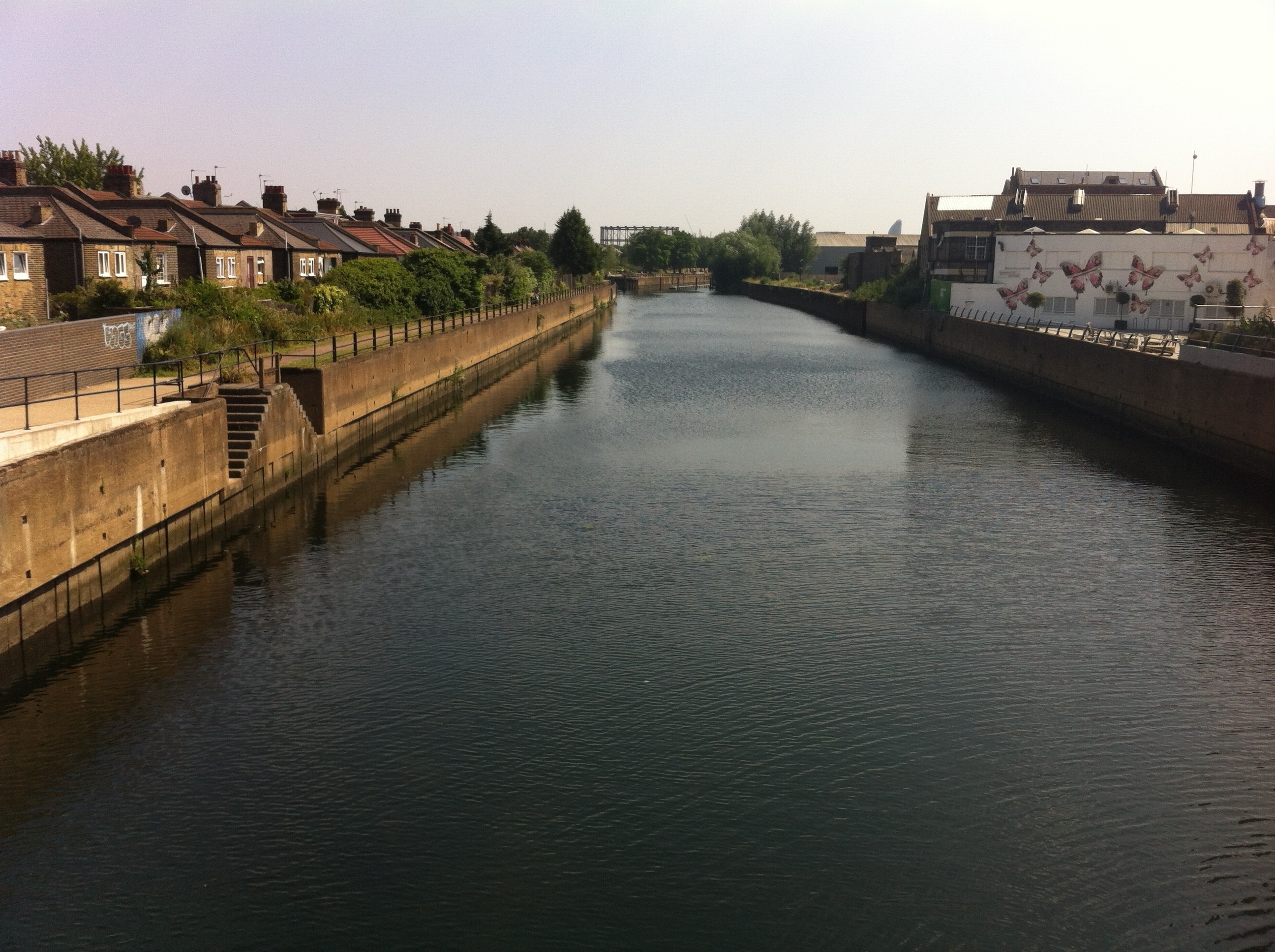
The River Lea close to where Luke Howard’s laboratory stood

On the 11th a “very red” sunrise was observed . By the 12th Howard describes the Arctic scene from his laboratory: “The River Lea is now firmly frozen and the Thames so much encumbered with ice that navigation is scarcely practicable.” Howard also notes on this date that the snow in upper parts of Hampshire and “on the Hind Head” had fallen to a depth of 15 feet in places.

A slight thaw was noted on the 16th from the warmth of the earth. More snow fell on the 18th and 19th. Snow on the 20th was accompanied by a strong NE’ly. On the morning of the 21st Howard noted drifts “many feet deep”.

The 22nd to the 25th saw more outbreaks of snow before the wind swung into the SW on the 26th with snow followed by rain – the cold spell was beginning to lose its grip. Howard notes on the 29th: As the barometer began to rise the wind came round by SW to NW and blew with great violence till near morning”. Classic freeze/thaw conditions followed over the next few days before the real thaw, and the end of the frost fair, arrived on February 5th. Howard notes: “Crimson sky at sunrise hollow wind snow and sleet. 6th A gale from SW with showers of rain at evening.”

Sunset from Southwark Bridge overlooking St Paul's Cathedral by WansteadMeteoThe rest of February, and meteorological winter, appears fairly nondescript. Howard notes that on the 12th a gunpowder explosion resulting in a fire at the Custom House, 5 miles south, caused a  “shower of fragments of burnt paper”. Sharp frosts and misty mornings prevailed to end of month, Howard noting the “clear orange twilights”, probably caused by the eruptions in Italy that formed a new crater on Vesuvius. Howard mentions a letter he received from Heligoland on February 21 which had also seen intense frost that was preceded by thick fogs and heavy falls of snow. The latter was 10 and 12 feet deep – the frost lasting six weeks.

Howard wrote his own account of the frost fair…

“The Thames Frozen Over

January 15: The masses of ice and snow had accumulated in such quantities at London Bridge on the upper side yesterday that it was utterly impossible for barges or boats to pass up. During the whole of this week that part of the Thames below Windsor Bridge called Mill River has been frozen over and has been crowded with persons skaiting.

February 3: The confidence of the public in the safety of the passage over the frozen surface of the Thames was yesterday increased. All the avenues from Cheapside to the different stairs on the banks of the river were distinguished by large chalked boards announcing A safe footway over the River to Bankside and in consequence thousands of individuals were induced to go and witness so novel a spectacle and many hundreds had what we cannot help terming the fool hardiness to venture on the fragile plain and walk not alone over but from London to Blackfriars Bridge. Several booths formed of blankets and sail cloths and ornamented with streamers and various signs were also erected in the very centre of the river where the visitors could be accommodated with various luxuries. In one of the booths the entertaining spectacle of a sheep roasting was exhibited

February 7: Friday several printers brought presses and pulled off various impressions which they sold for a trifle eg Printed to commemorate a remarkably severe frost which commenced December 27, 1813, accompanied by an unusual thick fog that continued eight days and was succeeded by a tremendous fall of snow which prevented all communication with the Northern and Western Roads for several days. The Thames presented a complete field of ice between London and Blackfriars Bridges on Monday the 31st of January, 1814. A Fair is this day February 4, 1814, held and the whole space between the two Bridges covered with spectators. This field of ice was indeed a very rugged one consisting of 1 masses of drift ice of all shapes and sizes covered with snow and cemented together by the freezing of the intermediate surface. The deceitfulness of the latter caused as is too common on such occasions the loss of some lives by drowning. The following passage announcing the opening of the river soon after is worthy of preservation on account of the spirit in which it is written.

February 11: We are happy to see the lately perturbed bosom of Father Thames resume its former serenity. The busy oar is now plied with its wonted alacrity and the sons of Commerce are pursuing their avocations with redoubled energy. Cheerfulness is seated on the brow of the industrious labourer those who were reduced to receive alms as paupers again taste the sweets of that comparative independence with which labour crowns the efforts of the industrious. What a fruitful source of congratulation does this prospect afford nor can the contemplative mind dwell on the subject without feeling gratitude to that beneficent Being who in a time of such calamity opened the hearts of the benevolent to administer from their abundance to the necessities of their poorer brethren and thus add cement to the bond by which all mankind are linked together. The mischief done on the river during the late frost is greater than can be remembered by the oldest man living. Among the craft alone it is calculated to amount to upwards of 10,000 independent of the damage sustained by the cables tackle & of the shipping.”
 

Snow Survey of London (1946 – 2025)

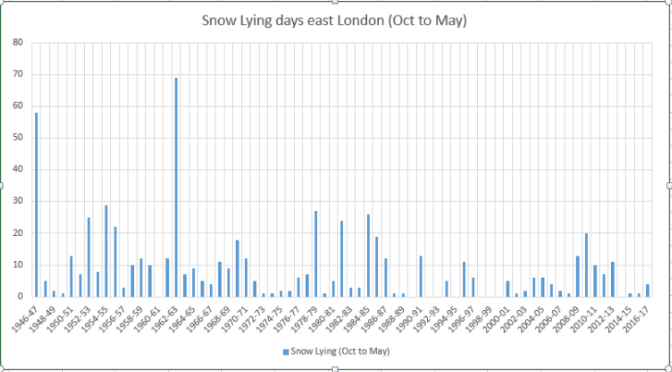
Winter 2024/25, considering the DJF mean, sits 68th out of 79 winters back to 1946/47.

It was the 13th snowless winter in the series . The only ‘top 10’ winter for snowfall of the past 30 years was 2009/10!

Snow is a very rare commodity in lowland Great Britain – even rarer in the Home Counties, and in our part of east London. Pulling back the curtains on a cold winter’s morning to be greeted by a fresh fall of deep, crisp and even snow is something most children experience and hold dear for life. The slush, ice and chaos that inevitably follows all too quickly is forgotten.

OLYMPUS DIGITAL CAMERAMy memories of winters in the 1970s and 1980s is that they were far snowier and colder than they are today. But were they *always* cold and snowy? I decided to have a look back through the archives to find out. My first stop was the Met Office’s now defunct Snow Survey of Great Britain. This excellent compilation of reports logged by observers nationwide was printed annually as part of British Rainfall. But through lack of interest and cuts printing ceased after the 1991-92 season. Data continued to be collected though the modern version of the survey uses satellite technology to estimate daily UK snow depths – the Met Office website says that this is far less subjective than an individual nipping out at 9am every morning to ‘stick in a ruler’ and, those within sight of high ground, to observe where the snow line is. This does a disservice to the hundreds of observers who down the years diligently logged all their information as objectively as possible. But on to the data…

Regional data was not included in the survey until the 1965-66 season. Though Wanstead isn’t listed I have taken an estimate from data supplied from stations at Eastcote (53m), East Barnet (70m), Charlton Park (46m), Twickenham (13m), Teddington (9m). Because this area is influenced by Thames streamer snowfall that blows in off the North Sea and is funnelled upriver I have also considered readings from Epping (107m), Rayleigh (73m) and Southend (27m). Indeed, in some years Wanstead’s snowfall is much more similar to Rayleigh and Southend than it is to Greenwich and Teddington. Though my site is only 18m it seems to catch the snow much better than surrounding areas – probably to do with the fact that Aldersbrook is surrounded by greenery. People walking down from Wanstead village often remark that Wanstead Park is far snowier than the village a couple of dozen metres or so higher. Before 1965 I have used data from Woburn, Bedfordshire, which at 89m and 40 miles away as the crow flies, is the closest station in that long running series.

The mean temperature of a winter can look cold but it doesn’t always tell the full story. You can have a winter dominated by high pressure over the near continent making things very dry. But the anticyclones that ridge from Central Europe to the Azores can leave us in the ‘warm’ part of the high – and often lead to days of anticyclonic gloom; cold grey, dank and boring weather with little sunshine. On paper a season can look cold but in reality totally unremarkable; it is the number of days with ‘snow lying’ that people remember. For snow to settle it needs to be cold! For this reason I haven’t bothered with ‘snow falling’ data as it can snow at 4C in very dry air – yet nothing settles. Most weather geeks find ‘snow falling’ the most frustrating when it doesn’t stick. So on to the results.

The Top 20 winters in Wanstead, using 'snow lying' and 'mean temperature' in stats. Click the image to view all 67 winters
The Top 20 winters in Wanstead, using ‘snow lying’ and ‘mean temperature’ in stats. Click here to view all 79 winters back to 1946/47

Once I worked out the ‘snow lying’ days I decided to devise a winter index by dividing ‘snow lying’ by seasonal mean temperature. Because the results using Celsius were problematic in that 1962/63 becomes very skewed upwards I decided to use Kelvin.

The results are quite surprising. Coming out top, not surprisingly, is 1962-63 with an index of 25.2 and 69 days of snow lying. Second is 1946-47 with an index of 21.1. Third is 1981-82  with an index of 10.5 – surprisingly ahead of 1978/79, the first winter in the series that I can recall; I remember returning home from school one night in December 1978 and the snow being as deep as the twelve-inch step to our house.

The index of 25.2 for the 1962/63 winter and 21.1 for 1946/47 – over double the amount of 1981/82 – shows how ‘off the scale’ those two winters really were. My father, who doesn’t share my enthusiasm for the weather, can distinctly recall the severe conditions of 1962/63. He said the roads were so thick with snow that when the thaw finally arrived in March he’d become so used to driving on snow that he crashed through somebody’s front garden wall, after losing control of his Mini on surface water sat on the ice.

More recent winters, which pale by comparison, rank surprisingly highly. The 2009/10 winter comes in at Number 10, higher than the legendary 1986/87, where the coldest day in recent times was recorded in London, which came in at Number 12. It should be noted that January 1987, when on the 12th the temperature did not rise above -5.5C all day, was sandwiched by a mild December and February.

OLYMPUS DIGITAL CAMERAJust by looking at winters with a mean of, say, 5C doesn’t tell you much about snowfall. When you look at 1985-86 (mean 4.1C)  there were 22 days of snow lying at 9am – yet 2005/06 was colder (3.9C) and only 3 mornings saw snow lying – though that winter was particularly dry – the 13th driest in the series.

The median for ‘snow lying’ days in this series is six. The rolling median of the past 30 years, however, is only 2 so, with this in mind, if it does snow you should get out there and make the most of it.

You can view over 70 years of winters in this area, all ranked using my winter index here.

Screen Shot 2017-12-21 at 14.44.05

*It should be noted that a day of ‘snow lying’ only qualifies if there is more than 50% cover at the observation time of 9am. This means that it could snow 1cm at 10am – if that snow thaws by 9am the next day it won’t count. Though 8 winters appear snowless it is possible that these winters did see temporary coverings

Winter Forecast 2013/14 (with no apologies to the Daily Express)

Much has been printed in the tabloids over the past month or so that we are in for a severe winter. Not a week goes by without the Daily Express splashing that the ‘Worst winter EVER is on the way’. Just this morning the same rag told us that three months of ‘exceptionally cold’ weather are due. On closer inspection the story elaborated the scene with quotes from James Madden of Exacta Weather, one of the ‘experts’ feeding these fantastical stories.

The Temple, Wanstead Park, always looks that much more stunning with a covering of snow

Quite how Mr Madden and other experts arrive at these forecasts is a bit of a mystery. The mystery has deepened further since I decided to crunch a few numbers and try to predict what is in store for the months ahead. Looking at data for this area stretching back over 130 years to 1881 I decided to calculate a seasonal average and arrived at a final figure using singularities – basically looking at the weather patterns we’ve had during October and November.

Many professionals would scoff at this method of pattern-matching, so I’ve incorporated a couple of other ‘now’ factors and taken on board current variables such as sea surface temperatures in the Atlantic and Pacific.

The figure I arrived at, taken as an average of the closest matching autumn periods, is a mean temperature of 4C with rainfall totalling 133mm over the months of December, January and February – that’s about a degree colder than average and 90% of average rainfall. The probability of a winter with a mean temperature of between 4C and 5C is 37% – the most likely outcome. With this in mind a winter in the form of 1986-87 is possible – though whether we would see the same extremes of temperature and snowfall that we experienced in January 1987 is open to question.

Here is a link of my method to predict the coming winter.

The Met Office, with all their computing power and expertise, seem to be hinting at something similar – ie slightly colder than normal. The opening couple of weeks to my forecast seem quite plausible, looking at tonight’s models. Look at the similarity in the synoptic charts for December 8th here.

Shoulder of Mutton lake, Wanstead PArk
Shoulder of Mutton pond, Wanstead Park

Over the last few years the snow lovers among us have been spoiled after a run of very mild winters during the late Nineties and early Noughties that prompted climate expert Dr David Viner to utter the immortal words that one day “children just aren’t going to know what snow is”. It was only a matter of a few years before the words from the senior research scientist at the University of East Anglia seemed a bit hollow.

Mark Twain, born this day in 1835 , once uttered the famous phrase: “Climate is what we expect; weather is what we get” – there is always a chance we could suddenly lurch back to milder winters. This winter could spring a surprise, be it very cold or very mild. But judging what’s happened over the last 130-odd years – a 1962/63 or a balmy 1989/90 look very unlikely.

* Forecasting models use probability on any given outcome. Millions of observations are fed into the Met Office database (and other countries’ weather agencies) every day. Supercomputers then crunch through this data to give probable outcomes. With the volatility of the atmosphere it is not surprising that certainty of any outcome often falls away rapidly. Forecasting has improved greatly in the last 20 years – though anything the models churn out beyond three to five days should be handled with caution. Long range models can give *some* idea of general trends for the months ahead – but changing just one variable can vastly alter an outcome at the end of the run.

* *Over the past few months I have been collating data for the area around Wanstead. This data is freely available from the excellent Met Office library and is emailed via Excel spreadsheet. Rainfall stats include a near-complete daily archive, stretching from 1961 to 2003, from City of London Cemetery . Sadly the rainfall station, along with many others, ceased to supply the Met Office after cuts were made shortly after the turn of century. Prior to 1961 I have used monthly figures taken at the Greenwich Royal Observatory stretching back to 1881. Though this is 6 miles away the difference in temperature between the two areas would be miniscule compared with rainfall data and so can be used. I use my own stats for the period after 2003.

Wanstead Meteo Bulletin (Jan 17 – 23)

The next seven days look to be remaining cold, with a risk of snow at times. The temperature will struggle to get above freezing most days – maximums are likely to average 0.1c by the end of the week. Minimums are forecast to average -4.6C – so plenty of frost around again and some very low minima possible should any snow settle. Despite warnings to the contrary by the Met Office I am not expecting Friday / Saturday’s snow event to amount to much for our area – 5cm to 8cm at most – with all of the action well to the west of us and over high ground. There’s a chance that the front will fragment before reaching us – or even stalling over southern England before “pivoting” away into France. This scenario has happened many times before when we’ve had a “block” of very cold air to our east and north-east as we do now. Another event looks possible on Tuesday – but don’t be surprised if we see very little snow.

The past week, as discussed in the last bulletin, saw a change to progressively colder weather, the change being very marked last Wednesday with the appearance of the sun after days of cloud and gloom. The murk and cloud returned though it stayed cold, by Saturday with a chill east wind. Sunday failed to bring the predicted snow – the front just wasn’t powerful enough against the cold block to our east. However, Monday was different and snow began to fall around 5am on Monday, giving a 1cm covering. The track of the low saw a warm sector pass over up, raising the dew point and turning the snow to rain at low levels. Epping and areas of a similar height managed to remain snowy.

Mean temp: 1.2C; Mean min -0.8C (0.2c warmer than forecast), Mean max 3.1C (1.1c warmer than forecast),

lowest min -3.5C(15th), highest max 4.7C (3rd), total rain 3.9mm

4 air frosts

Wanstead Meteo Bulletin (Jan 10 – 16)

“The River Lea is now firmly frozen, and the Thames so much encumbered with ice that navigation is scarcely practible.”

Saturday (January 12) represents the 199th anniversary of this event noted by Luke Howard in “The Climate of London” – a pioneering book on the study of urban climate, which contained continuous daily observations on temperature, rainfall and wind direction. Temperatures the following week of the severe winter of 1813/14 at his laboratory in Plaistow, just a few miles from here, are hard to imagine by today’s standards in the capital – the average maximum being -2.2C, with night temperatures falling to an average -7.8C.

There has been much talk of severe weather arriving from this weekend onwards, with some chatrooms on the web ramping up rumours of a repeat of the severe winter of 1947. Whilst it is going to turn cold, with the possibility of snow increasing from early Sunday onwards, it is far too early to make predictions of a repeat of the famous ’47 winter which did not really get going until well into the second half of January. Indeed, records from Camden Square show that this week in 1947 would be remarkably mild – with a mean maximum of 10C while nights were a mild average of 5C.

So what has the next seven days got in store? With confidence in weather forecasting models at an unprecedentedly low level it is hard to pin down exact values on temperatures and weather much beyond Sunday. At the time of writing we can expect maximums to gradually creep downwards through the period – giving an average of 2C by the week’s end. Minimums are forecast to average -1C – so plenty of frost around. It currently looks like any precipitation on Saturday will start as rain before turning wintry. There is the chance this will turn to snow by Sunday morning to give a covering. Far more snow looks likely from Monday onwards. As said there is much uncertainty so keep a very close eye on output from the Met Office if you are planning on travelling.

The past week has seen much dull, cloudy and quiet weather, influenced by high pressure on the near continent. I often find this to be the worst possible winter weather as nothing much seems to happen. A bonus it did bring, however, was a break at last from all the rain.

Mean temp: 9.1C; Mean min 7.8C, Mean max 10.5C,

lowest min 5.9C(5th), highest max 11.7C (3rd), total rain 2.7mm