The November monthly mean finished 6.4C, that’s 1.6C below average, the coldest November since 2010. It was the third month of 2019 where the monthly mean temperature finished below average.
The wet theme of October carried on into November; the 68.5mm collected was 116 per cent of the 1981-2010 average, slightly drier than last years.
Some 59.7hrs of sunshine were recorded, 102 per cent of average, the dullest for four years.
There were six air frosts.
You can find my thoughts on how winter is going to pan out here.
For this year’s winter forecast, because of time constraints, I am sticking purely to what the local analogues reveal.
Meteorological autumn was the wettest for 18 years and the coolest for 6 years, revealing some interesting similarities with past climate. Considering data back to 1797 I was able to make the following suggestions on how the next 90 days may unfold.
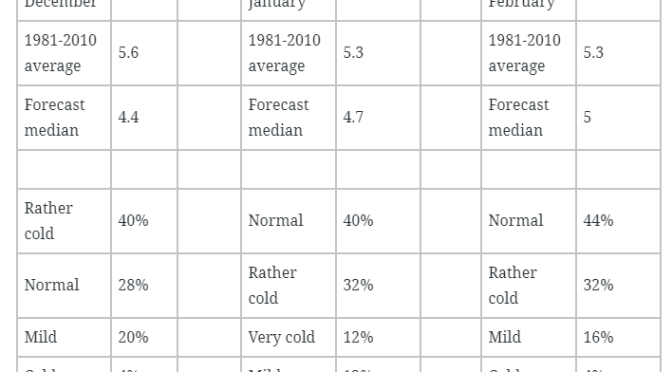
December is most likely to be on the cold side with rainfall slightly below average.
January is most likely to finish average temperature-wise and wetter than December.
London’s February extremes temperature also look average overall and the precipitation signal also creeps up in comparison to the first two winter months.
Best chance for snow? Impossible to pin down but the coldest weather is likely to be at the beginning of February, the third week of January and just after Christmas.
The warmest period looks to be around January 10th while there’s also a signal for that often phenomena of milder temperatures just before Christmas day.
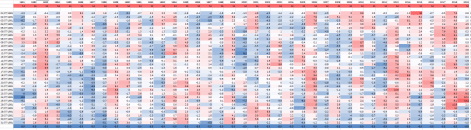
Most of the probabilities in the above statements are relatively low and are explained in the table below.
It’s been a while since this region has seen a sustained colder than average period. Though the past few weeks have seen colder than normal weather we have to go back to the beginning of 2015 where at least three consecutive months were colder than the 1981-2010 average.
The spell, which coincided with winter, was unremarkable with just one day of lying snow. The season finished 55th out of 73 of the most recent winters, the anomaly for the 90-day period was -0.3C. For deep, lasting snowfall events a monthly mean temperature must be at least 2C colder than average.
For anything ‘snow-worthy’ you have to go back seven years to a 10-month long colder than average spell that began in September 2012 and coincided with probably the last winter I can remember that had more than one cold spell with snow that lasted longer than a few days. The average mean for this spell was -1.3C.
The most potent cold period occurred during the winter of 1984/85, a winter where snow lay nearly a foot deep by the end of January and where seven ice days were recorded – these days we’re lucky to record just one ice day per winter! Only just behind was the 3-month period January to March 1987.
As with previous blogs I have devised a way of ranking these cold periods, by dividing the mean with the length in months. The first nine months of 1986 achieved the highest ranking, a period that included the 5th coldest February in this area since 1797.
And in chronological order…
It is looking like the mean this November will finish below average, making it the second month in a row, something that hasn’t happened since March last year. Will December make it three in a row and a new addition to the list?
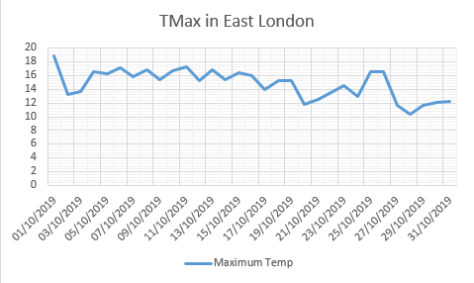
The wet theme of the final week of September carried on into October; the 100.3mm collected was 150 per cent of the 1981-2010 average, the wettest 10th month for 15 years.
The monthly mean finished 11C, that’s 0.8C below average, the coldest October since 2012. It is only the second month of 2019 where the monthly mean temperature finishes below average.
Only 72hrs of sunshine were recorded, 68 per cent of average, the dullest October since 2002.
The area’s first frost arrived 10 days before the median date back to 1959. And 3 days earlier than last year. A shower with >5mm hail was observed on the 9th.
Two hundred years ago this October the extremely rare phenomenon of lying snow in October was recorded in London.
A likely plunge of Arctic air on the 21st saw rain turn to snow which lay nearly 8cm deep by the morning and remained for nearly a week.
The month started dry and warm. On the 1st Luke Howard recorded 75°F at his laboratory in Stratford. The warmth remained into the second week with 77°F recorded on the 10th, 11th and 12th.
The values from Luke Howard’s Climate of London.
The wind swung into the north on the 18th and with it arrived the first hoar frosts that were cold enough to kill garden plants.
On the 21st the cold air further dug in and with it rain that turned to sleet. Howard said: “It began to snow about noon falling in very large flakes thick and rapidly for an hour and covering the ground. Some rain followed.
“In the evening the wind rose and it blew hard in the night from NNW. At midnight came a second heavy fall of snow which continued till 6am and though at first much of it melted it lay in the morning a full three inches deep.”
Howard adds that the surroundings ‘took on appearance of mid winter with the single exception of the foliage still remaining on the trees which mingled with an enormous burden of snow presented a very singular and grotesque appearance’.
The weight of the snow was also enough to break off large limbs from fruit trees.
The snow was still lying on the 23rd and, probably caught out by the earliness of the polar plunge, swallows were seen at Stamford Hill. On the 24th a very white frost was observed with a low of 31°F recorded at Tottenham.
The event was covered in the national press. The Imperial Weekly Gazette mentions impassable roads in to London, including at Walthamstow.
More wintry weather followed in November, December and January.
Could snow fall here again in October? The probability is very low but it is not impossible, given the right synoptic conditions. Recent cases of notably positive and negative anomalies following in quick succession somewhat mirror the weather of Howard’s day.
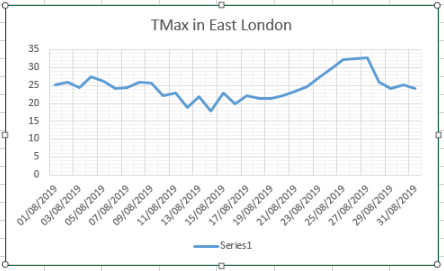
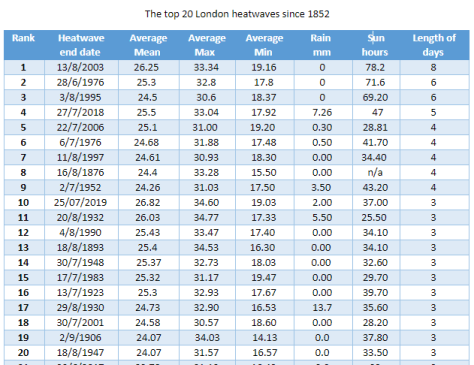
Last month’s heatwave was the hottest three-day event recorded in this area since 1850. It bettered a similar event in 1932 by 0.8C to take 10th in my all-time list of heatwaves.
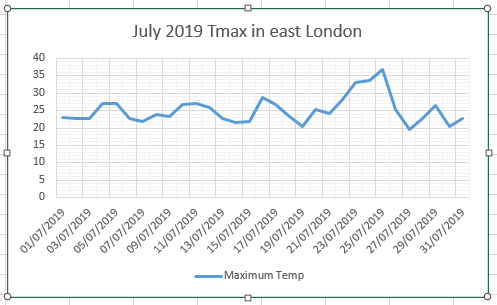
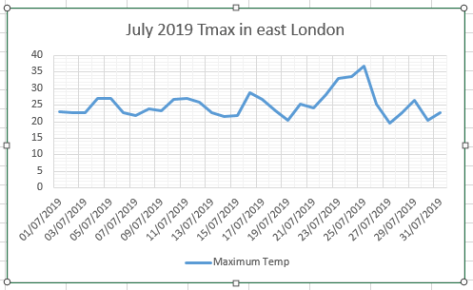
July 2019 saw the month’s daily maximum record broken on the 25th with a high of 36.8C, The reading beat the previous record set on July 1st 2015 by 0.8C and was the second highest reading recorded in this area. Cloud that drifted in mid afternoon put paid to any chance of all-time record though Cambridge, further north, managed to break the UK record with a reading of 38.7C. This temperature set in the Botanic Gardens beat the previous record of 38.5C set in Brogdale, Kent, in 2003.
Brogdale
Cambridge
The weather enclosure in the Cambridge Botanic Gardens meets WMO guidelines
Although it has been mentioned that the Cambridge site appears to be overdeveloped it meets the WMO standard and the Met Office are happy with the record.
Compared with 2003 the heat this time was far more widespread and further north, with many stations recording higher values than 2003, as shown by these 24 hours to 6pm readings below.
In 2003 some 44 stations recorded 30C or above whereas this year some 67 reached 30C or higher.
Though the heat was record breaking it was much shorter lived than 2003. Like last month and July 2015 the 9-day temperature trace is far more ‘pointed’ – perhaps a symptom of the changing behaviour of the jet stream.
Overall the monthly mean finished 19.9C, that’s 1.4C above average though 1.8C cooler than last July – the warmest month on record.
Rainfall at 61.5mm, was 141 per cent of average, the wettest for 2 years. Sunshine, at 165hrs, is 85 per cent of average and well down on last July’s 273hrs.
June 2019 saw no high temperature records broken but a jump in anomaly, produced on the 29th by the 3rd hottest June day back to 1959, is higher than any I can find back to that year..
The only phenomena similar that I can find, albeit in the other direction, is the Beast from the East in March 2018 that sent temperatures plummeting.
The month finished a little above average though the final figure, like May and April, masked cool warm spells.
The mean temperature finished 16.9C that’s 0.8C above average, the coolest for 3 years.
Rainfall was 63mm, 123% of average, the wettest for 2 years. Sunshine was 158 hours, 88.7% of average, and dullest for 3 years.
June can be a strange month weatherwise. Scorching temperatures as well as washout, cold weather, perhaps epitomised by the Queen’s Diamond Jubilee pageant on the river Thames in 2012, can feature prominently.
The month can also throw up some striking anomalies, none more so than the fact that the 13th is the only day in the month where the temperature has never reached or exceeded 30C anywhere in the British Isles.
According to TORRO the highest daily maximum recorded in the UK is 28.3C at Earls Colne, Essex, in 1948; at Brixton, south London, in 1896 and Aboyne in 1994. Yet either side of this date has records comfortably above 31C, as the table below shows.
The closest we’ve got locally to 30C in the last 60 years was in 1989 when 27C was recorded.
So why is the 13th ‘cursed’ with traditionally being the coolest day of the month? The best explaination perhaps is the fact that the date occurs more or less during the middle of the North-west European monsoon.
According to Philip Eden’s list of singularities the June monsoon can strike any time between the 1st and 21st but normally peaks on the 16th with a 77 per cent frequency.
As well as cool temperatures the phenomenon can also bring copious amounts of rain, as happened in 1903 when large parts of Redbridge were inundated following a 59-hour deluge that started on… the 13th.
Will we see a repeat this Thursday? Unlikely, though the general pattern is not that different to what led to events over a hundred years ago.
You must be logged in to post a comment.