Tag Archives: weather

Record low pressure of Christmas Day 1821

The lowest pressure recorded in the southern UK happened on February 25th 1989 when the barometer fell to 942.4mb.

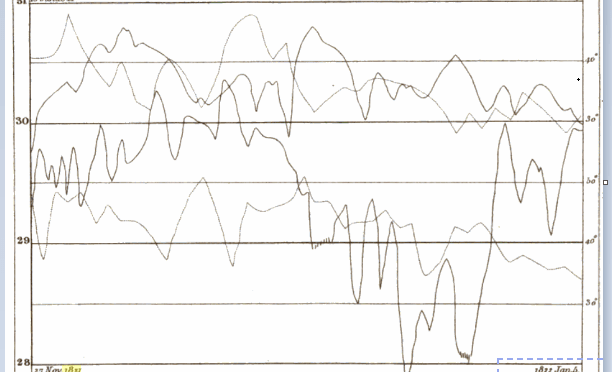
I was also reminded this week of another occurrence of extraordinary low pressure in southern England on Christmas Day 1821. Luke Howard’s Climate of London recalls the event in his December summary where, he states, the air pressure fell to 27.83 inches (942.4mb).

This month is remarkable for a depression of the barometer which for London at least or its vicinity is nearly without a precedent on record. The lowest observation here given 27.83 in was obtained at Tottenham from a portable barometer of Sir H Englefield’s construction about 5am on the 25th.

Luke Howard

In what appears to be remarkably similar to what is unfolding with Storm Ciaran Howard added that despite the low pressure the weather on Christmas Day was ‘very fine’, a day that was sandwiched by much rainy weather.

In his entry Howard explains:

We had no storm of wind of any consequence after this great depression which it should be remarked had been coming on for about two weeks. It appears by the papers that a like state of the barometer was extensively observed at the same time on the continent and that very tempestuous weather attended it far to the south of our island.

Luke Howard

Howard also received a letter from Thomas Squire of Epping who wrote.

The fall of the barometer has been as wonderful as the fall of rain. On the 24th at midnight my barometer was 27.76 in. It continued nearly stationary till about six next morning when it was 27.73 in. This was its minimum altitude shortly after it began to rise at 8am.

Thomas Squire

Squire’s readings, taken at Epping (105m), can be adjusted for sea level and compared with the hourly trace for Storm Ciaran. Taking this into account the barometer actually bottomed out at 927.6mb! Plotted against Storm Ciaran the behaviours of the two depressions are remarkably similar.

Howard would go on to discuss his findings with the Royal Society the following month in January. He remarks that the low pressure was notable in that it happened in the same year that notably high pressure was recorded in the February. Just like this year! I recorded 1060.1mb on February 5th.

Though low by southern UK standards there have been many deeper depressions to the north.

Spend £100k to save millions on flooding

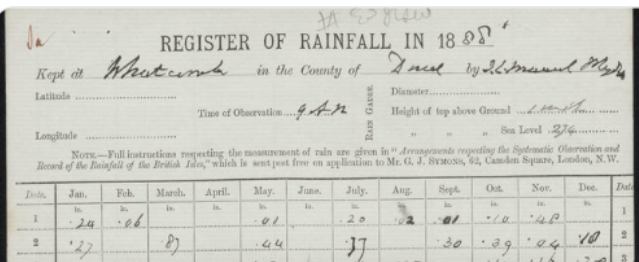
The Met Office Library holds millions of daily rainfall observations in its archives. Though anyone can access these physical treasures in person, and on request by email, a lot of these records taken before 1960 remain hidden away.

Yet these data provide an excellent insight into the behaviour of our weather on a local scale. As good as computer models are they are still a distance away from being able to forecast thunderstorms and frontal rain at smaller resolutions. Data from the literally hundreds of smaller rainfall stations set up in Victorian times would provide local government agencies the ability to identify where rainfall is historically heaviest and therefore areas where flash flooding is a greater risk.

For a number of years some of the archives have been digitised with the help of citizen science campaigns; the records of the Ben Nevis Summit Observatory being one historic station now digitised.

Though AI has improved computers still struggle with handwritten records; the best method is still to scan them all by hand before an army of volunteers get to input them onto online spreadsheets.

The cost to scan the rainfall archive pre-1960 would be £100,000. Though this sounds a lot for a ‘nice to have’ digital archive it could save millions in the cost of reactionary local authority work thanks to measures taken to plan against problems with flash flooding before they appear.

Wanstead weather in October

The current site hosting Wanstead’s weather station has been running for 11 years next month; the automatic station uploading data every 10 minutes to the internet.

The 10-year averages from the station are now good enough to be listed on the Climatological Observers Link.

A look at the tenth month shows some interesting trends…

The 9am air pressure readings were not included in previous climate summaries owing to analogue barometers only giving approximate air pressure readings. The advent of AWS has changed that, particularly for independent amateur observers.

A look at the below graphic shows pressure lowest around the 21st, the stormiest weather of the month. Storm Babet in 2023 is proof of that.
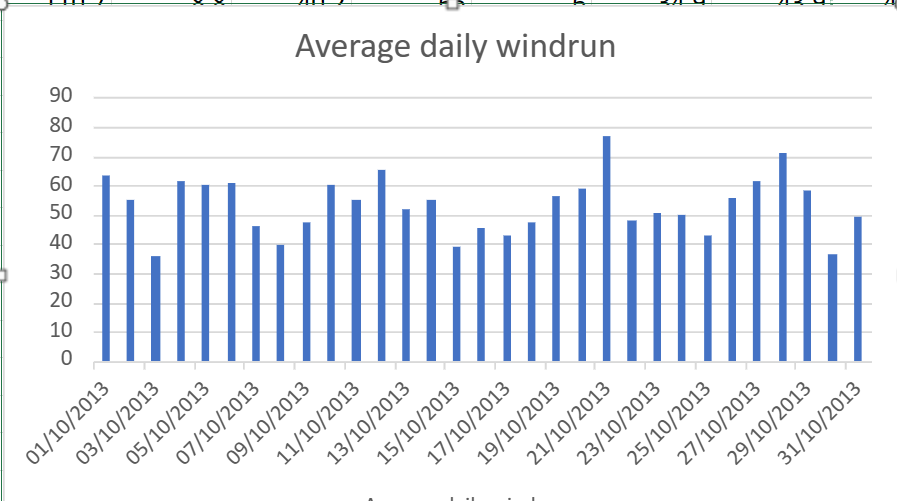
Average daily windrun is how much wind there’s been during a 24 hour period. Again the 21st comes out as windiest.

Average rainfall

Average daily maximum

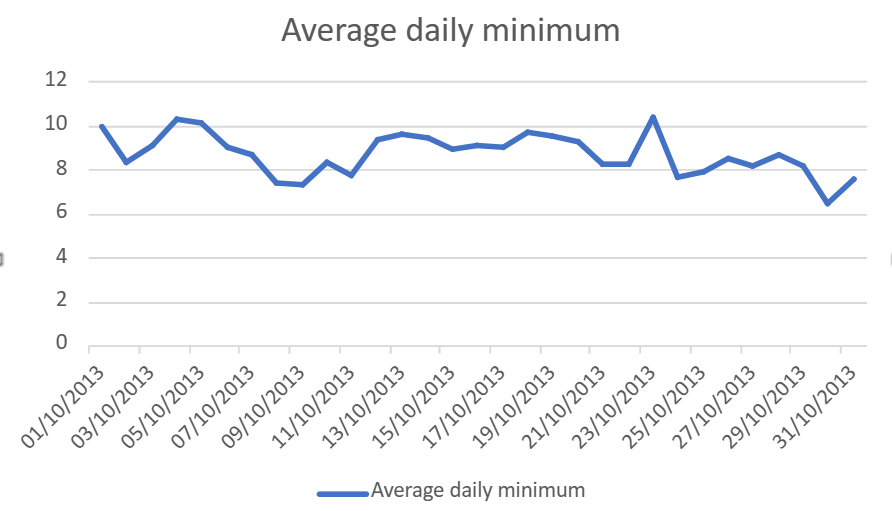
Average daily minimum

‘White flakes falling on the city brown’

Written in 1890 this poem was composed when white Christmases were far more common.

LONDON SNOW by Robert Bridges

When men were all asleep the snow came flying,

In large white flakes falling on the city brown,

Stealthily and perpetually settling and loosely lying,

Hushing the latest traffic of the drowsy town;

Deadening, muffling, stifling its murmurs failing;

Lazily and incessantly floating down and down:

Silently sifting and veiling road, roof and railing;

Hiding difference, making unevenness even,

Into angles and crevices softly drifting and sailing.

All night it fell, and when full inches seven

It lay in the depth of its uncompacted brightness;

The clouds blew off from a high and frosty heaven;

And all woke earlier for the unaccustomed brightness

Of the winter dawning, the strange unheavenly glare:

The eye marveled–marveled at the dazzling whiteness;

The ear hearkened to the stillness of the solemn air;

No sound of wheel rumbling nor of foot falling,

And the busy morning cries came thin and spare.

Then boys I heard, as they went to school, calling,

They gathered up the crystal manna to freeze

Their tongues with tasting, their hands with snowballing;

Or rioted in a drift, plunging up to the knees;

Or peering up from under the white-mossed wonder,

“O look at the trees!” they cried, “O look at the trees!”

With lessened load a few carts creak and blunder,

Following along the white deserted way,

A country company long dispersed asunder:

When now already the sun, in pale display

Standing by Paul’s high dome, spread forth below

His sparkling beams, and awoke the stir of the day.

For now doors open, and war is waged with the snow;

And trains of somber men, past tale of number

Tread long brown paths, as toward their toil they go:

But even for them awhile no cares encumber

Their minds diverted; the daily word is unspoken,

The daily thoughts of labour and sorrow slumber

At the sight of the beauty that greets them, for the charm they have broken.

A chilly and dry autumn on the way?

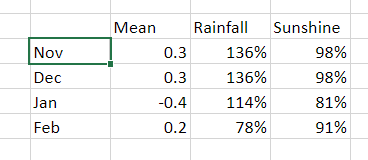
Anomalies of the past two months throw up some interesting singularities as we head into late summer and autumn – with a hint that we could be heading for a much colder than normal December.

Using stats from the past 60 days revealed the following years. Those most similar to the current ENSO situation are highlighted in bold.

The most negative month on average will be December.

In terms of rainfall those hoping for a deluge look likely to be disappointed, at least in the south-east, with a continuation of synoptic conditions that favour drier than average weather.

The best chance for a wetter than average month appears to be September though, given recent synoptics, this is likely more a result of trough disruption than any sustained period of Atlantic-driven fronts.

London droughts back to 1871 (2022 update)

Since I wrote the original blog on London droughts in July 2018 there have been five more meteorological droughts.

The latest, as I write this on August 8th 2022, now sits joint 2nd in longest droughts in this area.

The rolling 12-month rainfall total has now reduced to 457mm; the lowest since 2017, and low given that the annual Jan-Dec rainfall average here is 602mm. At this point last year the rolling 12-month total was 818mm!

Looking further back, at a monthly rainfall series that goes back to 1797, the opening seven months of this 2022 are the 6th driest.

Whatever way you look at it this area is desperate for rain.

Seven seasons: modern climate of the south-east

Our weather seems to be all over the place these days.

Spring bulbs shooting up in late November, weather warm enough for T-shirts in December and January, heatwaves in February…
The seasons have become very ill-defined.

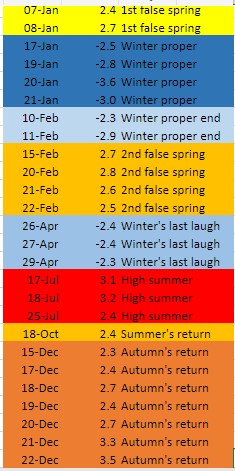
A look at local statistics over the last 10 years reveals a climate that can lurch from one extreme to another in a matter of days.

The below list can obviously move forward or back a couple of days from year to year but these dates represent the biggest positive and negative anomaly periods.

The Christmas storm singularity

One of the best articles written regarding weather forecasting is Philip Eden’s ‘Does the Weather Have a Memory?’

The crux of the article is that certain weather types can repeat at the same time of year with one having a 100 per cent probability!

The Christmas storm singularity occurs in 84 per cent of years.

While 84 per cent certainly doesn’t mean ‘nailed on’, in the current set up of models being evenly spread between settled and stormy it can be safely guessed at this range that there will be unsettled weather around on the 25th. Whether it will affect the whole country remains uncertain.

The last big snorter of a Christmas storm I can remember in London was 2013. The entry for the 23rd into the 24th reads.

“Cloudy and breezy start grew steadily duller with rain just before noon. Rain grew heavier with some really strong gusts into evening culminating at 2am. Cloud at one point was 10kms thick. Three deaths related to weather.”

There was chaos nationwide with flooding and power cuts.

https://www.bbc.co.uk/news/uk-25512391

The average wind run for this station shows the singularity as well as the mid December settled spell we are now seeing.

Fantastical Christmas day snow modelled

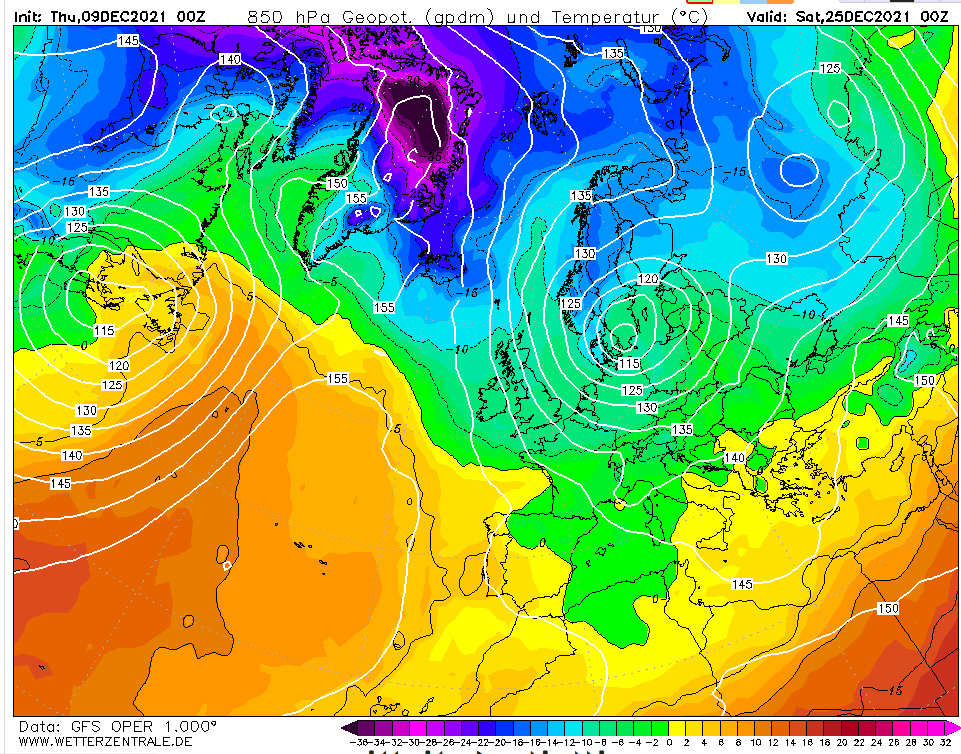
It’s that time of year again! With the midnight run of this model bringing the start of the 25th into range the prognosis for the big day is a rare white one – with snow likely almost anywhere.

But 15 days is an eternity in modelling so we can take this with a council depot load of salt.

It’s often not until 10 days out that models will start to get a firm grip on what the weather will be like on Christmas day.

My guess at this range is a quiet one with fog and frost and a high of 6C in London.

Friday, December 10th

24hrs on and, interestingly, the pattern hasn’t completely flipped to something opposite to above…

Saturday, December 11th

The high is more centrally located over the UK with proper cold air from eastern Switzerland eastwards. Cold, calm with frost and fog in London.

Sunday 12th December

Little change though any colder air is even further east. A Eurotrash high with declining air quality.

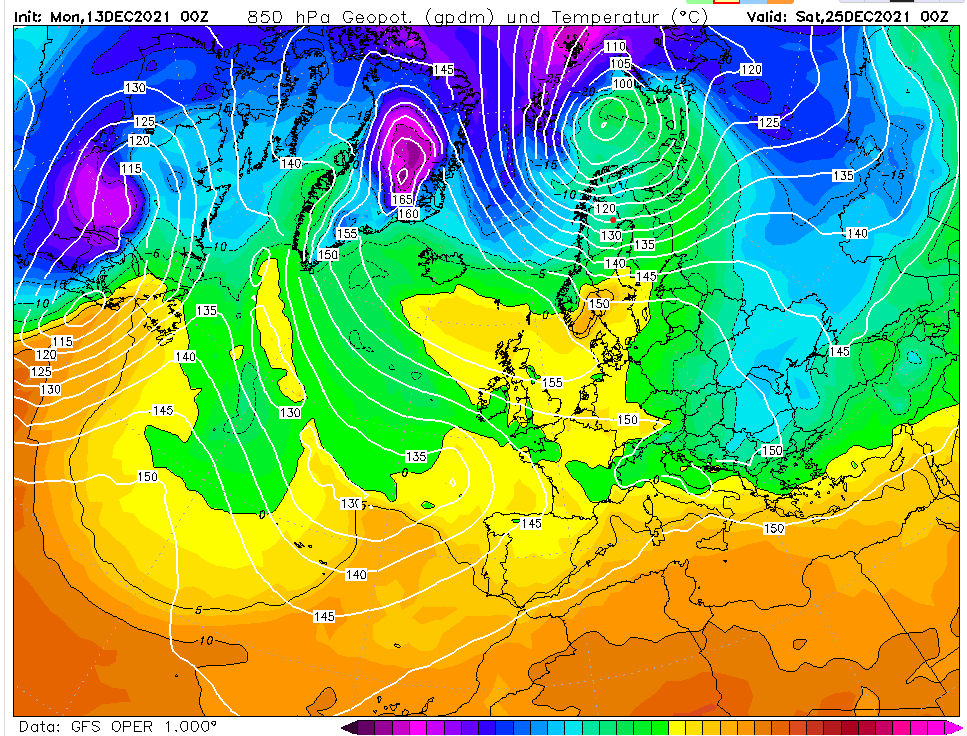
Monday 13th December

The models are in a state of flux, more so than usual by the looks of it. No change on my thoughts though.

Tuesday 14th December

Another slack flow with any true, cold air well to the east. My guess remains a dull and cold Christmas day after a slight morning frost.

Wednesday 15th December

Within the much more reliable 10-day range now and the GFS is throwing out quite an odd looking chart. It shows a mass of cold air just to our east, the start of a cold spell that takes us up to New Year’s Eve.

Thursday 16th December

My thoughts on Christmas day still remain the same as they were days ago. Cold, calm with a high of 5C. Beyond that GFS is hinting the Atlantic floodgates will open. I suspect it is jumping the gun by a couple of days and we’ll see a couple of cold days, the 27th being notably cold?

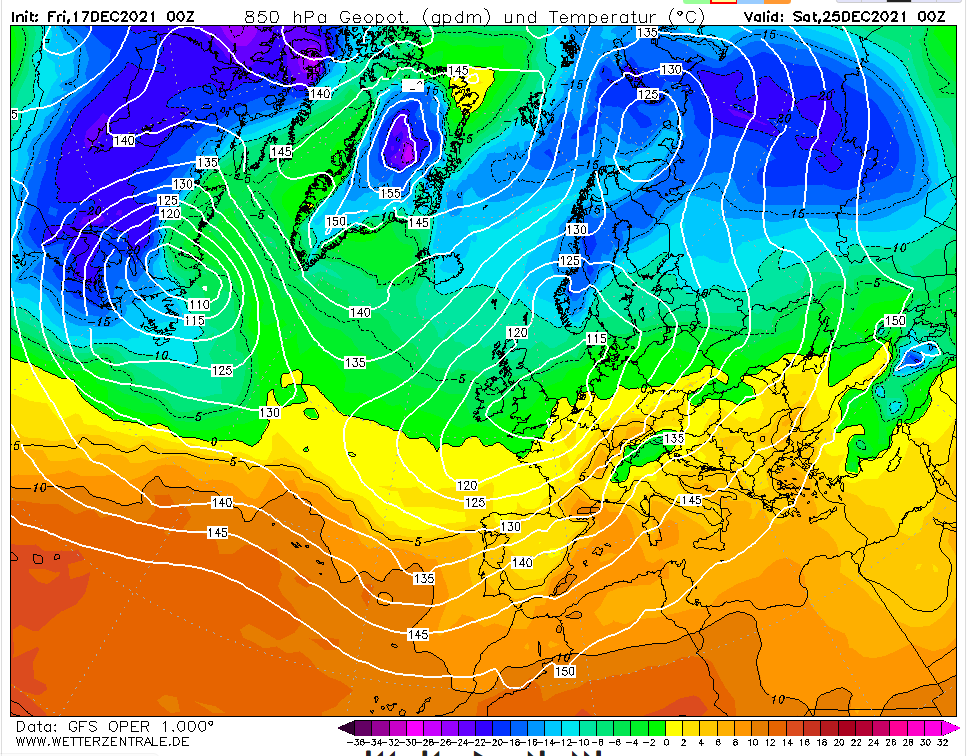
Friday 17th December

The GFS having another hiccup overnight. The situation at 0z hours probably 5C and cloudy in London. But it’s a deteriorating situation with 850mb temps plunging from the north – the conditions that could bring being consistent with the title of this blog. But I’d pay little notice to output like this until it is 48-72 hours away.

Saturday 18th December

A classic battleground scenario on the midnight operational. An even spread on ensembles, too. My hunch is that the high pressure will survive long enough for a quiet Christmas day. After that?

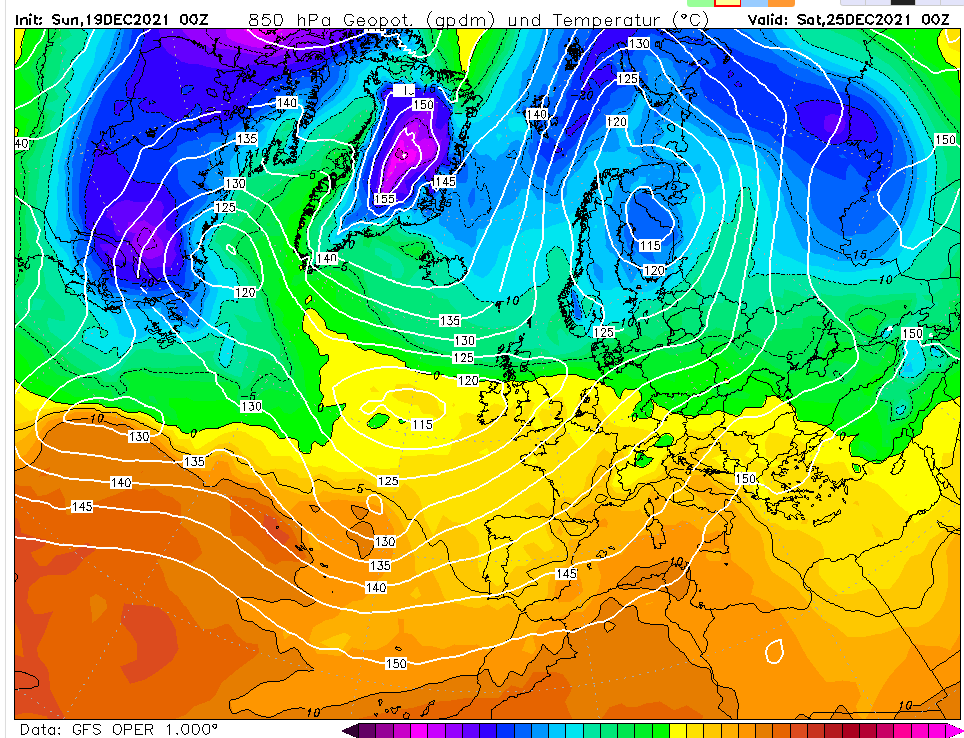
Sunday 19th December

GFS wants to bring 11C, outbreaks of rain this morning…

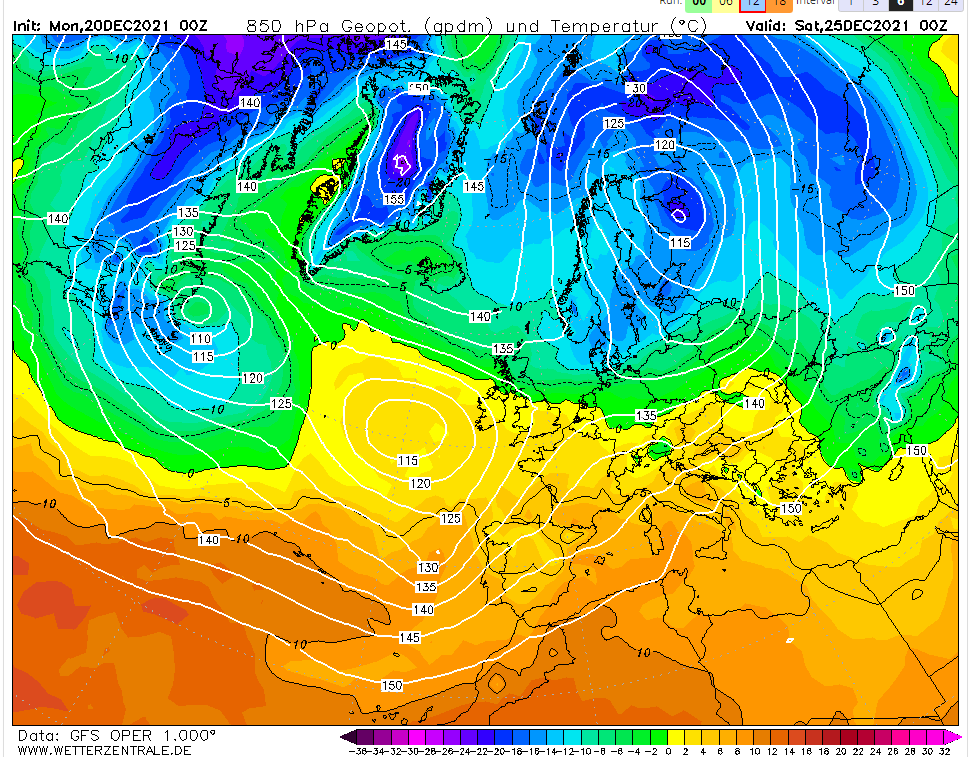
Monday 20th December

Mild with showers in London.

Thoughts on winter

Lots of hype regarding winter at the moment with contradictory model output being released almost daily.

My early take on this is based on the current state of the El Nino Southern Oscillation (ENSO) index which is currently -0.6 and trending more negative (La Nina).

Using analogues from previous events would suggest that the coming winter in the south-east of England will be broadly average in terms of mean temperature and wetter than average.

Looking more closely at each year suggests the following.

Further scrutiny of the local statistics suggest that the mean temperature for November could be lower than average, some 1.7C below average with rainfall around 20 per cent below average.

I should be noted, however, that in the years that were most similar to this September and October (1958, 1961, 1967, 2001, 2005, 2019) the ENSO index was much closer to neutral than it is now. In other words what happens next month could be vastly different to what happened in those years.

Years prior to those mentioned above add intrigue as ENSO statistics are not available.

1802 (cold January 1803), 1849 (severe January 1850 with ice in the Thames) 1862, 1865 (heavy snow southern England 10/11 January) 1874 (notable December storm)

Obviously a lot can change atmospherically in the next few weeks; this is an early take on my usual winter forecast which will be released on December 1st.