It was the summer when the ‘sea’ came to Redbridge. A record-breaking 59-hour deluge in the middle of June 1903 left vast swaths of the borough inundated. But this was no thundery downpour. All across London and the South East record rainfall rates and totals were set, many of which still stand well over a century later.
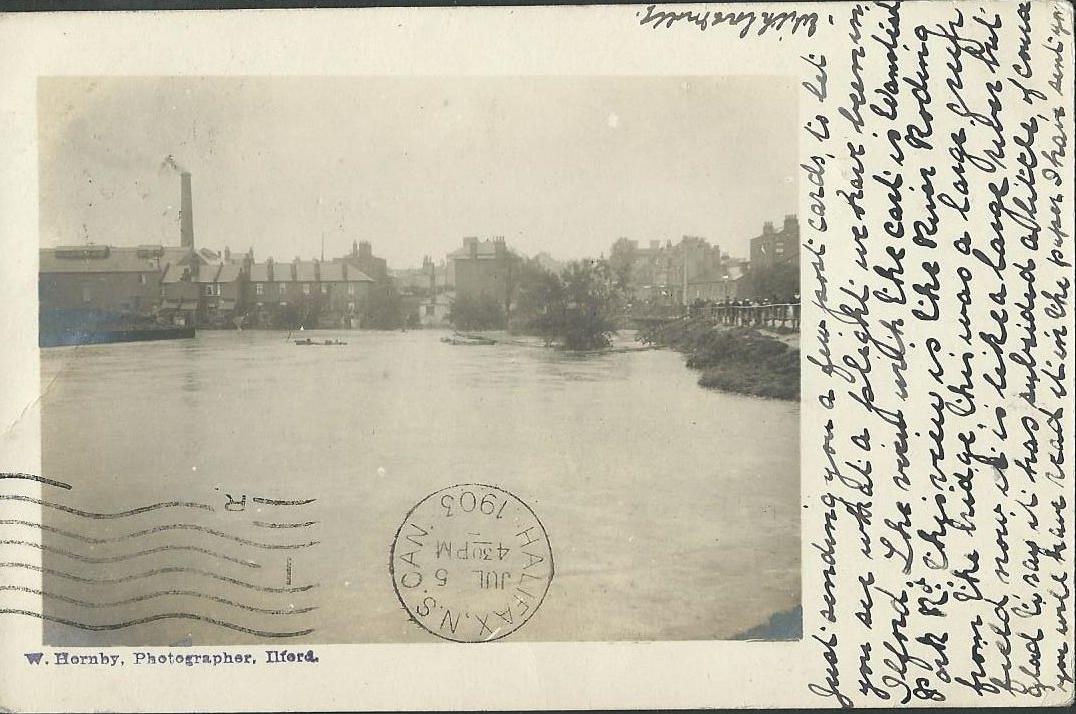
The author of this postcard wrote the following: “Just sending you a few postcards to let you see what a plight we have been in Ilford. This view is the River Roding from the bridge. This was a large green field now it is like a large river but glad to say it has subsided a little of course. You will have read it in the papers I have sent you.”Images of the flooding were captured by Watson Hornby, an amateur photographer and artist, who traded at 7 Cranbrook Road, Ilford. This terrace of houses in Wanstead Park Road, which backs on to the River Roding, were also flooded out. The postcard was written on July 1st, 1903
According to one local historian the fields between Wanstead Park and Ilford – as far as Uphall Road – were like an open sea and the railway track at Seven Kings resembled a shallow river.
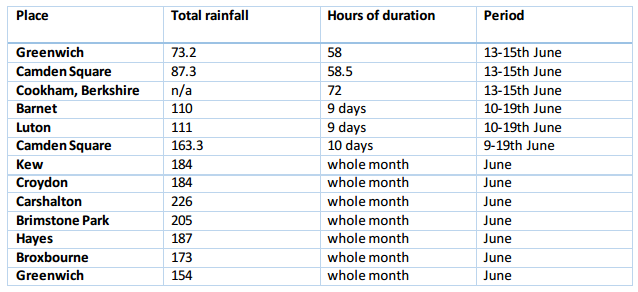
After a dry start to the month June quickly went downhill with notable falls of rain during the second week. The main deluge arrived around noon on Saturday, June 13, and lasted until near midnight on the 15th.
The rain was caused by a depression that moved slowly across southern England, becoming stationary over the English Channel close to the Isle of Wight for 24 hours before moving north-east. It introduced a very cool NE’ly airflow – the temperature on the 14th and 15th failed to climb above 11C and on the 19th a high of just 9.2C was recorded as yet more rain fell.
Across the London area there were five days within the period 10th to 19th June when over 25mm of rain was measured in many places. The deluge added to what became the wettest summer month on record. At the Royal Observatory, Greenwich, just over 154mm fell, three times the amount of what normally falls in June in this area. Further west, Kew Observatory recorded 184mm.
The June 1903 flood at Empress Avenue at the junction of Wanstead Park Road
The 1903 rains produced an unprecedented summer flood on the Thames. At Teddington 7335 million gallons (33,374 million litres) of water flowed over the weir on June 21st. Elsewhere the Lea Valley was one vast lake, especially around Enfield, with the Royal Gunpowder Factory inundated.
The Friday, June 19th edition of the Essex County Chronicle abounds with other tales of woe from the floods…
Barking and District: In the large area of low-lying ground between Lea Bridge, Ilford, Barking, and East Ham, houses stood in a great inland sea, which was washing over the garden fences and lapping at the lower windows. Upstairs the occupants could be seen moving about or gazing hopelessly out at the dreary waste of black waters. Boats from Barking Creek were rowing about with supplies of milk and bread, and those who wished were taken away. All along the Barking Road from East Ham scenes almost identical were witnessed, but, happily with the end of the rain, the water did not retain its level long. Past Barking and on to Rainham the roads on Tuesday were quite impassable, much of the heavy traffic which goes through Rainham towards Barking having to turn back.
The floodwaters between Wanstead Park and Ilford were described as a vast inland sea
Woodford and Wanstead: The inhabitants of Claybury Asylum and Woodford Bridge were cut off by 3ft of water from Woodford. The whole of the Roding Valley was in a deplorable state; sheds, trees and stock that was once alive floating in all directions. Wanstead was divided from Ilford by a great lake, but happily the total of loss in property was here very small.
Lea Bridge: The Leyton marshes were covered by one great sheet of water, Lea Bridge Road itself being quite 2ft under. Boats were to be seen plying among the tramcars.
Epping: The valleys were well-nigh impassable, especially at Thornwood and parts of Theydon Bois.
Romford: The floods reached to Romford High Street, and made the thoroughfare impassable for pedestrians. The crisis caused a heated exchange among members at a meeting of the Urban Council on Monday evening where it was agreed to allow the free use of the town fire engine for pumping water from ratepayers’ premises, provided that those who required its services paid for the labour. Cllr J. Bassett thought the residents should make their own arrangements for getting rid of the water. Cllr J.R Holliday replied: “You don’t live near the river. I should like to stick you in the middle of it. I think it is the duty of the council to protect property.”
Laindon: Here the height of the deluge was experienced between seven and eight o’clock on Sunday evening. The rain descended in apparent ropes of water, causing consternation, flooding houses, choking drains and water-troughing, cutting deep channels in roads, washing up plants and new potatoes. On Monday the water was between 3 and 4ft feet deep at Noak Hill and other bridges.
Woodford: An exciting scene took place at Woodford Bridge, where a steam circus, with its owners, was in the most precarious position. Men and women were submerged up to their armpits while extricating the caravans.
Away from the South East the weather was much dryer. Felixstowe and Yarmouth newspapers reported that Sunday had seen “delightfully sunny weather, with cool north-easterly breezes”. Lincoln, meanwhile, recorded less than an inch of rain for the whole month!
Could these rains happen again? Meteorologically, given the same synoptic set-up, it is possible. In terms of the June monthly total of rain we came close in 1997 when 133mm fell – though this was much more evenly spread throughout the month. And thanks to massive investment in local river systems since the 1950s the flooding nightmares brought by the Lea and Roding rivers should stay firmly in the past.
*You can see the full stats from Greenwich for June 1903 by clicking this link.
The Met Office, earlier this week, warned us that extreme summer rainfall may become more frequent in the UK because of climate change. The research, produced in collaboration with Newcastle University, says that while summers are expected to become drier overall intense rainfall producing serious flash flooding could become several times more frequent.
I hadn’t thought much about the story until, as part of my attempt to find out what this summer is going to turn out like, I discovered some fascinating details of several events during the summers of 1811 and 1828. Many have remarkably similar characteristics to the Boscastle flood in 2004 – the kind of episode the Met Office tells us could become far more common by 2100.
The entries for 1811 in Luke Howard’s book The Climate of London once again shows that extreme weather is nothing new and serious flash flooding was actually more common all those years ago.
May 20 1811 A severe thunder storm came on at Ingatestone, Essex, accompanied with a deluge of rain. In ten minutes the water ran about three feet deep in the streets. The same night at Potter street on the road to Newmarket hailstones nearly as large as pigeons eggs fell accompanied with the most terrific thunder and lightning.
May 27, 1811 Hereford: We were visited by a dreadful storm of thunder and lightning accompanied by torrents of rain very destructive eastward of this city. It commenced about three o’clock in the afternoon and continued with little intermission till past eight. This storm and the consequent inundation of several thousand acres of land destroyed a number of lives and much property.
June 8, 1811 A severe storm of rain hail and lightning took place in Birmingham and the neighbourhood. The hail or rather pieces of ice which fell are described as of prodigious size and considerable damage has been done to the windows. Worcester this day another most tremendous storm of thunder lightning and rain took place about 11am equal to that of the 27th except the hail.
A storm was also experienced June 28 at Bury and its neighbourhood. The lower part of the houses were filled with water which lay in the street 5 feet deep. The hail stones 5 8ths of an inch in diameter broke near five thousand panes of glass. About twenty six head of cattle were killed last week by the lightning at Bisby and Walsham in Norfolk.
July 2, 1811 In the neighbourhood of Wonersh near Guildford after one of the most sudden strokes of thunder a deluge of rain took place so instantaneously as to carry away or destroy every thing which impeded its progress. The damage is estimated at not less than 1,500.
July 21, 1811 A heavy fall of rain did much damage at Stamford. In the meadows about Barrowden, Wakerly, Harringworth, Thorpe, Caldecot and Bringhurst immense quantities of hay were carried away. Several thousand loads it is supposed have been destroyed in addition to which the injury sustained by the land has been very great. The water rose thirteen feet in less than four hours in Wood Newton parish.
View from Greenwich Observatory toward the Royal Naval College
In 1828, a spring that was also similar in terms of temperature and rainfall to this year, more entries in Climate describe flash flooding events.
July 8, 1828 Extensive rains on Tuesday afternoon the 8th instant about four o’clock a storm of wind rain and hail accompanied with thunder and lightning broke over the town and neighbourhood of Taunton with a degree of violence never before remembered by the oldest inhabitant. The thunder in heavy peals was heard simultaneously from the east and west and the wind at one period of the storm blew a perfect hurricane. At Kingston the banks were thrown down for several miles and three rams the property of Mr Welch valued at thirty pounds were killed by the lightning. The corn is sadly levelled by the storm. The hailstones were of uncommon thickness and in their descent destroyed much glass in the windows of private dwellings and outhouses. Various statements of mischief have reached us from our correspondents for many miles round all representing the storm to have been of unqualified violence. Taunton Courier
The inundations occasioned by the constant heavy rains in Flintshire and Denbighshire have proved most injurious and in some instances destructive to the iron works in those counties. The Coed Talon works belonging to the Welsh Iron Company have sustained very considerable injury, the bridges, dams and culverts belonging to those works were all carried away by the tremendous torrents and bursting of the springs. On Thursday night week the waters in the immediate vicinity of the works rose to the extraordinary height of 22ft above their ordinary level and in a few hours extinguished the furnaces such was the impetuosity of the flood and the influence of opposing elements of fire and water that the most serious apprehensions were entertained that the furnaces would have been blown into the air.
The Met Office says summer deluges and intense rainfall will become more common
Happily the buildings sustained the shock and no lives have been lost. It is stated by the oldest inhabitants in the neighbourhood that such awful effects from impetuous torrents were never before witnessed by them. Throughout a great part of Oxfordshire and Worcestershire the wheat and barley have suffered considerably by the late heavy rains Friday afternoon, a solitary dark cloud passed over the north end of Winchester towards the valley of Itchen Abbas the sun shining from the opposite part of the horizon. The spot whereon the cloud appeared to rest seemed to be enveloped in total darkness whence shot a stream of electric fluid accompanied by a short but tremendous crash of thunder and hailstones of considerable magnitude. So violent was its force that it killed two fine horses belonging to Mr Twitchen of Itchen Abbas and struck the carter to the ground where he lay in a state of insensibility for some time, his frock was singed by the lightning. About the same time a cottage occupied by the shepherd of Mr Twitchen s brother at Mitcheldever experienced its violence by being greatly shattered and the shepherd’s wife struck instantly dead. During the same day three horses belonging to Mr Budd of Hatch Warren Farm, near Basingstoke, were struck dead by the electric fluid and a man who had charge of them was so dreadfully injured as to render recovery hopeless. Bath Chronicle
The list goes on… I’ve had a look at all summer rainfall since 1797 to see if 1811 and 1828 were particularly wet years but the records I have, taken by Luke Howard at Stratford, are nothing out of the ordinary.
The summer of 1811 in London saw a mean temperature of 16.1C (1.5C cooler than the current 1981-2010 average) while rainfall was 211mm (just under 150% of the current average). The summer of 1828, however, was warm for the period – at 17.5C. Rainfall was high at 317mm (218% of today’s summer average). Of course totals in the areas affected in the articles would have been much higher.
So when the Met Office says climate change is going to bring more flash flooding in summer I wonder if it is the climate cycling back to a period where we’ve seen it all before.
This graph of summer statisitics shows a regular series of peaks and troughs for rainfall. The mean temperature is generally 1C warmer than it was 100 years ago
*For those interested below is a continuation of summer flooding events that plagued the country in 1811, 1828 and possibly many other events of records we have probably sadly lost.
Sussex The accounts from the western part of this county both on the coast and in the weald concur in stating that the effects of the thunder storm of the 3rd instant were most severely felt. So severe a storm has not been experienced since 1821. The storm on the evening of Thursday night was most violent in the neighbourhood of Chichester and lasted from eight in the evening till nearly four in the morning, the electric fluid entered a cottage at Birdham and shivered a bedstead rolling its occupier with the bed on the floor lut who escaped without injury. Brighton Herald
The almost constant rain which has been experienced in Penzance and its neighbourhood has been very detrimental to the hay harvest West Briton PL
July 10, 1828 We regret to state that the floods in this neighbourhood still continue and the waters indicate by their colour how great the mischief is amongst the hay. The Welland and the Nene are of the hue of strong tea proceeding from the essence of the hay which is entirely washed out of whatever was not stacked before the 10th instant. – Stamford Mercury
Cambridge The late heavy rains in this part of the county have laid and much injured the corn crops and likewise considerably impeded the hay harvest Bury Herald
July 17, 1828 Sheffield In our last publication we alluded to the long continuance of hot weather which had been experienced in this neighbourhood. On Tuesday, however, a change took place and on Wednesday the rain fell more heavily and incessantly than it is remembered to have done at the same season for several summers past. Indeed not only were our two rivers remarkably high but the springs of many wells which had failed at the usual time experienced a temporary refluviation. Sheffield Iris, July 17
Malton, July 17 Every hour brings fresh accounts of the extensive losses sustained by the occupiers of land bordering on the Rye and Derwent. Hay has been floating in swarth and in cock of all sizes and the loss in various kinds of grain and potatoes is incalculable. Such a weight of rain and such a flood were never known at this season of the year. On Sunday morning last Sunderland was visited by a thunder storm. The lightning was remarkably vivid the peals of thunder were tremendous and the rain fell in torrents. The Wear was also much swollen. Great quantities of hay came down the river. From our correspondent at Durham dated Sunday afternoon: Since early on Saturday morning Durham and the neighbourhood have been visited with a succession of heavy rains insomuch that the river Wear is swollen to a dreadful height and has done and is still doing frightful damage to the adjacent fields which are overflown to the extent of many hundreds of acres many of which are meadow some just mown some in pike and some standing uncut – Tyne Mercury PL, July 17
Doncaster, July 19 I have within a few days been over a considerable tract of land in this and the adjoining county for the purpose of ascertaining the effects of the late floods on the crops. A great portion of the country through which the Derwent runs as well as the other rivers which empty themselves into the Humber has been overflowed to a very considerable depth and the consequence has been the complete destruction of the greater part of the grass which was cut and those crops which were not cut will not be worth the trouble. We regret to state that in this town and neighbourhood the weather has continued extremely unfavourable throughout the week. Scarcely a day has passed in which we have not been visited by heavy falls of rain accompanied in some instances with thunder and lightning. We have not heard of any further injury being done in the vicinity by floods but we fear that the wheat and other crops as well as fruit and vegetables will suffer greatly from the long continuance of wet weather. – Manchester Mercury PL, July 20
Although within the last few days several thunder storms have fallen in this immediate neighbourhood we have not heard of any serious injury to life or property. On Wednesday week 9th at Great Houghton during a thunderstorm the lightning descended through the sky light which it destroyed in the roof of Mr Brook’s house and through the ceiling into an upper apartment and shook down the tester of the bed on which Mrs Brook was reposing without, however, inflicting any injury further than the alarm into which she would naturally be thrown. Its course was then along a passage in which there was a cupboard whose contents of glass and earthenware were partly demolished and the door of the cupboard dashed along the passage at the extremity of which was a young female who happily escaped unhurt. – Doncaster Gazette PL, July 21
Newark July 21, 1828 You cannot possibly have an idea of the effects of the late stormy weather and the consequent inundation of the large tract of country unless you were to see it. All the country from this place situated on the banks of the Trent down to the Humber has been completely overflown and has borne the appearance of one expansive sea.
Bedford July 22 In consequence of the dreadful and continued rains every thing in the neighbourhood of this town is in the most frightful state. The Ouse has overflowed its banks in every direction as well below as above the bridge and for miles nothing is to be seen but a weary waste of waters with islands of hay or haycocks. The early season for hay gathering in the northern counties was favourable in the extreme and a great quantity of hay out of the abundant crop was secured in capital condition. About the middle of the last week the barometer sunk rapidly and torrents of rain fell day after day till the rivers became swollen and on Sunday and Monday last vast tracts of land particularly in the southeast part of this county extending from Doncaster to Hull were inundated. Even in the neighbourhood of Wakefield the hay was seen floating in the fields and near Barnsley a great deal was either washed away or rendered useless except for litter. The corn crops have also been much beaten down by the heavy rains and potatoes in low situations have suffered from the floods. – Leeds Mercury
Whitby From the 8th to the 13th instant a succession of heavy rains has been experienced at Whitby and its neighbourhood which did considerable damage to the bridges on the Esk. On Sunday morning the platform of the elegant suspension bridge at Ruswarp belonging to James Wilson Esq MP was wrenched from its abutments and together with the cast iron pillars was thrown into the stream. The small stone bridge recently erected by Edmund Turton Esq on the new line of road was also carried away likewise a bridge at Cock mill and another in the neighbourhood of Egton. The neat bridge at East Row has been so far injured as to be passable only by foot passengers. Great quantities of timber, hay were washed away and the fields and gardens completely flooded. From all parts of the country accounts pour in of the disastrous effects produced by the late uncommonly heavy rains. From Ganstead and Withernwick in Holderness to beyond Driffield a distance of from twenty five to thirty miles the country presents an almost unbroken sheet of water. The quantity of hay corn and potatoes destroyed and likely to be so is beyond all calculation thousands of acres of the latter are literally rotting in the ground. From Doncaster down to Gainsborough and the low grounds at the junction of the Ouse and Trent the inundation is stated to have been still more destructive than in this immediate neighbourhood. – Hull Advertiser
The south western districts of Scotland appear to have been visited by the same excessive quantity of rain that has been experienced so generally over England. It would appear, too, that the crops there are in general good and that the wheat in particular promises to turn out better than in the south July 30.
August 1828
Deal Aug 9 The wind has blown very hard the whole of this afternoon at intervals almost a hurricane. Wind WSW
Brixham (Torbay) Aug 9 At three o’clock this morning it came on to blow quite a hurricane from the SSW and continued unabated until four this afternoon since when it has been more moderate.
Falmouth Aug 9 It blew a heavy gale here last night and continued until noon this day from the SSE to WSW
Penzance Aug 9 The wind has blown a perfect hurricane from SW all this morning. Accounts of damage.
Noon. PL The storm still continues with unabated fury. Great numbers of trees have been blown up by the roots and many mows of corn in the fields are quite upset and the sheaves blowing about in all directions PL
The Thames was higher on Wednesday last than has been known at this season for twenty seven years. All the low land about Goring Pangbourn Mapledurham, Caversham, Sonning &c was under water. – Berkshire Chronicle
With flooding in the Somerset Levels dominating the headlines it is easy to get carried away with media hysteria that we are in unprecedented times in terms of rainfall. But as with so many media stories these days you don’t have to look far back in meteorological records to find that we’ve been here before.
The jetstream has been virtually ever present over the UK this winter, driving depression after depression over our isles
Although I base this blog on local figures – two series of stats going back to 1881 and 1959 – it is notable that this particular microclimate has actually been dryer than neighbouring areas, including east Essex where the rain crossing this area often peters out. With such power in the jet stream, however, bands of rain have been pushing right through this winter. Surrey has also been notably wetter, with orographic uplift only partly responsible for the increased wetness. Anyone driving around the M25 will have noticed the flooded fields at the side of the motorway.
It has been mentioned that this winter has been the most cyclonic in recent memory, but you only have to go back to the winter of 2000-01 to find a more cyclonic winter, though that season saw fewer severe gales.
Since the beginning of the meteorological winter on December 1st Wanstead has recorded 235.6mm of rain to February 6th. Considering the 1959 series that’s 7% wetter than the winter of 1989/90 – though this winter is actually 0.9C colder than that season 24 years ago.
Looking at the bigger picture, and with 22 days to go, this winter is currently 7th wettest in the series going back to 1881 – quite a way behind 1915 which saw 343.7mm recorded. Looking at the GFS model out to 9 days, however, there is much more rain to come.
The season so far, in terms of temperature and rainfall, has been notable in that autumn did not really offer any hints as to how winter would unfold. At the beginning of December I would have put the probability of a winter such as we have had so far at 10%. Should the rain continue to fall while the temperature stays mild the probability would fall to 1% – a truly exceptional winter in the same league as 1962/63 – but at the other end of the scale.
After my less than impressive stab at a winter forecast I am a bit loathe to make any more predictions. Trying to predict the weather more than a few days ahead with any detail is impossible. And seasonal forecasting is fraught with difficulty. However, precedent suggests we could be in for a warm and settled March. Indeed, if this year is anything like what followed in 1990 we could be in for a very nice summer. But then again we might not. As Mark Twain said: ‘Climate is what we expect; weather is what we get’.
The last time January was so wet Eddie ‘The Eagle’ Edwards was about to fly the flag for Great Britain in the ski jump at the Winter Olympics in Calgary, Canada, in 1988.
There was occasional respite from the persistent rain
Some 130.6mm of rain (251% of average) fell in January, beating the previous record set in 1988 by just 2.8mm around midnight on Saturday 1st. Unlike 1988, last month followed a December that was 154% wetter than average. The wet spell, which started on December 13th, is only now making a real impact on the river Roding which is now running very high.
January was also warmer than average with a mean temperature of 6.4C (1.5C above the 30-year average) – ranking it 20th in the series since 1881 – and the warmest January since 2008. Though the month was very mild no single day was particularly mild. Highest maximum was 12.7C on the 7th.
The most notable day was probably Saturday 25th when what started as a bright, fine day quickly changed around 4pm as a strong squall with heavy rain blew through with associated thunder and lightning and 6C fall in temperature in an hour. Wanstead escaped the damage of elsewhere. Numerous trees blocked rail lines in Kent and gusts of over 60mph were widely reported.
There were two other incidents of thunder and lightning on 5th and 6th – very unusual in the middle of winter and an average normally observed in high summer.
Air frosts: 5 : coldest night of winter so far was observed on morning of 12th with -2.9C
For anyone who likes cold weather it has been a dreadful winter so far with no snow falling or lying in this part of Britain.
An inversion during the first half of December saw the edges of ponds in Wanstead Park begin to ice up
A very mobile synoptic regime has seen numerous vigorous depressions blowing in off the Atlantic bringing flooding misery for many as swollen rivers burst their banks.
The predominantly maritime air over us has meant that even air frosts have been few and far between.
Since December 1st, Wanstead has recorded just 7 air frosts – half the number of last year. The coldest night was just -2.9C , warmer than the -6.9C recorded by this point last January.
The current mean temperature this winter to January 14th is 6.6C with rainfall 133mm – statistics that are remarkably similar to the winter of 1985/86 (mean 6.8C rainfall 130mm). That December and January was followed by a very cold February – the 4th coldest in a series stretching back to 1881.
However, before any coldies reading this get excited it should be noted that this season is also remarkably similar to winter 1989/90 (mean 6.8C, rainfall 128mm), which was followed by more stormy weather, including the Burns’ Day Storm, and the warmest February on record in this region.
Further scrutiny of stats for the Wanstead area reveal other years were similar. Using my method for finding patterns stretching back over 50 years to forecast this winter I picked out years that were +/- 10% of the mean. From these I then weeded out the seasons where the rain was +/- 10% of the 2013/14 rainfall total. This gave a list of five other winters with similar temperature and rainfall. Leaving aside 1985/86 and 1989/90 the other winters weren’t anything special with ‘snow lying’ days below the median for this area of six.
As I write this there are tentative signs on the weather models that a Scandinavian high may begin to form next week, introducing colder air from the east – exactly what we need to precipitate snow. However, they are just tentative signs and the cold air may never reach this far west anyway. Bear in mind also just how strong the influence from the Atlantic has been so far this winter. The Met Office have said the storms have been the worst in 20 years – which takes us back to the year in the above table of 1993/94. The only snow lying in that DJF season occurred in a short cold snap around February 15th – though, admittedly, an impressive fall of snow happened the previous November.
So, in summary, the probability at this point of at least one fall of snow before the end of February could be put at 75%. No snow: 25%. Abundant snow: 25%.
Damaging gusts associated with the depression on December 23rd felled this tree by the war memorial in Wanstead High Street
While compiling the figures I found that for my winter forecast to be correct would need a second half to winter exactly the same as 1985/86.
Some comparisons have been made between this winter and the balmy winter of 1988/89 – though that winter, the second warmest in the 1960-2014 series up to this halfway point, was a full degree warmer than this season and much drier, with only 30.9mm falling in over 6 weeks.
The culprit of the dry weather of that season 24 years ago was the influence of a very strong European high pressure which ‘blocked’ weather fronts from reaching this part of the UK, sending a conveyor belt of depressions skirting over Scotland bringing incessant rain instead of snow to Cairngorm resorts.
The nature of the weather this time round has been very different. Though December started with a strong anticyclone over Europe fronts associated with very deep depressions off the Atlantic have made inroads deep into the continent.
A classic Genoa low brought over 2 metres of snow above about 1,000m on Christmas day to resorts on the south side of the Alps. The nature of the airflow subsequent to that, however has brought some very high temperatures for the year.
Scottish and continental European winter sports enthusiasts will remember the season of 1988/89 well for all the wrong reasons, with little snow falling before March. I can vividly remember some amazingly cheap skiing holidays advertised on Teletext in January 1990. One deal was a week to Andorra for £19, including flights, transfers and half board in a 3-star hotel. A few of the lads in my A-level economics class took full advantage – only to return with tales about snowless mountains, sprained knees and wrecked skis, though it’s not clear how much of an influence the duty-free booze had.
Although many resorts were already investing in artificial snowmaking it was this season that quickened the pace of investment in snow cannons.
There was a time when not too far from the hustle and bustle of Selfridges, Harvey Nicks and Fortnum & Mason stood a fine scientific instrument supplier.
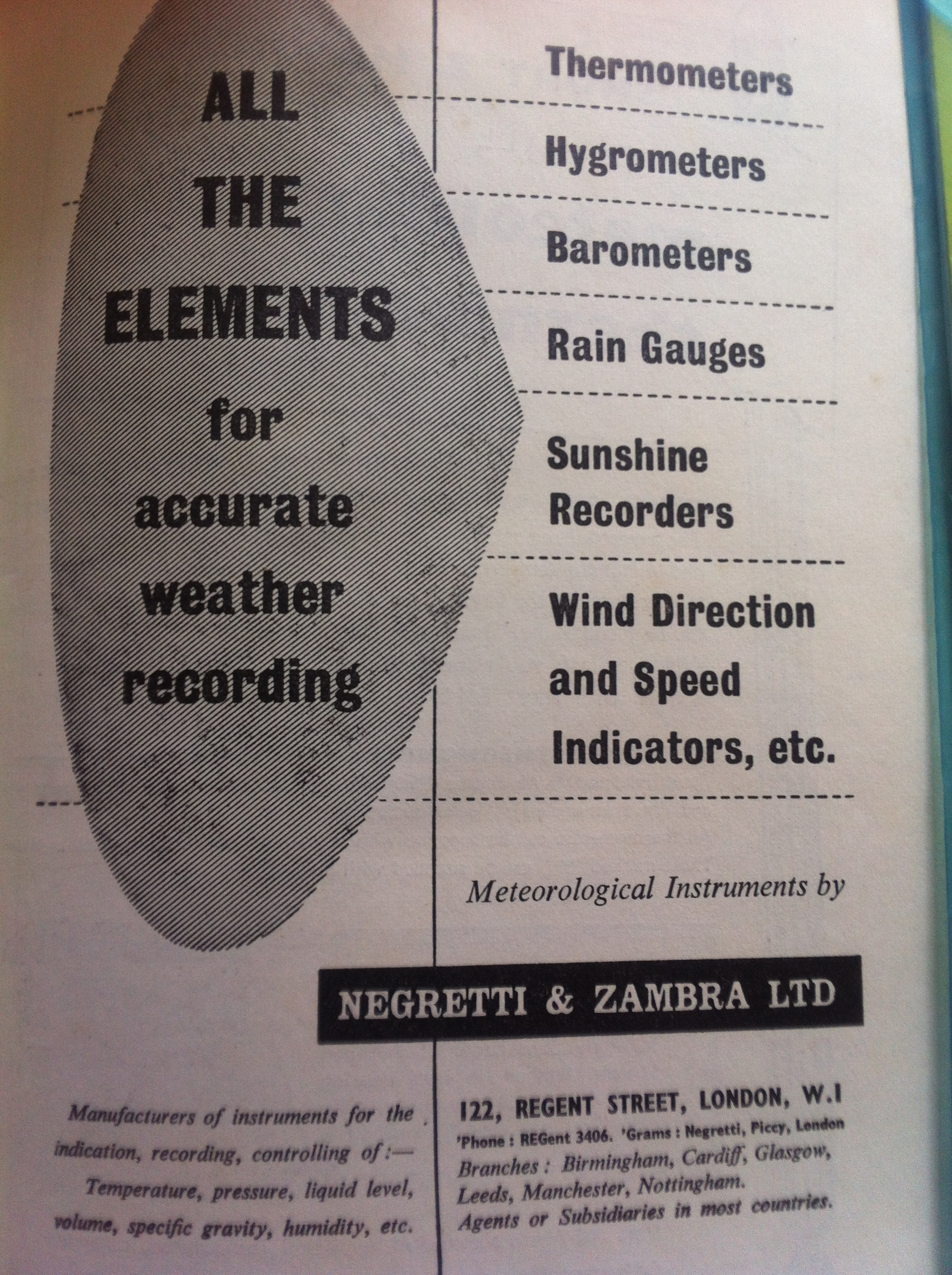
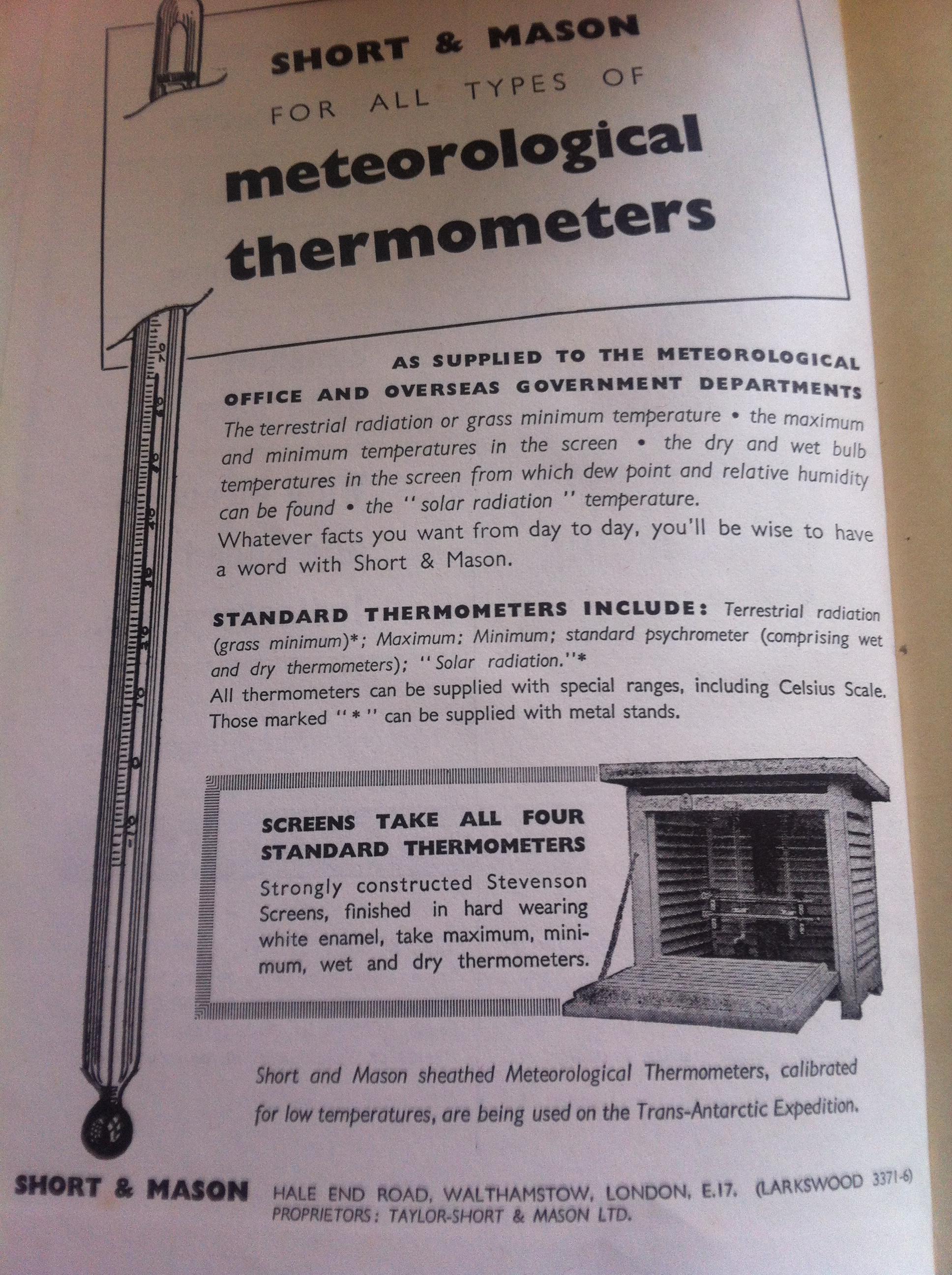
This advert, in an old HMSO Observer’s Handbook, gives a no-nonsense list of what you’ll find at No.122 Regent Street
Negretti & Zambra, at No. 122 Regent Street and later at No. 15 New Bond Street, specialised in barometers and thermometers – everything you could need to set up a weather station. The brand among weather anoraks is the byword for quality. The company, along with Short & Mason, probably made the majority of barometers that adorn many hallway walls across Britain. Next time you visit old aunt Flo or uncle Albert chances are the barometer hung on the wall is made by one of these companies.
Enrico Negretti and Joseph Zambra started their company in 1850, which was run by them and their descendents until well after the Second World War. They had shops firstly in Regent Street and later at Holborn Viaduct. The company was highly successful, winning a medal at the Great Exhibition in 1851, counting among their customers the Astronomer Royal, Prince Albert, the Royal Observatory and Admiral Robert Fitzroy.
Initially they specialised in barometers and thermometers, particularly those needed for taking deep sea and atmospheric measurements, which until they arrived were very unreliable. Later they increased their range to include telescopes, gun sights, theodolites and optical instruments. During the Second World War Negretti expanded substantially to meet the demand for instruments for war planes in particular. Their instruments were also produced under licence to supply the USAAF.
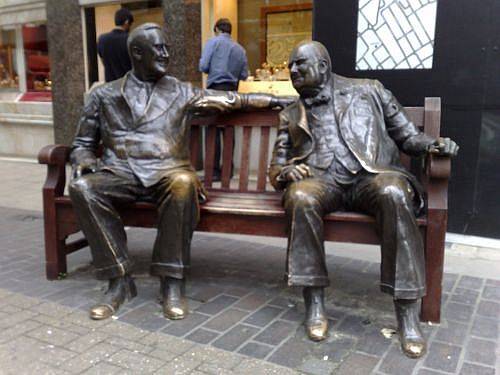
After their stand against Nazism in World War II, the two men helped found the United Nations. Churchill’s mother was American and he and FDR were distant cousins
Go to No.122 Regent Street today and you’ll find a shuttered branch of the Body Shop. The shop at No.15 New Bond Street, which closed in 1975, 11 years after the company moved production to a factory in Aylesbury, is now a branch of watchmaker Patek Philippe. Outside you will find seated bronze statues of Allied wartime leaders Sir Winston Churchill and Franklin D. Roosevelt sharing a joke. The statue by Lawrence Holofcener was unveiled in 1995 by the Bond Street Association to mark 50 years of peace. I’m not sure how intentional this was but how fitting that they are outside Negretti’s old shop, the instruments of which played a big part in helping the Allies to prevail over the Axis.
Back in the day N&Z was highly regarded in the local community and people would phone to access data that the company compiled from its rooftop weather station. In the late 1950s it was the job of Geoffrey John Gill, an office junior who went on to become an apprentice draftsman, to collect these stats.
“I was getting tea, coffee and buns from a Greek cafe in Soho’s Wardor Street for the office staff, collecting the mail and using the franking machine and last but not least the holy of holy’ climbing to the shop roof top and collecting the charts from the sunshine glass ball recorder, the rain gauge, barograph and the hygrometer box. You see it was common in those days for people to phone N&Z to enquire what these readings had been for the past day or so, a typical quality N&Z service.” A full account of his time with the company can be found here.
Short and Mason were based in Walthamstow for nearly 60 years. They supplied instruments to the Polar expeditions of Scott and Shackleton
Short & Mason were established five years prior to Negretti in 1845 by Thomas Short and James Mason. The business was located at 40 Hatton Garden, London, and produced precision measuring instruments including barometers, anemometers, and compasses. They became leaders in the field of barograph design and supplied scientific instruments for the Scott and Shackleton polar expeditions in the early 20th century and for Everest climbers.
In 1910 the company relocated to Macdonald Road, Walthamstow. It was here that 11 years later the company pioneered the theory that a storm forecast could be made from just observing the air pressure and whether it was rising or falling. The company went on to develop aeronautical, medical, meteorological and surveying instruments and were listed exhibitors at the British Industries Fair in 1922 and 1947.
In 1958 the business moved to Wood Street, Walthamstow, where it continued to trade until a merger in 1969 with Taylor Instrument Companies, of Leighton Buzzard, Beds. An account of somebody with experience of working for Short and Mason can be found here.
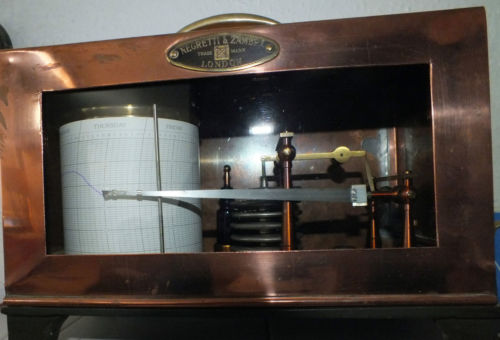
Many examples of Negretti & Zambra and Short & Mason instruments can be found on eBay and antique shops across the world, the finer examples often turn up at auction houses such as Bonhams where they go for thousands of pounds.
Though, like many industries, weather observing has become mostly automated there are are still probably hundreds of observers who still take the manual measurements every morning ‘because they can’. Though this observer relies on an automatic weather station for daily readings – there is nothing like the daily ritual of emptying the Snowdon raingauge or shaking down the maximum thermometer at 0900 GMT every day. One observer who still supplied the Met Office with monthly rainfall readings while in his 80s said that it was the one thing that got him out of bed every morning.
Examples of Negretti & Zambra instruments can be found on eBay
Perhaps it’s a little similar to the ever growing popularity of classic cars. A sense of being able to hold a piece of British engineering history that was so well designed that it still works today.
November was colder than average with a mean temperature of 6.7C (1.2C below the 30-year average) – ranking it 69th in the series since 1881. Rainfall of 56.5mm was 99% of average – ranking it 61st in the series.
The month was just 0.04C cooler than last November – with 93% of the rain that fell in November 2012.
I’m now starting to publish my monthly stats on this blog. This month was warmer than average with a mean temperature of 13C (1.2C above the 30-year average) – making it the 10th warmest in the series since 1881. Rainfall of 83mm was 127% of average.



 Away from the South East the weather was much dryer. Felixstowe and Yarmouth newspapers reported that Sunday had seen “delightfully sunny weather, with cool north-easterly breezes”. Lincoln, meanwhile, recorded less than an inch of rain for the whole month!





 Wanstead Meteo
You must be logged in to post a comment.