Tag Archives: East London weather

Beast MkII or just a late March cold spell?

After the severe spell at the end of February that lasted into this month there’s lots of excitement / dread (*delete as appropriate) that the synoptic conditions that brought very cold air from our east is about to return.

The latest run on the GFS model shows that very cold air (-10C at 5,000ft) could be over us by next Sunday, with the ECM 12Z operational looking particular cold. ec

Snow this late in the year is very rare in the London area though, if the conditions are right, a blizzard is not impossible, as happened during the spring of 1952 when a two-day blizzard at the end of March brought drifts up to 6ft deep in the Chilterns.

Much more likely will be severe, possibly record breaking frosts. The coldest March night since 1959 across the London area occurred on the 3rd in 1965 with -7.4C recorded at Heathrow. Central London fell to -5C on the same night.

A look back at cold spells in March reveals that while snow was very scarce in London and the Home Counties it can be common on high ground from the Peak District northwards.

A history of March cold

1812: Luke Howard in The Climate of London noted that “great inclemency of the weather” on the 21st March disrupted mail deliveries between the north of Scotland and  Carlisle. The road between Appleby and Brough was impassable because of snow and between Sheffield and Manchester and Bradford and Halifax the snow had drifted from “two to three yards deep”.

Mail deliveries were also disrupted across South Wales.
In Plymouth a “a most tremendous gale from SW the whole of last night and this morning” brought flooding.
Howard’s account would confirm a classic battleground scenario of mild Atlantic air from the south pushing against cold Polar continental air in the north.
His own records from Stratford show a couple of cold days from the 16th, highs never lower than 2C, the coldest night on the 24th, being -4.4C. On the 20th he mentions snow in the morning followed by rain.
Wanstead mean: 4.9C (-2.8C) rainfall: 74.4mm (183%)

The following accounts of cold spells in March are recorded on the site London Weather.

1962: The first ‘spring’ month was colder than any month during the preceding winter. Frosty nights were much more frequent than normal, and sleet or snow fell on 10 days, although amounts were often trivial . On the 5th, the maximum temperature was only 2.2 C. Towards the end of the month, north to northeast winds were replaced by somewhat, cloudier milder, and moister south-westerlies. Atlantic fronts brought rain bands, and on the 29th nearly 10mm was measured.
Wanstead mean: 3.3C (-4.4C) rainfall: 36.5mm (90%) sun: 95.4hrs (88%)

1964: The first week of March was mostly cold with wintry showers and a fresh northeast wind. The temperature on the 7th only reached 2.3C. The second week was changeable and milder, and the high on the 13th was near 14C., but on the 15th, rain turned to sleet and gave a total of 26mm as cold air slowly encroached from the east. Nearly 15mm of rain fell on the 19th as milder air returned, but the rest of the month stayed mostly rather cold and changeable.
Wanstead mean: 4.9C (-2.8C) rainfall: 80.4mm (90%) sun: 63.5hrs (58%)

1969: The first week was mainly dry, and although dull and cold at first, it became fairly sunny and milder but with severe frosts. Overnight on the 6th/7th the minimum temperature was close to minus 8C. During the second week it became dull and wet, but after a cold start temperatures rose above average. Cold north-easterlies returned on the 16th with a high of only 3C., and cloudy, rather cold, and often wet, weather persisted until westerlies returned on the 29th.
Wanstead mean: 4.6C (-3.1C) rainfall: 53.2mm (131%) sun: 55.8hrs (51%)

1979: The first 12 days of March were changeable and windy with temperatures mostly above average. A wave depression formed on a cold front and produced 23mm of rain on the 13th, and as this depression became slow moving to the east of the country the rain turned to sleet and snow on the 14th, and continued into the 15th and 16th with highs near 3C. After mid month, the weather became less unsettled and milder, and the high on the 25th was near 15C.
Wanstead mean: 5.8C (-1.9C) rainfall: 96.5mm (237%) sun: 100.5hrs (92%)

1985: After a changeable start to the month, pressure built, and it became mostly dry, although often rather cloudy, with temperatures close to normal. On the 15th, showery rain turned to snow during the morning, and several cold and unsettled days followed. Sleet or snow fell on 5 days, and on the 21st the temperature failed to rise above 5C. Sharp frosts occurred, and although it then became less cold, the 26th was a miserable day with 11m of rain falling.
Wanstead mean: 5.9C (-1.8C) rainfall: 44.1mm (108%) sun: 100.5hrs (87.4%)
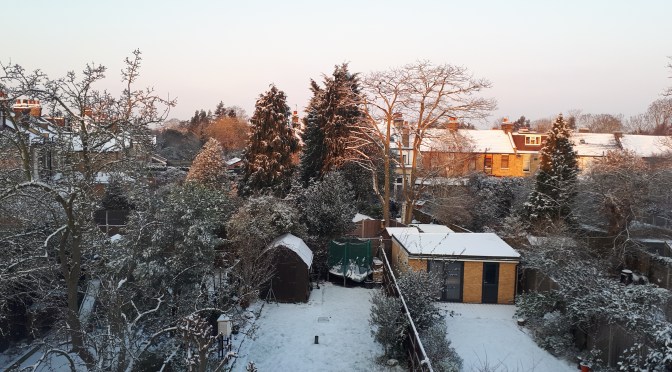
February 2018: cold, very sunny, snowy end

February 2018 saw the start of the first decent cold spell since 2013 with thick (by modern standards) snow cover, deep cold air and bitter winds.

Screen Shot 2018-03-03 at 15.50.35
February 2018 is marked by the steady downhill temperature trend from the 18th.

It was the coldest February since 1991, the mean temperature of 2.8C was just over 2.5C below average. The month was ‘cold’ though it was the 19th onwards that really dragged the value down.

Precipitation was just below average; just over 34mm is 87% of average.

It was a sunny month, the sunniest February since 2012 and the 12 sunniest in a local record going back to 1881. Some 87.9 hours were recorded, 120% of average. Of that top 12, eight have occurred since 1988! A mix of changes in weather patterns, industry and council action?

Air frosts: 16. Ground frosts: 19. Snow falling: 6 days. Snow lying: 3 days (greatest depth 8cm 28th)

Full stats for February here: http://1drv.ms/1rSfT7Y

settled snow 28th
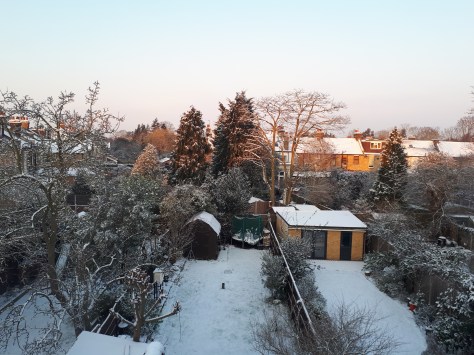
The 28th dawned sunny with fresh snowfall after an hour long shower at 3am. Within hours more showers moved in.

The most potent cold spells since 1960

‘This cold spell is rubbish compared to what we used to get!’
Every winter when weather model hype builds expectation for many, often days in advance, the outcome never seems to quite match the hype.

This expectation among weather nerds is inflated even further when the tabloids cotton on and build anticipation further only for it all to end in a ‘damp squib’.

I’ve lost count of the number of times when excited enthusiasts proclaim that an incoming cold spell is going to last at least three weeks; the reality being that the intensity of the cold has gone after four or five days. Cold spells since 2008 often arrive as a ‘blob of cold air’ from the continent that eventually gets ‘warmed out’; it’s been a very long time since we had a cold spell that’s been fuelled by a continual feed of air off the continent.

Screen Shot 2018-02-22 at 09.02.23
In 2018 the really cold air aloft had warmed after 5 days

To illustrate my point I had a look back at every cold spell in this area of suburban east London since 1960. I weeded out the feeble efforts of the last few years by only considering spells where the maximum didn’t exceed 2.8C. The results spanned from the most recent very localised cold spell of December 2022 to the mammoth 31-day Siberian blast that began on Boxing Day 1962.

In another blog I remarked how similar the 2018 pattern was to February 1962. This cold spell began on the 26th and lasted 9 days. Some 7cm of snow fell, this drifting in the wind, possibly making it seem worse with only 4 hours of sunshine which would have maintained any snow cover.

One of the snowiest cold spells happened in February 2009, eight days after an SSW event that lead to a polar vortex split. This four day spell saw a total of 26cm of snow fall.

February 1991 was even snowier, the intense cold lasting some 11 days.

Looking at other February cold spells a 7-day spell occurred in 1985 about a month after an SSW event.

Overall the median length was 5 days with an average of 6cm of snow and 8hrs of sunshine.

*A survey of winters ranked for temperature and snow can be found here.

2022cs

The cold spell of February / March 1962

The last week or so has been agony for model watching coldies wishing for a snowy end to winter.

27021962
The Synoptic chart for February 27th which saw 4 inches of snow in Stratford, east London

Solutions have often flip-flopped between a mild and cold outlook. Even this morning at 6 days out the GFS and ECM model temperature outcomes differed by some 20C, a choice between spring and deepest winter!

Sometimes you have to try and second guess what is going to happen by looking at previous patterns from years past.

Yesterday at Philip Eden‘s funeral I spoke to Woodford Green resident Ron Button. He pointed out how much this February reminded him of February 1962, a month that was non-descript for the first three weeks before turning very cold and snowy. Ron, who has kept a meticulous record of the weather ever since his interest was prompted by the severe winter of 1947, produced diaries of 1962 when he was living in Stratford. The entry for 26th / 27th read: “4 inches of snow with drifting”!

The March that followed was the coldest of the 20th century, ranking 10th in my list back to 1797, and 0.3C colder than March 2013. The fact that the monthly sunshine in 1962 was only slightly below average is testament to how cold the source of the air must have been. March 2013 was very dull by comparison!

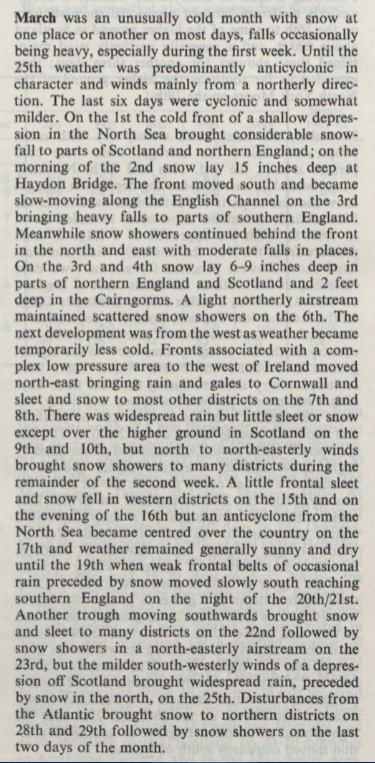
An entry in London-weather.eu reads that March was colder than any of the previous 3 winter months: “The first three weeks were mostly mild and dry. It was often breezy which resulted in fewer than average night frosts. Frontal systems off the Atlantic passed through the London area, most of them weak though on the 12th, nearly 8mm of rain fell with southwesterly winds gusting to 57 knots. During the last week of the month, it became much colder, and on the 26th snow fell with the temperature not rising above -0.3C all day.”

There was no stratospheric sudden warming that winter and ENSO was neutral.

The winter of 1961/62 ranks only 14th in my list of worst winters, mostly because the core of the cold happened in March which is considered spring in meteorological circles

Screen Shot 2018-02-16 at 13.54.17

march 1962 summary

The Snow Survey of Great Britain also makes interesting reading with these entries for February and March.

feb1962feb19622

march 1962

A new weather station for Wanstead

Wanstead has a new automatic weather station to complement the one set up in November 2012.Screen Shot 2018-02-13 at 19.13.20

The new AWS, situated in the grounds of Wanstead Golf Club, comes thanks to Friends of Wanstead Parklands. Data from the unit, which is sited very close to where Wanstead House once stood, will be used to help monitor the levels of the park’s lakes.

The sensor unit, 750m NNE of the weather station wansteadweather.co.uk on the Aldersbrook estate, is much better exposed and will hopefully offer more accurate wind and sunshine readings. It will also provide a chance to further investigate the area’s microclimate.

The station has already shown that the golf course is warmer on a radiative cooling night than the Aldersbrook Estate. Screen Shot 2018-02-18 at 14.22.08

The AWS can be found at WeatherCloud https://app.weathercloud.net/d0507444306#profile

Also at Weather Online
https://www.wunderground.com/personal-weather-station/dashboard?ID=ILONDON737

It also tweets hourly and provides an automatic 24hr daily summary. You can follow it @WansteadParkWX

Hourly tweets and all things weather continue as normal at @wanstead_meteo

wxmap.PNG

How does an SSW affect London’s weather

There’s been much anticipation regarding the forthcoming sudden stratospheric warming (SSW) event with many hoping that a resultant split vortex will result in unseasonably cold weather in the UK and… copious snow in the low-lying south-east.

An SSW event, which reverses winds high up in the atmosphere from a westerly to easterly, can downwell into the troposphere, bringing weather from a (usually) cold continent instead of the warm Atlantic.

While a split PV event is usually more conducive for cold weather in the UK, as opposed to a ‘displaced vortex’, which usually favours only the eastern US, it is by no means a guarantee of a cold pattern subsequently evolving.

Screen Shot 2018-02-09 at 18.43.11Using results published in the paper Tropospheric Precursors and Stratospheric Warmings (Judah Cohen and Justin Jones), along with meteorological data for east London, I set out to find what influence past warmings had on the weather in the capital.

Looking 45 days either side of the central date for vortex splits gave the following, chaotic graph.


Screen Shot 2018-02-09 at 18.08.00

But every year is different. And there appears to be more likelihood of an SSW making a difference, in terms of prompting a colder pattern, the earlier in the winter it occurs.

The SSW in 1985 was followed by a 45-day mean temperature anomaly of -3.8C! If you look at a shorter timescale, 15 days after a split PV and the anomaly is -10C on January 16th: -4.9C is the second coldest January day in Wanstead of the past 60 years.

At the other end of the scale the SSW event on March 23rd 1965 was followed by a POSITIVE anomaly of 3.4C. Perhaps solar influence this late in the year can override any SSW? Elsewhere, however, according to the website london-weather.eu: “3rd March – A combination of deep snow cover and clear skies allowed minimum temperatures to fall below -21C in northern Scotland.”

During another SSW in 2001 results in London were fairly unremarkable though heavy snow fell in Ireland.


Screen Shot 2018-02-09 at 19.33.43
This graph shows a general downward trend in the 15 days following an SSW event

Screen Shot 2018-02-10 at 10.42.39The other result to consider is the influence from ENSO. It seems that when La Nina is ‘too negative’ this can ‘overcook’ proceedings and actually leave our part of the UK with a positive anomaly, as this table shows. It should be noted, however, that thicker Arctic ice in the 1960s would also possibly have had more influence than now.

There hasn’t been a full SSW event for years. The impact this one will have on our weather in London, a tiny part of the globe, is impossible to quantify. Though the latest model output is encouraging for anyone looking for a chilly end to winter.

Screen Shot 2018-02-09 at 19.48.42

And here’s @wxcharts idea on two weeks from now.


The ‘nearly cold spell’ of February 2008

Recent model output that has many bullishly predicting a cold spell in February reminds me of the winter of 2008 when the likes of the GFS and ECMWF models kept teasing us that a Scandinavian high pressure was imminent.

This rare pattern brings the south-east its coldest weather in winter, in the past bringing the January 1987 and February 1991 cold spells.

feb16
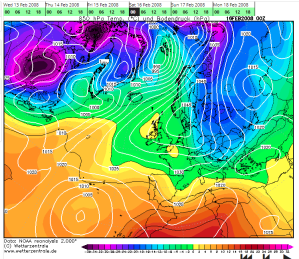
Midnight on February 16th 2008 just before the high moved south, taking its cold weather into the Balkans

A look back at the pressure patterns in 2008 show that high pressure was in the ‘right place’ between the 11th and 16th but, just as -10C uppers looked poised to flood across from eastern Europe, the high pressure collapsed south, leaving the UK in a SE’ly flow off a mild France.

There was snow in 2008 but it didn’t arrive until the spring, in late March and, the best fall, in early April when I remember waking up on the 6th to a 5cm covering that mostly melted by lunchtime.

I suppose the one silver lining for any coldies reading this is that February 2008 was the sunniest on record.

2017
The mean temperature for December 1st – January 30th is 6C for both 2007/08 and 2017/18

The maps below show the sea surface temperature anomalies. A slight La Nina on both. ENSO, considering my winter forecast, has been the best guide for how this winter has so-far panned out – front loaded.

Screen Shot 2018-01-30 at 11.49.50

Screen Shot 2018-01-30 at 11.50.40

wl
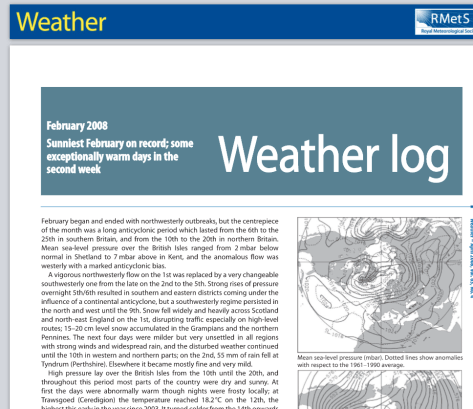
Philip Eden’s column in the journal Weather showed that there was some wintry weather in February 2008 but it was restricted to the north of England northwards

* The focus of these blogs is usually on what the weather was, or may be, like in my backyard – though they usually broadly apply to anywhere in the south-east that is close to sea level.

A 100% guaranteed snow risk for rest of winter

This weekend marks the halfway point through winter. Though December brought some snow January has been broadly average – really cold air has been absent with only one air frost recorded this month.

The cloudy, anticyclonic type weather is about to be replaced, however, with cold, polar maritime air this week set to flood down from the north-west.

Since December 1st, Wanstead has recorded 12 air frosts – about average. The coldest night was just -3.7C. The current mean temperature this winter to January 14th is 5.7C with rainfall 111mm – statistics that are remarkably similar to the winters of 2012/13 and 1990/91. Both those seasons were followed by cold late winters, February 1991 saw some of the deepest snow that I’ve ever seen in the south-east; the mean temp for that February finished 1.6C, the 14th coldest in the local series going back to 1797.

Using my method for finding patterns stretching back over 50 years to forecast this winter I picked out years that were +/- 10% of the 2017/18 total rainfall. From these I then weeded out the seasons where the average temperature was +/- 10% of the 2017/18 mean.

This gave a list of just two other winters with similar temperature and rainfall. Both winters had above average ‘snow lying’ days, the long terms average for this area being six.

Before any readers accuse me of going all Daily Express with the title of this blog I would emphasise that this piece doesn’t echo the latest long-term output from the models, which are in a state of flux, caused mostly by the evolution of the explosive cyclogenesis expected midweek. It is simply a reflection of what the local data is telling me.

A 100% guarantee of snow isn’t such a fantastical claim as, during the past 10 years, there is only one winter when no snow fell or was lying at 9am!

In terms of the rest of the winter, outside of the models, I would expect a couple more snowfall episodes, similar to the ones we had in January and February 2013. A repeat of February 1991, while not impossible, looks unlikely – there seems to be far too much energy coming from the Atlantic to allow the all important Scandinavian / Russian high to form and exert its influence far enough west for long-lasting cold and snow.

The cold spell of January 1826

This weekend marks the start of a cold spell that brought widespread wintry conditions across Britain.

Entries in Luke Howard’s Climate of London detail several instances of the wintry weather reported nationwideScreen Shot 2018-01-06 at 01.41.17.

In London the freeze lasted 10 days, briefly losing its grip on the 19th, before returning in the final week. At its lowest on the night of the 14th the temperature fell to 10F (-12C). Despite the intense cold their was little precipitation in this area. However, across the country came reports of deep snow and hardship for shipping.

Gale force easterly winds were reported in Plymouth, Falmouth, Liverpool and Portsmouth on January 7th and 8th. On January 9th a ‘hard ENE’ly gale’ was reported at Deal, Kent.

A report reads: “It has continued blowing strong from the eastward all this day. On Thursday morning between one and two o’clock as a person was passing through Paternoster Row he observed the watchman on that beat in a state of complete paralysis and insensibility occasioned by the frost.

“He had him immediately removed to the watch house of Farringdon, within where he had not long arrived when a fellow sufferer was brought in by two of the patrol who found him in his box in Stationers Court, Ludgate Hill, absolutely frozen and unable to articulate a syllable.

“Both were immediately placed near the fire the influence of which combined with the administration of warm cordials shortly restored their suspended faculties. The thermometer at the Royal Exchange yesterday at 12 o’clock stood at 28F.”

An entry on January 14th, nearly a week into the freeze, reported a Thames “choked up with ice”.

“The river is so completely choked up with ice that the fishing boats with fish dare not come higher up than Limehouse. Putney Bridge arches are choked up with ice formed by the ebbing and flowing of the tide to a great height. At one o’clock yesterday afternoon (16th) the fog in the city was as dense as we ever recollect to have known it.

“Lamps and candles were lighted in all the shops and offices and the carriages in the streets dared not exceed a foot pace. At the same time five miles from town the atmosphere was clear and unclouded with a brilliant sun.

“Fahrenheit’s thermometer stood at 14F at 8 o’clock in the morning.

Around Britain

Newcastle: on Sunday morning last a severe frost set in here and has continued since. A considerable quantity of snow has fallen during the week.

Sunderland: the river Wear has been frozen over for the last four days down to Hilton Ferry within four miles of this town. The navigation above that place is entirely suspended.

Carlisle: a smart frost set in here on Monday morning and has continued gradually increasing up to this day Friday in severity. The river Eden is more than half frozen over near the bridge and many persons are diverting themselves on its surface. On Tuesday we had a partial fall of snow which still continues.

Westmorland: on Stainmore the weather has been more severe during the last week than it has been known for four years past. The frost is not only more than usually intense but the snow lies in fearful drifts and the wind on Friday and Saturday blew a perfect hurricane rendering it extremely difficult if not dangerous to travel.

Chester: the frost during the last week has been intensely severe and the wind is gentle and blowing almost constantly from the eastward. The thermometer on Saturday morning stood at 17F or 15F below the freezing point.

Manchester: on Friday last the temperature in the city was as low as 16F and this in the very centre of the town where the crowded buildings and immense fires kept in the manufactories must have had some effect on the atmosphere. On the 18th of January 1814 the extreme temperature was 22 below the freezing point. On the 21st of February 1810 it was the same.

Liverpool: the weather during the last week has been intensely cold, the thermometer for the last few days having been lower than during the past five years. A self registering thermometer denoted the extreme of cold on Saturday night to have been 19F and yesterday, Sunday morning at half past seven, it stood at 20F. It is very probable the present weather may continue several days as it commenced with the new moon.

Bridgewater: our river is so completely frozen over as to impede the navigation fortunately there is a good supply of coals in the town.

Canterbury: On January 17th the river Medway is frozen over and the navigation is stopped. The merchants have advanced the price of coals six shillings a chaldron.

The Royal Military Canal being now completely frozen over numerous parties are daily skating thereon. It is not unusual to take a breakfast at Hythe, a luncheon at Rye (about 20 miles glide) and return to Hythe to dinner.

On the continent

Elsineur:  the sound is full of ice and the navigation suspended. (January 14th ).

Hamburg: the frost is very intense and every appearance of its continuance. Extract from a private letter dated ‘Cadiz Jan 24’: ‘We have had terrible gales at this place so violent that upwards of two hundred and fifty vessels were driven on shore.

Rotterdam: We have had frost again from the 25th but very moderate and the ice has but little increased. The wind prevails from the eastward and there is no appearance of a thaw.

Antwerp: the river continues full of drift ice. An easterly wind took place on the 25th January. The ice decreases very fast (31st) and if the thaw continues for which there is every appearance the river will be navigable in two days.

The mean temperature for the month finished 0.7C, the 14th coldest January in London back to 1797. Just 5.1mm of precipitation was recorded, the second driest January in the series. Screen Shot 2018-01-06 at 22.31.39

December 2017: average temps, wet

December 2017 was a wet month. Just over 83mm of rain was recorded, 157 per cent of average, the wettest December since 2012 and the 38th wettest since 1797.

Screen Shot 2018-01-03 at 19.30.21
The snow depth on December 10th reached 5cm at its maximum

The monthly mean finished 5.6C, precisely average and the coolest December for five years.

Some 48 hours of sunshine were recorded, 120 per cent of average, slightly less than last year.

The most notable event was the on December 10th which produced the best snowfall in 5 years

Air frosts: 10. Ground frosts: 14. Snow falling: 2. Snow lying: 1.

January (on the 3rd) is looking like it may produce more snowfall events similar to December though, with models suggesting a build in heights to the north. A look at the output, including GFS and ECM, suggests the UK will be in a battleground between a cold airmass to the east and warm Atlantic air to the west.

It would seem to back up my winter forecast and also the December analogues with nothing warmer than average.

Average: 33%
Rather cold: 17%
Cold: 17%
Very cold: 0%
Severe: 33%

Screen Shot 2018-01-03 at 19.29.51

Full stats for December here:http://1drv.ms/1rSfT7Y

Summary for December 2017
Temperature (°C):
Mean (1 minute)  5.8
Mean (min+max)   5.5
Mean Minimum     2.8
Mean Maximum     8.3
Minimum          -3.7 day 11
Maximum          14.2 day 30
Highest Minimum  9.8 day 21
Lowest Maximum   2.4 day 10
Air frosts       10
Rainfall (mm):
Total for month  83.7
Wettest day      14.6 day 10
High rain rate   12.1 day 31
Rain days        21
Dry days         10
Wind (mph):
Highest Gust     25.1 day 30
Average Speed    3.5
Wind Run         2570.0 miles
Gale days        0
Pressure (mb):
Maximum          1036.4 day 22
Minimum          970.3 day 10
Days with snow falling         3
Days with snow lying at 0900   1
Total hours of sunshine        48.3 (120%)
Screen Shot 2018-01-03 at 19.30.41