A blog that tries to make sense of how the UK's national climate translates into local weather for Wanstead and the surrounding regions of east London and west Essex.
Check out my twitter feed @wanstead_meteo for local weather forecasts, stats, records and phenomena for the east London areas of Wanstead, Aldersbrook, Leytonstone and Stratford. And anything else weather
Thunderstorms and prolonged heavy rain aren’t what you usually associate with the Aegean in August. So to experience three days in a row of inclement weather must be rare in this beautiful part of Europe.
Water from the hills above turned local roads into rivers
Arriving at the end of a heatwave the owner of my hotel in Skiathos remarked that humidity had been particularly high though temperatures had cooled from the previous week’s level of 36C – not bad in itself but when you consider the low fell to just 27.1C those sorts of values make it impossible to sleep without air conditioning.
Sunshine on the first couple of days came to an abrupt end on the Friday night with the arrival of the first disturbance – the sound of thunder and torrential rain audible above the low buzz of the air conditioning. The storm gradually cleared in the morning to leave sunny spells by the afternoon.
This process repeated itself over the next couple of days although by the third night only heavy rain developed. Since returning to the UK I’ve had a look at statistics from a weather station located on the north of the island near Kastro. Rain totals on August 21st, 22nd and 23rd were 36.2mm, 39.2mm and 34mm respectively – bringing the total for the month to 113mm, nearly three times what fell last August. Looking at national Greek totals on Ogimet the disturbance was very localised.
Torrents of water from the storms caused deep scars in the landscape. I spotted this at the edge of an olive grove during a walk through a forest to Mandraki
The torrents of rain carved deep gorges in the paths that criss-cross the island. And during a walk from Koukounaries to Madraki part of the impacted sand/soil road down to the beach had been washed away.
Locals didn’t seem that phased by it and judging by the number of tavernas with wind down sides to their awnings it is perhaps a common feature of the climate?
Mean temperature for August was 0.3C up on last year: 27C, though the number of days of >32C was nearly half last year.
The island, part of the Sporades, is famous for being the location where the hit musical Mamma Mia was filmed – though most filming was done on neighbouring Skopelos. It’s a very green area – much more so than southern islands I’ve visited such as Ios and Crete which are arid by comparison.
During a visit to Skopelos, which has a landscape that looks almost Alpine from a distance with its pine forested hills, I was puzzled by the lack of wind turbines, especially considering how reliable wind seems to be in the surrounding waters.
One of the many stunning beaches on Skiathos. This bay is close to Mandraki
Greece does have an extensive wind power programme though much of it is based in the mountains in the north. EU politics over energy tariffs also probably play a part.
Thunderstorms also played a part on our flight home. As we crossed the mountains of Macedonia and the Balkans to the north I could see vast cumulonimbus begin to form. The pilot made an excellent job of keeping turbulence to a minimum by steering us around these forces of nature – a couple of which reached above our cruising altitude of 39,000ft.
* Storms also affected Skiathos and Skopelos in September. A weather station on Skopelos reported 209.6 mm on 22nd September, with an additional 56.2mm on the day before and 49.2mm the day after. The month there has abundantly given 317mm, but this is *not* the wettest area of Greece for September so far. The very warm seas at this time of the year have given numerous places a lot of precipitation, backed up, of course, by great support aloft .
The storm caused much damaged and devastation to infrastructure in the towns in Skopelos.
The island of Skopelos is even more stunning than SkiathosMuch convective development could be seen during the flight home as we crossed Macedonia and the Balkan mountains to the northThe pilot made a good job of steering round the storms. It made a change to see these marvels of nature from above – though some still developed higher than our 39,000ft cruising altitudeIn a shop close to Koukounaries beach I noticed this selection of snowy pictures that were taken on the island a few years ago. Being north of Athens it is not surprising that they occasionally see snow here
Summer 2015 has got quite a bad press over the past couple of weeks but it hasn’t really been that bad overall in this area. And, as ever with the weather, it wasn’t without interest.
Though the summer was wet overall it was very dry well into July
Two extreme records were broken: The maximum on the 1st of July of 36.1C and the minimum on the 30th of July of 6.9C. There were also a couple of cracking thunderstorms.
Mean temperature for the three months was the lowest since 2012, the same year that saw more rain than this summer’s 167.7mm. Both 2012 and 2011 were a fair bit wetter than this summer and this season’s rainfall wasn’t a patch on some of the washout summers of my youth – both 1985 and 1987 were at least 150% wetter than summer 2015.
More notable was the lack of sunshine – it was the dullest summer since 2002.
Looking beyond Wanstead the perceived poor summer elsewhere was largely caused by cooler than normal sea temperatures west of Ireland, together with warmer water around the Azores. Simon Keeling explains this well here.
Three months ago I predicted that summer would be broadly average temperature-wise with average to slightly below average rainfall and average sunshine. So how did the forecast do?
In terms of temperature my predicted figure of 17.4C was 0.5C lower than the result. My rainfall prediction was only 76% of what actually fell and I over-estimated sunshine by 16%.
Despite some of the dire reviews of summer elsewhere in the UK there were some fine spells
This August was the third dullest since 1881. I’ve seen mentioned recently that August used to be regarded as an autumn month. For the past couple of years the final ‘summer’ month has been very disappointing for anyone looking for fine weather – much more akin to September or even October.
A storm in south London gave this eerie light seen at Southwark Bridge on the 5th
The first third of the month began pleasantly enough with a couple of days exceeding 27C. And on the 22nd the temperature reached 31.4C, only the third occasion that the mercury has risen above the 30C mark this summer. But summery highlights were few and far between.
Just under 120 hours of sunshine were recorded – that’s 62 per cent of the monthly average, the dullest August since 1968.
There were six occasions when the maximum exceeded 25C. Mean temperature for the month was 18.2C, which is on the nose of the 1981-2010 mean. Rainfall of 79.8mm was 159% of average. The wettest day occurred on the 24th with 18.4mm of rain.
What has September got in store weatherwise? The models today (September 1st) suggest a very slow progression of high pressure ridging into the UK from the west this weekend. Until then a cool northerly flow will persist with a mix of sunshine and possibly heavy showers. Most models suggest that by the end of the week a trough will run south, bringing a spell of cloud and rain before high pressure from the west eventually cuts off the cool northerly, replacing it with little or no wind, warmer sunny spells by day and misty nights – typical late summer / early autumn weather. Models then split over what will happen with the high next week. It could stay settled or, according to the ECMWF and GFS, the start of a breakdown could happen at the end of next week.
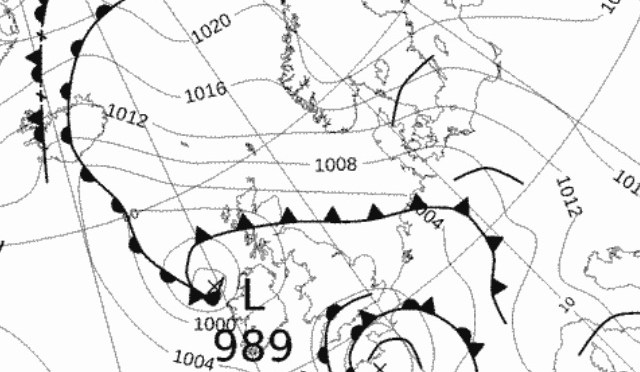
The synoptic chart shows the frontal set up that brought the greatest daily rainfall on the 24th
My long range outlook method suggests that September will be average temperature-wise, a mean of about 15.4C, at 52% probability. The next highest probabilities are for something rather warm and warm, both at 14% probability, though something rather cool also comes out 14% probability.
The highest probability for rainfall is 45% for something average. The next highest probability is for a dry September, at 23%. Rather wet works out at 14%.
My data for sunshine only stretches back to 1878. There is a 60% chance of average sunshine in September.
My August outlook was OK – I went for an average to rather cool August. I also said there was a 73% chance of a duller than average August – so not bad overall.
Here follows the full weather diary for August…Full stats for the month here:http://1drv.ms/1rSfT7Y
1st Bright but hazy start. Cloud gradually thinned to give a sunny afternoon with just a few clouds. Warmer.
2nd Sunny start with decreasing cloud.
3rd Sunny start quickly turned cloudy and blustery with brief burst of rain at 4pm. Then dry with variable cloud overnight and breezy.
4th Bright start but lots of cloud around and breezy. This lasting through the day.
5th Cloudy start, a few bright intervals and a strange light as thunder clouds passed to the south. Some light rain.
6th Cloudy start but cloud thinned to become sunny just before 2pm. Then variable cloud through the day with another eerie sunset.
Many places around the coast recorded far more sunshine than Wanstead, typical of the type of weather experienced in August
7th Sunny start though was very cloudy at times.
8th Bright start and cloud quickly melted away to leave a stunning, sunny day in Sussex and Camber. Some cloud was seen a few miles inland but even this eventually melted away. Night turned chilly with heavy dew by dawn.
9th Sunny until 3pm then a bank of cloud brought cloudier spells. Warm overnight.
10th Bright start with sunny intervals. A burst of rain at 2pm damped the ground then it was mostly cloudy for the rest of the day.
11th Cloudy, calm start, spits and spots of rain before more organised rain in evening.
12th Cloudy start then brief sunny spells late morning before clouding up again. Warm front stalled over South Coast dumping 32mm on Herstmonceux.
13th Cloudy with rain spreading in late morning, this lasting until 3pm with odd burst of drizzle for rest of night. Some 78mm in Polegate and flooding reported in Brighton.
14th Cloudy and very humid with some brightness late morning. Showers returned at 3.30pm then more general rain arrived at 8pm.
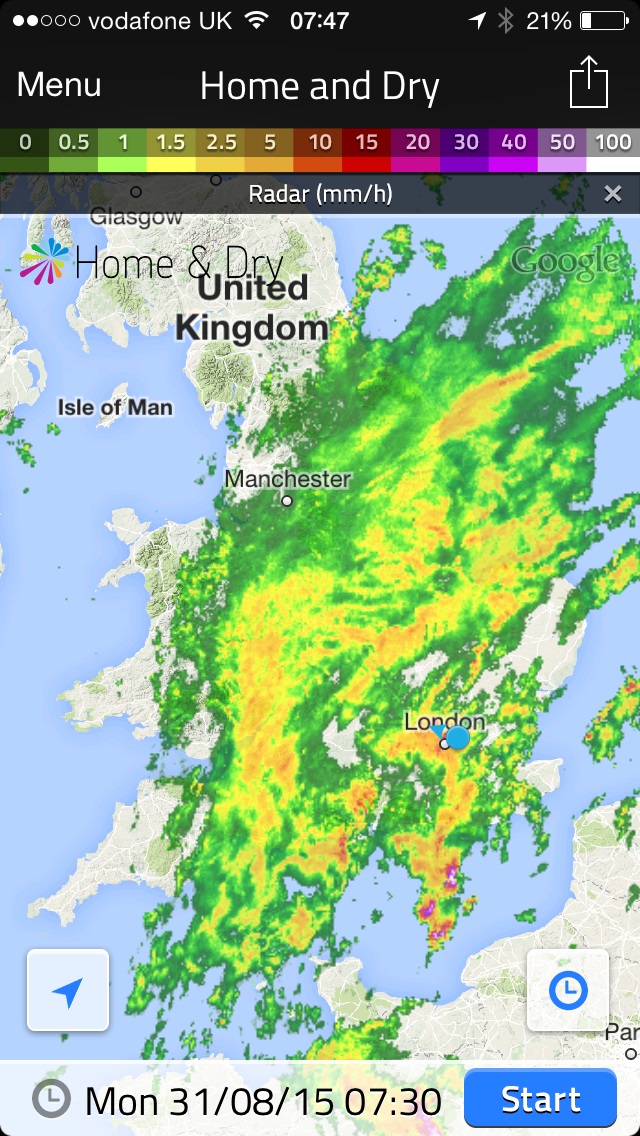
This radar shows the area of rain that brought over 10mm to Wanstead on 31st
15th Sunny start, clouded over at 2.30pm but then became sunny again at 5.30pm. Clear spells overnight.
16th Sunny start then cloudier in the afternoon. Very still air though made it feel pleasant.
17th Sunny start then cloudier around lunchtime. Sunny spells late afternoon though sun didn’t feel that strong.
18th Sunny start though quickly clouding over and dull. Some spots of rain on way to airport but dry in Wanstead.
19th Sunny start then going downhill with rain in the evening and overnight.
20th Bright start, clouding over.
21st Bright start before breaking to sunny spells and warm.
22nd Long sunny periods and 3rd occasion of 30C.
23rd Bright start but cloud built to give rain between 12.45 and 2.45pm.
24th Dull, rainy with rain between 9am and 11am.
25th Rain between 1pm and 3pm. Showers overnight then more general rain at obs time.
26th Dull and rain morning with squall blowing through at 1.30pm. Brightening up by 5pm then some bright spells late afternoon.
27th Bright start but with heavy cloud present. A brief shower in the afternoon before a clear evening made it chilly overnight.
28th Sunny start with light breeze, tending to cloud over middle part of the day. Skies cleared again to give sunny, pleasant evening.
29th Sunny start, cloud filled in by 3pm then rain arrived at 4pm, with moderate bursts.
30th Cloudy and humid start. Cloud stuck around all day – airless and therefore felt pleasant.
31st Cloudy start after overnight rain. The rain soon returned after 10.20am and fell, often heavily through until 12.30pm.
This month 180 years ago a huge fire consumed a large area of Wanstead Flats. Approximately one tenth of the total 335 acres of grassland was set ablaze – the cause believed to be a discarded tobacco pipe.
Looking east over Wanstead Flats from Centre Road. Long Wellesley sold off a lot of the peat on the Flats to local nurseries
At first the fire was ignored – locals thought the blaze would burn itself out or that rain would damp it down. However, it continued to grow. The Bucks Herald, on August 15th 1835, reported that in a period of three weeks the Flats had become “one mass of fire” and that in many places the blaze had descended to a depth of two feet from the surface of the peaty surroundings.
Locals, in an age where the Fire Brigade was still 30 years away from being formed, sought to put out the flames themselves. A number of horse-drawn watering carts belonging to the Essex Turnpike Trust were commandeered to carry water from a pond to extinguish the flames. For the best part of nine days residents tried in vain to defeat the fire.
Mr Speering, the deputy of the Lord of the Manor, the hapless Mr Long Wellesley, was summoned to convey the desperate circumstances to the government of the day – to try and appeal for help to defeat the blaze. Some 70 men, miners and “sappers” from Woolwich, duly arrived to dig a trench 5ft wide and six to eight inches deep around the perimeter of the blaze, but it was not before much damage was done to the land that locals depended to feed their cattle and horses.
Looking at the statistics of that summer the temperature and rainfall looks fairly average – ruling out a dry spell being the catalyst of the inferno. It was suggested at the time that the fire was exacerbated by neglect of the land – the blame therefore lying ultimately at the door of Long Wellesley.
The slow reaction time by the government of the day prompted the following poem to be published in the Leeds Times:
WANSTEAD FLATS ON FIRE
Go, ring the alarm bell, call the Crier.
And warn the neighbours the Flats are on fire.
Not Wanstead Flats; no, duller far,
And dryer, the Flats I speak of, are,
Made, like old timber that hath the rot,
Old rages, old shavings, and what not,
To crackle and blaze with vast elation
I a brief but furious conflagaration;
But enough – what need of further words? –
The Flats are on fire in the House of Lords!!
There’s Winchelsea “flaring up”, like a rocket,
With lush-light Clumber, low in his socket;
There’s Strangford blazing like red-hot steel, And Lyndhurst ignited from head to heel;
Cumberland makes that sort of show,
He’ll make one day in the – – -,
Whiz! goes Law, tied fast to the Duke,
Like a squib to a pedagogue’s peruque;
Wicklow and Buckingham, blessed pair!
Flash, like the Lesser and Greater Bear; –
In short, their Lordship’s, like Dido’s pyre,
Are all just now one mass of fire!
‘Tis a sad – a terrible case no doubt;
What shall we do? Shall we put them out?
No, let them blaze away, while we
Look on with undissembled glee,
And laugh to think, like rational folk,
How soon their fire will end in smoke!
Cold front clearance over Wanstead Flats on February 28th. The day saw three potent cold fronts with steep temperature falls. <5mm hail in the last and thunder heard in Woodford Green
Though officially the House of Commons held the reins of legislature the House of Lords still held great influence, as Lord Wellington noted that year: “The House of Lords still constitutionally possesses great power over the legislation of the country”.
The current custodians of our local parklands, City of London Corporation, would do well to take note from this story. While they are taking action in improving the care of the land it is obvious from the comments I hear while walking around the Flats and Wanstead Park that much more needs to be done.
The title of this monthly review is probably very misleading as July was a month that blew hot and cold.
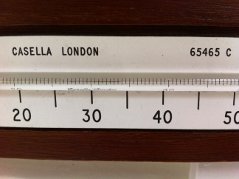
The Casella ‘check’ thermometer registered 35.8C on July 1st – 0.3C lower than the AWS reading, within the contraints
The start of the month began with the July all-time record being set: 36.1C. The month ended with a couple of very chilly nights: 6.9C in the early hours of 31st with a grass minimum of 4.5C. I haven’t yet been able to go through my records but, according to the Met Office, temperatures in southern England on the same night that fell to 1C represent an all-time low July record.
There were ten occasions when the maximum exceeded 25C. Mean temperature for the month was 18.6C, 0.1C above the 1981-2010 mean and the coolest July since 2012. Rainfall of 70.4mm was 162% of average though it is worth noting that three quarters of this was recorded on two days.
There were 174 hours of sunshine recorded in this area which is 91% of what we can expect to see during an average July. The wettest day occurred on the 24th with 32.4mm of rain. There were two days of thunder recorded.
So what has August got in store weatherwise? The models this morning (August 1st) suggest very little change in the overall pattern of things. The jet stream is still well south across the Atlantic and is likely to remain so for the forseeable future. However, because we are on the eastern side of the troughed flow across the eastern Atlantic this allows the potential for some very warm or even hot conditions to be drawn up across the UK in the coming five days and possibly beyond. However, the longer projections turns the flow more west to east across the south of the UK again returning cooler air to the SE as well in week two.
This means a continuation of changeable conditions as low pressure remains anchored in the north-west or north of the UK. Thunder could be likely.
In contrast to the models my long range method suggests that we are in for a rather cool August, about 1C below average, at 41% probability. The next highest probability is for something average at 27% probability. So an average to rather cool August works out at 68% probability.
Rainfall is uncertain. There is the same probability for dry (50% average) and very wet (175% average): 23% probability. However, the next highest probability is for average at 18%.
This grainy image shows distant lightning illuminating a cloud. The storm was centred over St Albans on July 16th
My data for sunshine only stretches back to 1878. There is a 73% chance of a duller than average August.
My July outlook was very poor, I predicted a rather warm to warm month – but it was nothing like last year’s or the 2013 classic. My rainfall and sunshine predictions were also hopelessly out. However, it was the first month since January that my temperature forecast has been wide of the mark. It’s just weather – in that it frequently doesn’t do what you think it’s going to do.
Here follows the full weather diary for July…Full stats for the month here:http://1drv.ms/1rSfT7Y
1st: Sunny until after midday when cloud bubbled up and took edge of temperature. Hottest July day ever was set at 5pm. Breeze made it feel bearable.
2nd: Sunny start though cloud quickly built with rain at midday. Just 0.3mm fell which evaporated on impact with the hot ground.
3rd: Sunny, clear day though humidity began to build from mid afternoon with the appearance of cloud. Still sunny spells till late into the evening. Big thunderstorm from around midnight for an hour.
4th: Sunny and muggy start. Long sunny spells, hardly a cloud in the sky until later. Sunny dawn but rain arrived at 9am.
5th: Light rain to start. This cleared late morning to sunny spells. Feeling muggy.
6th: Sunny start though lots of fair weather cumulus bubbled up.
7th: Cloudy start with light patchy rain around 11.30am, clearing to sunny spells. Some rain after 9am.
8th Cloudy and blustery with rain in the air. A few showers around.
9th: Sunny with just a few clouds, low humidity. Sky completely cleared after 3pm for a gorgeous evening.
10th: Sunny start. Some cloud bubbling up as jetstream neared – lots of cirrus and then cirrocumulus forming. Turned sunnier late afternoon. Also dawned clear and sunny.
11th: Long sunny spells with just a few cirrus and cumulus at times. Feeling warm and humid. Some light rain around midnight but not amounting to much.
12th: Cloudy and comparatively cool compared with recently. Light rain at 5pm with drizzle in wind through evening. More rain at 7.30am that fell intermittently up to obs time.
13th: Light rain to start with bursts through morning to 10.45am. Further bursts of light rain into early afternoon then overcast and muggy all night. More drizzle early am.
14th: Drizzly start – this continued into late morning. Then overcast and muggy. More drizzly burst overnight into the early hours – drizzle was persistent from 8.30am to 9am.
15th: Sunny intervals after light drizzle.
16th: Bright and sunny spells tending to turn more cloudy after midday. Big electrical storm around midnight with 67 flashes per minute seen to the north-west.
17th: Light drizzle to start turned to bright spells and a pleasant summer’s day.
18th: Sunny start with cloud bubbling up late afternoon. Light rain shower at 8.30 at end of Music in Wanstead Park and again in early hours at 6am.
19th: Sunny morning tended to cloud in at midday before cold front cleared to leave sunny evening. Mackerel sky at dusk with light rain at 8.15am.
20th: Showery rain to start.
21st: Sunny start but clouds bubbled up through the day for long sunny spells. Warm with a breeze.
22nd: Sunny start, cloud bubbling up during the day with spots of rain at 5pm – heavy shower in Wanstead.
23rd: Cloudy with occasional bright spells, feeling humid.
24th: Drizzly start. rain started falling at 11am. Outbreaks of prolonged rain through the day, heaviest between 5pm and 6pm. More rain after 8pm but then a drier interlude before more rain at midnight as occluded front came back. Last tip of the gauge just before 4am.
25th: Sunny and breezy though much cooler. A pleasant evening at John’s party though. Cloudy spells overnight before rain moved in at 9am.
26th: Rain to start with heavy outbreaks up to 1pm. Further outbreaks of rain through the day and into the evening.
27th: Drizzly bursts of rain to 11am. Then dry and bright.
28th: Bright and breezy to start. A light shower in evening then cool and clear – sunny start.
29th: Bright start but cloud filling in. Burst of rain at 8.30pm then variable cloud overnight.
30th: Bright but a burst of rain just after 10am. Then mostly cloudy with a few bright breaks.
31st: Sunny start but cloud filled in.
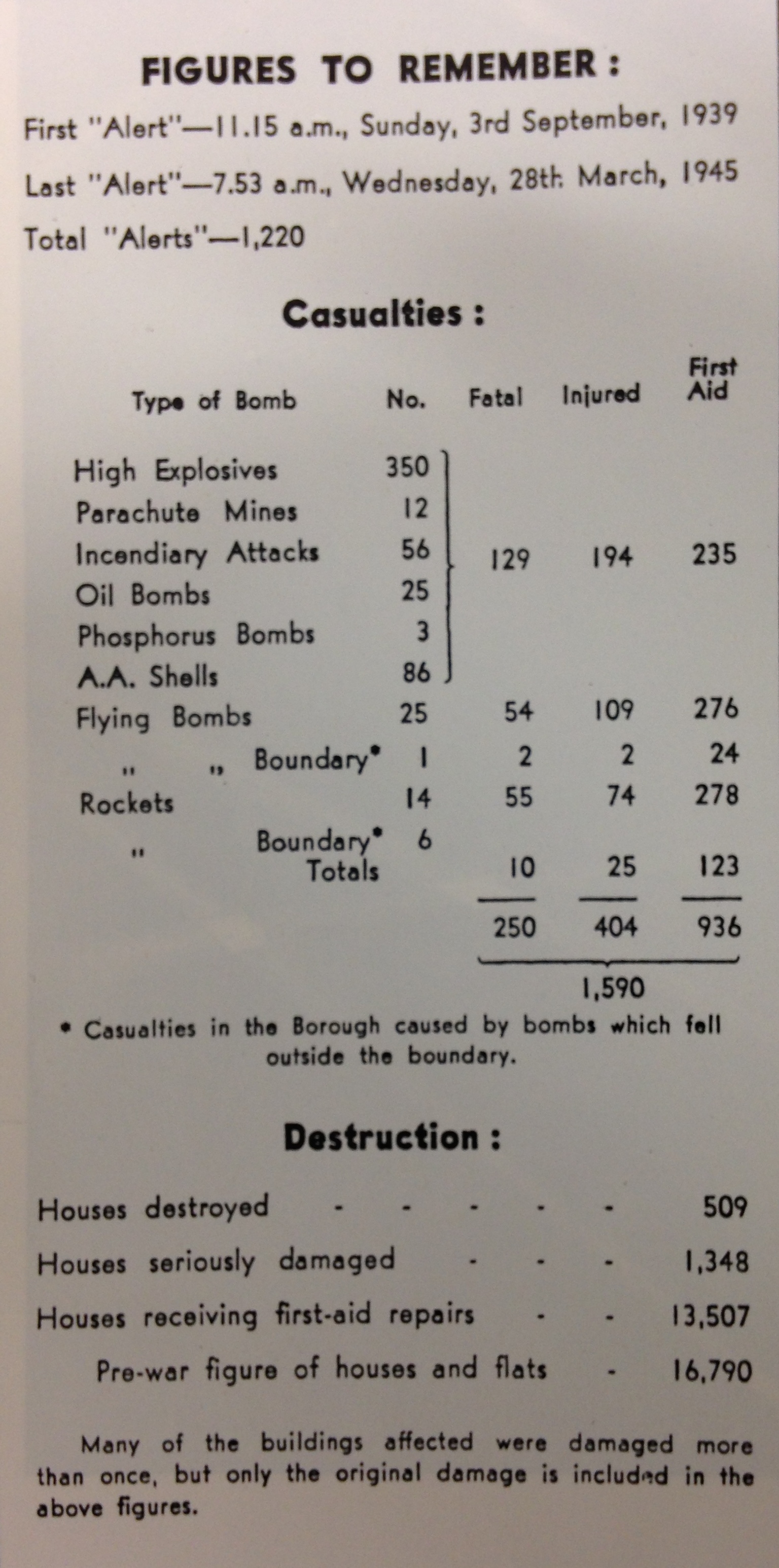
This month marks the 75th anniversary of the start of the Blitz in Wanstead and Woodford. Over a period of eight months around 450 bombs were dropped on the two boroughs, killing 129 people and injuring 194.
The Churchill statue at Woodford Green
The summer of 1940 had been varied; a warm and dry June was followed by a cool and wet July. The weather turned much warmer and drier in August, just 2mm of rain fell during the whole month. Only one August has been drier since and parts of London went 46 days without any measurable rain.
As people got on with their summer and the Phoney War (Britain had been in conflict with Germany for nearly a year) events in Europe must have seemed a world away. This all changed just after 11pm on Wednesday, August 28th when two high explosive bombs and one incendiary were dropped at two addresses in Woodford Green. Damage was light and only one minor injury was reported but the event brought home to citizens that the war was starting to happen on their doorsteps.
The days that followed were fraught with uncertainty; sirens sounded at any time of the day or night – the rapping of machine guns could be heard faintly in the skies as British fighters and enemy spotters fought invisible battles; the anti-aircraft guns pounding away on outlying sites including Wanstead Flats.
On the afternoon of Saturday, August 31st, a British fighter plane crashed in Hereford Road, taking out the front of a house and landing in the road – the pilot having earlier bailed out.
The opening week of September saw the hottest spell of the season. But summer, and the relative peace that Britain had enjoyed since the announcement of hostilities a year earlier, came to an abrupt end on September 7th.
It had been a beautiful day on the 7th with wall-to-wall sunshine and warm temperatures – the eighth day running the thermometer had reached the mid to late 70s fahrenheit. Many people were outside taking advantage of the weather when at 5pm the drone of the first Luftwaffe bombers could be heard passing to the south of the borough. By 6pm the skies were empty but all Thameside blazed.
The bombers struck again soon after 8pm, guided to their earlier smoking targets of the docks and the East End. As the sun began to set a red glow in the sky to the west and south-west gave the impression that all London was burning.
Wanstead and Woodford, so far unscathed, sent rescue parties to East Ham to help. Within a few hours, however, the area itself became the target of bombing when, at 1.25am, the first of three high explosive bombs fell in the Grove Park area behind the High Street. Two houses (Nos. 7 and 9) in Grove Park and the central block of the Shrubbery flats collapsed. A row of shops in the High Street, what is now Boots, was badly damaged by the third bomb which was dropped along with about 500 incendiaries.
A fire gutted the roof of 30 High Street, a house overlooking Christchurch Green, which is now a large block of flats on the corner of Wanstead Place, opposite the pie and mash shop.
The explosions left eight dead in the immediate vicinity while another blast in Highfield Road, Woodford Green, claimed the lives of three others. Some 50 people were injured across the two boroughs during the raid which was over by 2.30am. Rescue teams worked through the night to combat fires and tend to the injured. Wanstead and Woodford had suffered far less damage than other parts of London and a decision had already been taken to accept 2,000 evacuees from the East End. By Sunday lunchtime the first of these began to arrive in buses and lorries.
It was a dull day, ten degrees cooler than Saturday and probably reflected the public mood at the time. The bombings went on nightly through September – in the next two months there was little falling off. The manner of peoples’ lives is summed up in this entry from the diary of a local man:
“Night of September 11-12: Terrific AA barrage ended about 5am. To bed at 5.40. At 6.20 phone call saying office hit and we were to work at – . Left home at 7am. Settled down in strange building with difficulty, and grew so overwhelmingly sleepy that (having been awake for 5 nights) fell asleep standing up.”
But, two days later:
“Saturday 14th – left office 2 o’clock and spent two hours gardening. Beautiful autumn afternoon.”
As the boroughs learnt to cope with high explosive bombs, each weighing between 250-2,000lbs, the horror of the first parachute mine emerged within a couple of weeks. On September 23, a paramine fell in the Stanley Road area of South Woodford, killing 17 people – the highest number of deaths recorded in any single incident in the borough.
The borough was the first district to experience an explosive incendiary. A fire watcher of over 70 lost the sight of an eye from this type of bomb but continued on duty until the end of the war.
A warden called “Will” wrote this letter to his parents on September 29th 1940. It is intriguing for me because in the letter he mentions a house that I lived in in Cavendish Drive, Leytonstone. He says that an incendiary bomb lodged in the loft before burning through to the floor. While decorating one year I uncovered scorch marks in the landing well as well as charred damaged on the bannister and scorch marks on the floorboards – evidence of bomb damage.
As Wanstead, Woodford and the rest of suburban London got over the initial shock of the start of the Blitz people acted to keep life going as normally as possible.Many people who weren’t appointed as wardens learnt, through local authority training, to deal with incendiary bombs – airborne missiles dropped by the Luftwaffe that could easily pierce slate roofs and set fires below. Stirrup pumps could be bought and, through a family effort, fires could be extinguished or controlled until the arrival of the fire brigade.
The intensity of the night raids that brought so much destruction in September continued through October. The neighbouring borough of Woodford bore the brunt of the bombing but Wanstead, being so close to anti-aircraft guns sited on Wanstead Flats, continued to be hit. On the 11th six high explosive bombs fell on Wanstead Park, one damaging the Temple. Two days later high explosive bombs fell on land close to the City of London Cemetery on Aldersbrook Road, leaving six craters.
On the 14th three people were killed when a high explosive bomb landed in Woodlands Avenue on the Aldersbrook estate while incediaries caused many small fires in properties on Elmcroft Avenue.By the end of October the attacks started to be scaled back.
Synoptic chart for November 3rd 1940. Image courtesy of the Met Office
Bad weather at the start of November coincided with a 6-day pause in bombing incidents. It was a very cyclonic month that probably hampered German air operations. Indeed, on November 3rd, 40.8mm of rain was recorded at Greenwich – a daily record for November that remains to this day.
Another 6-day pause in the bombing happened after November 16th. When the Luftwaffe returned on Saturday, November 23rd, it was Wanstead that bore the brunt. At 4.12pm, as light was fading on a dull, dreary afternoon, high explosive bombs caused fires at and partly demolished nos 78 and 89 New Wanstead. A minute later another bomb ruptured water and gas mains in Spratt Hall Road. At 4.30pm a further high explosive bomb fell in the High Street, killing 4 people. The raid ended at 5.16pm as a bomb fell in Fitzgerald Road though this time there were no injuries.
By now the weather was beginning to quieten down though weeks of deep depressions with associated gales and heavy rain had taken their toll – many residents reported problems of Anderson bomb shelters being constantly flooded – but it was probably the design as much as the weather that was to blame. Some 171.6mm of rain was collected by month end in Greenwich – a record for this region that also remains to this day.
As pressure built in the last few days of November the first frosts of winter arrived but the bombs returned. High explosive devices fell in Woodford New Road and Bunces Lane on the 30th, fracturing a water main.
On December 3rd bombs fell in Nelson Road, Woodford Road and Eagle Lane, damaging road surfaces. Later the same night houses in Wellington Road and Elmcroft Avenue were badly damaged by bombs.
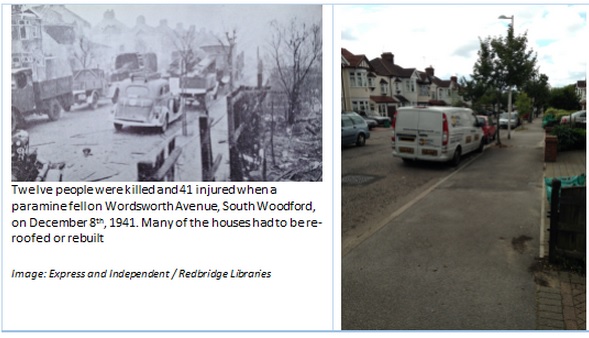
The final raid of the year, on the evening of December 8th, saw yet more tragedy befall the boroughs. Just after 7pm a high explosive bomb fell in St Albans Road, killing three people. And at 10.25pm a paramine was dropped on Wordsworth Avenue, South Woodford, killing 14 people and injuring 41.
The raids didn’t start up again until January 5th. Mostly dry, cloudy and cold weather allowed residents who hadn’t moved out to make what they could of Christmas.
The turn of the year saw the weather turn much colder as an anticyclone became established over Scandinavia. The opening week was dominated by bitterly cold easterly winds with temperatures barely above freezing, severe frosts at night and some snow – a near repeat of the severe January a year earlier.
On January 5th bombs were dropped on St Albans Crescent and Canfield Road. Further high explosive bombs fell in the area on the 7th and 11th as the cold continued to bite. The minimum on the night of the 15th/16th fell to minus 7.5°C, but during the third week a thaw set in as heavy snow turned to rain, it became misty, and temperatures slowly rose. On the 20th, nearly 17mm of rain (including melted snow) fell, and on the 22nd the temperature rose above 8°C.
A dull and rather wet February followed with temperatures close to normal. The early part of the month was cold with frost and some snow. After a minimum temperature below minus 6°C. on the night of the 4th/5th, outbreaks of snow occurred during the day and the maximum temperature stayed below freezing. Though it was cold in Wanstead much heavier snowfalls occurred over north-east England. A thaw set in at the end of the first week, and on the 8th the maximum was above 11°C.
Just one raid happened in February but further horror lay in wait in March – a month which continued the theme of the wet, miserable and dull winter.The early part of the month was unsettled with heavy rain at times. On the 6th, over 13mm fell. During the second week it became dry with sunny periods. There were some frosty nights and lingering fog. On the 12th, the maximum temperature was only 5°C. Temperatures slowly rose during the third week.
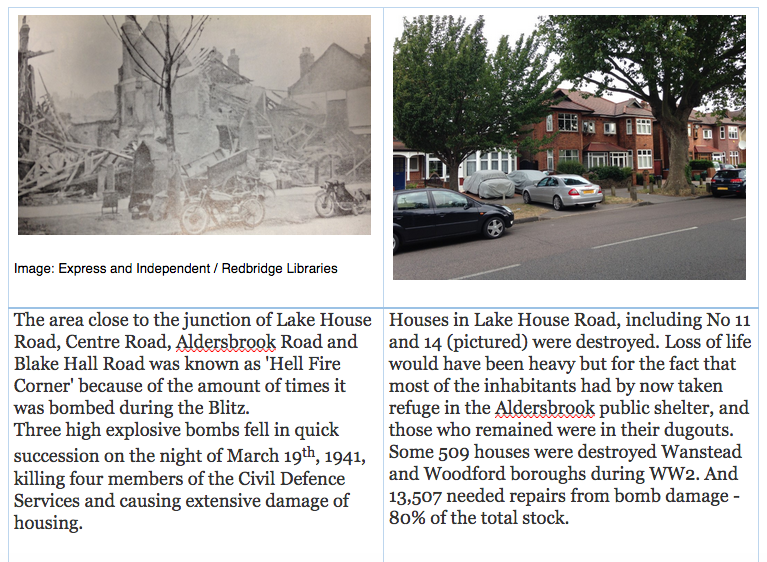
On the 19th four members of the Civil Defence Services gave their lives as they went about their duties at Post 41 “F” District headquarters (Aldersbrook Tennis Club), an area of South Wanstead, which, from the battering it received from the early days of bombing (and which later continued through the phases of the flying bomb and the V2 rocket) became known as “The Battle Field” or “Hell Fire Corner”.
The following impression of that night is written by one who was at the scene:
“The wail of the siren opposite the Post announced at 8.15pm the arrival of the raiders. The Post personnel saw a startling sight. The Flats were a sea of flame. Thousands of incendiaries were burning on the open space. The guns roared. It was obvious that the enemy was making a concerted and determined attack. Bomb flashes stabbed the blackout. Planes droned overhead. The batteries on the Flats joined those further away in putting up a terrific barrage.
At 8.50pm, three high explosive bombs fell in Lake House Road, damaging a number of houses and partly demolishing Nos 14 and 31. A few casualties resulted, one being a man who was trapped in the doorway of No. 14. Wardens heaved on the obstruction to release him. Gas escaping in the same house caused a fire. This was quickly dealt with and the flames smothered. A nearby barrage balloon had burst into flames, illuminating the scene with glaring brilliance and revealing the widespread damage.
At 9.20pm this first incident appeared closed, and services were awaiting the result of a final search and check-up before being dismissed. Then a parachute mine landed. It exploded a few yards from Aldersbrook corner on the Leytonstone side. A house in Lake House Road, already badly damaged, tottered to destruction. Number 11 caught fire and was destroyed. Loss of life would have been heavy but for the fact that most of the inhabitants had by now taken refuge in the Aldersbrook public shelter, and those who remained were in their dugouts.
The attack died down. Wardens returned to their posts – but the number for 41 was sadly lacking. The two boys’ bicycles stood in their usual place. ‘Busy somewhere’ said the chief. But the absent ones did not return, and a search was made. They were found – in the mortuary, three of them. It was known that two others had been taken to hospital. Warden Barnett was one of these. He died next morning of his injuries.
Just before the mine exploded, the messengers had been giving assistance in one of the less badly-damaged houses. Broome, although officially not on duty, had rushed out to lend a hand. Warden Hutton was endeavouring to turn off the gas at No 14 when the mine fell.
So the four from Post 41 died doing their duty on the Home Front. The two boys, pals in the service, sleep in one grave in Old Wanstead churchyard. The two men lie close by, in Ilford Cemetery.
A few days later their comrades stood silently at attention as the funeral cortege halted outside the Post. A Union Jack covered each of the four coffins.
The four members of the Civil Defence Services who gave their lives were: Thomas Hutton, 44, a warden, of Blake Hall Crescent, Wanstead; William Barnett, 36, a warden, of Belgrave Road, Wanstead; Roy Broome, 17, a messenger, of Lake House Road, Wanstead; and Herbert Stower, 18, a messenger, of Clavering Road, Wanstead.
Winston Churchill’s letter to his constituents
As spring wore on the weather remained mostly miserable though raid incidents lessened and petered out in May. Wanstead and Woodford had its last bombs of the period on May 10th. There were no more that year.
In total 129 people lost their lives and 194 were injured during the campaign. This figure would nearly double when the next phase of the bombing, using V1 flying bombs and V2 rockets, would begin three years later in June 1944.
It is hard to imagine how people coped with the constant barrage of bombs during the Blitz. What seems to get lost in articles and historical texts I’ve read is just how grim the weather was at the time – remember this was a time before central heating. Not only were bedrooms freezing cold people must have laid there wondering if they were going to see morning.
It seems to be a human condition that when we are faced with adversity we just find a way of ‘getting on with it’ as best we can.
This graph shows how much colder the weather was at the time of the Blitz compared with the period September 2014 – May 2015Wanstead and the surrounding area is shown to be peppered with bombs on the website http://bombsight.org/ but many of the accounts listed in Tiquet’s book are not listed
* Much of the inspiration for this blog comes thanks to the book It Happened Here by Stanley Tiquet. The book is available for loan and can be purchased at Redbridge libraries.
Legend has it that the weather on St Swithin’s will be the same for the next 40 days.
St Swithin’s day, if thou dost rain,
For forty days it will remain;
St Swithin’s day, if thou be fair,
For forty days ’twill rain na mair.
St Swithin’s Day is probably among the most well known of weather folklore – but, taken at face value, it is probably the most unreliable.
Grasslands around Wanstead Park have gradually turned brown because of the lack of rainfall since March
Since 1848 Wanstead and the surrounding region has enjoyed 93 dry St Swithin’s Days (56%). From these the longest dry spell that followed was just 18 days, in 2000. On average, if St Swithin’s is dry, the weather stays fair for 3 days, with rain arriving on the 18th. Many dry St Swithin’s Days (17%) are followed by rain the next day – these results skew the median for rain after a dry St Swithin’s to just 2 days!
Another interesting observation is that the 40-day period that followed a dry St Swithin’s is on average 13% WETTER than if it rained on July 15th.
So what does this mean for the rest of July and the summer? Looking back at other years that have seen a mostly dry and warm pattern in the run up to St Swithin’s Day we should see a continuation of frequently dry, warm and sunny conditions, interspersed with rainy days and, perhaps, thundery breakdowns. A typical British summer!
Putting superstition and singularities aside current weather models back this up.
St Swithin’s reputation as a weather saint is said to have arisen from the translation of his body from a lowly grave to its golden shrine within Winchester cathedral, having been delayed by incessant rain for 40 days
St Swithin was born around 800AD and died on July 2, 862, at Winchester, Hampshire. According to historians he was fond of building churches in places where there were none. St Swithin, who was bishop of Winchester, was buried in the churchyard of the Old Minster at Winchester, where passers by might tread on his grave and where the rain from the eaves might fall on it.
His reputation as a weather saint is said to have arisen from the translation of his body from this lowly grave to its golden shrine within the cathedral, having been delayed by incessant rain for 40 days.
The basis of the St Swithin’s saying follows the fact that by July 15th summer weather patterns are already well established and tend to persist through the coming weeks.
In meterological terms the position of the frontal zone around the end of June to early July, indicated by the position of the jet stream, determines the general weather patterns (hot, cold, dry, wet) for the rest of the summer. Like a little stream in its bed, the frontal zone tends to ‘dig in’ shortly after the summer solstice.
As the path of our weather systems is controlled by the jet stream, a more southerly location of the frontal zone – as happened last year – is likely to bring unsettled, wet and cool weather. On the other hand, a frontal zone shifted further to the north – as is happening this year – will help the Azores high to build over western Europe, thus bringing dry and pleasant weather to the UK.
Other western European countries also have similar St Swithin’s day sayings – that follow the principle rule. In France they say ‘Quand il pleut a la Saint Gervais Il pleut quarante jours apres’ – If it rains on St. Gervais’ day (July 19th), it will rain for fourty days afterward.
In Germany the Siebenschlaefer or seven sleepers day (July 7th, after the Gregorian calendar) refers to the weather patterns of the following seven weeks.
The hottest July day on record was recorded at Heathrow airport on Wednesday 1st. The 36.7C recorded between 1500 and 1530 exceeded the previous record of 36.5C set at the Royal Horticultural Garden at Wisley, Surrey, in 2006.
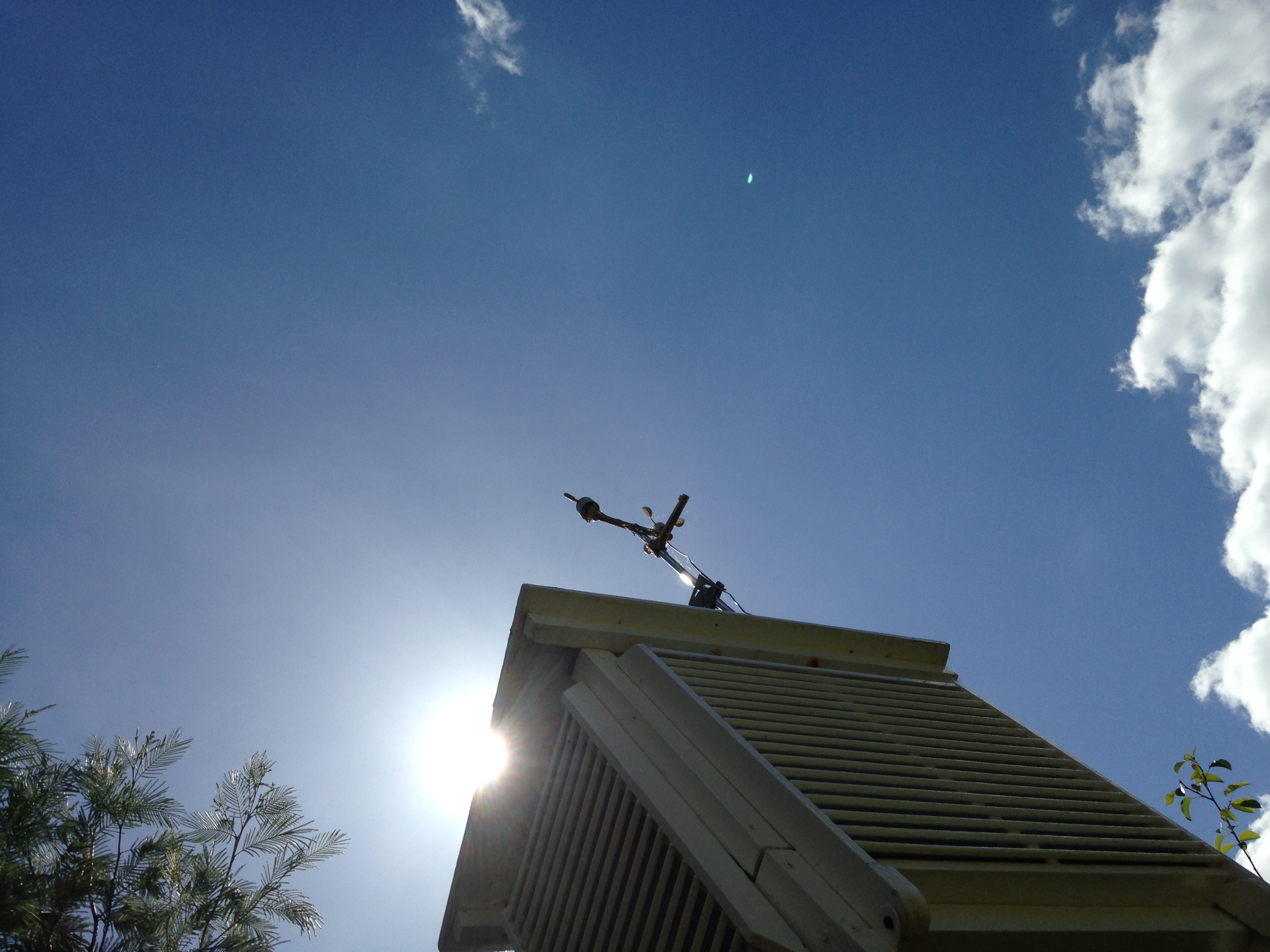
The meteo is sited on the Aldersbrook Estate and uploads data to the web every 10 minutes, 24 hours a day
I recorded 36.1C in Wanstead, a reading that exceeded the previous July record of 35.9C set in 1868 – indeed it was the fourth highest temperature this area has seen since local records began in 1848.
Already, however, questions have arisen over the validity of the Heathrow value mainly because the official measurement far exceeded that of Northolt, an airfield and the closest official station, which recorded 35.7C, a full degree cooler.
I’ve always been a bit sceptical on the validity of airport readings – there’s a lot more concrete at Heathrow than Northolt and obviously far more jet engines. The previous July record at Wisley is surely far more representative of standard conditions? I fear that with a new runway Heathrow will only get hotter and, perhaps, a review of the official MetO station should be taken.
I’m often asked why my own station is not used for official readings. The simple answer is that, being in a suburban garden, it is too sheltered to qualify for the open exposure that the Met Office demands.
But, apart from the exposure, everything is as representative as possible to conditions set by the Met Office. When readings differ it is simply because the character of the area is warmer or colder than official stations, the closest of which is St James’s Park.
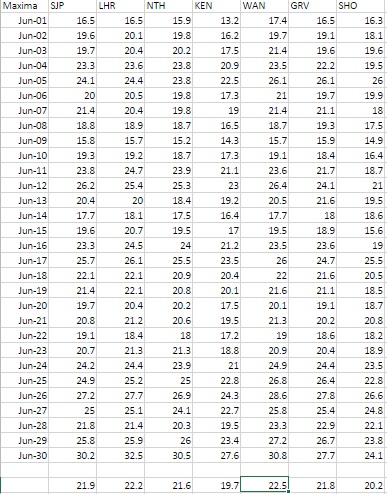
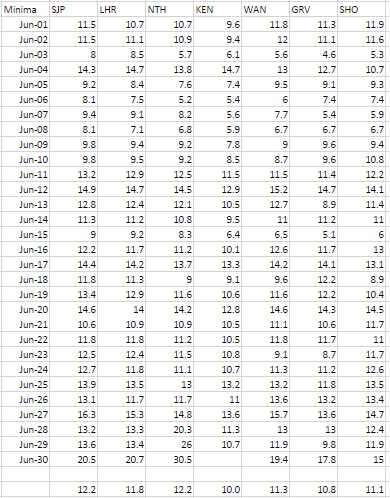
Maxima for stations near Wanstead SJP: St James’s Park, LHR: Heathrow, NTH: Northolt, KEN: Kenley, WAN: Wanstead, GRV: Gravesend, SHO: ShoeburynessMinima for stations near Wanstead SJP: St James’s Park, LHR: Heathrow, NTH: Northolt, KEN: Kenley, WAN: Wanstead, GRV: Gravesend, SHO: Shoeburyness
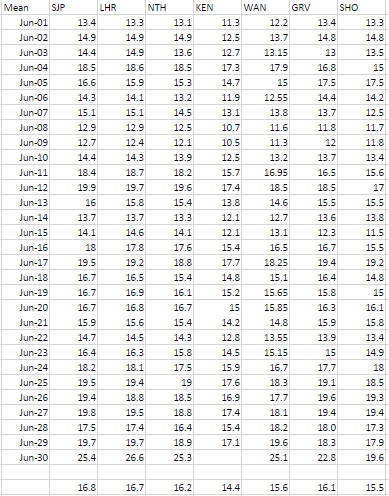
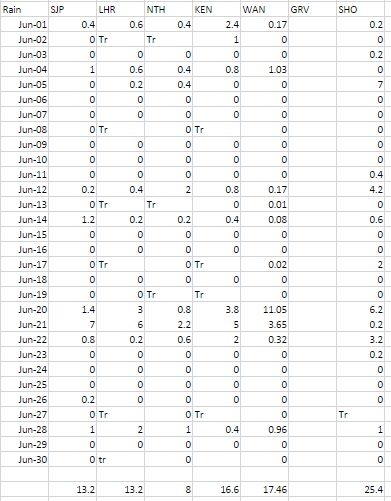
To try to quantify this I’ve had a look at all the official stations around Greater London throughout June. The results show that readings from Wanstead are remarkably similar to other stations.
I first had a look at maxima which revealed that Wanstead is 0.3C warmer than Heathrow and 0.6C warmer than St James’s Park.
Mean for stations near Wanstead SJP: St James’s Park, LHR: Heathrow, NTH: Northolt, KEN: Kenley, WAN: Wanstead, GRV: Gravesend, SHO: ShoeburynessRainfall for stations near Wanstead SJP: St James’s Park, LHR: Heathrow, NTH: Northolt, KEN: Kenley, WAN: Wanstead, GRV: Gravesend, SHO: Shoeburyness
Minima, on the other hand, revealed that Wanstead was 0.5C cooler than Heathrow and 0.9C cooler than St James’s Park – a stark illustration of how much warmer inner London is than the suburbs.
This obviously had a bearing on the mean temperatures of the region, Wanstead being 1.1C cooler than Heathrow and 1.2C cooler than St James’s Park.
In terms of rainfall Wanstead was wettest, but only by 4mm.
So, all in all, the weather station at Wanstead is a pretty good measure of our local climate, as close as possible to what official conditions for measurement of climate demand.
I am currently in the process of trying to find a site local to the area that will fulfil Met Office conditions but it is a long, drawn-out process that will take time to organise.
Maxima for stations near Wanstead SJP: St James’s Park, LHR: Heathrow, NTH: Northolt, KEN: Kenley, WAN: Wanstead, GRV: Gravesend, SHO: ShoeburynessMinima for stations near Wanstead SJP: St James’s Park, LHR: Heathrow, NTH: Northolt, KEN: Kenley, WAN: Wanstead, GRV: Gravesend, SHO: ShoeburynessMean for stations near Wanstead SJP: St James’s Park, LHR: Heathrow, NTH: Northolt, KEN: Kenley, WAN: Wanstead, GRV: Gravesend, SHO: Shoeburyness
If you like thunderstorms Wanstead seems to be leading something of a charmed life these past couple of years.
The storm at 23:43
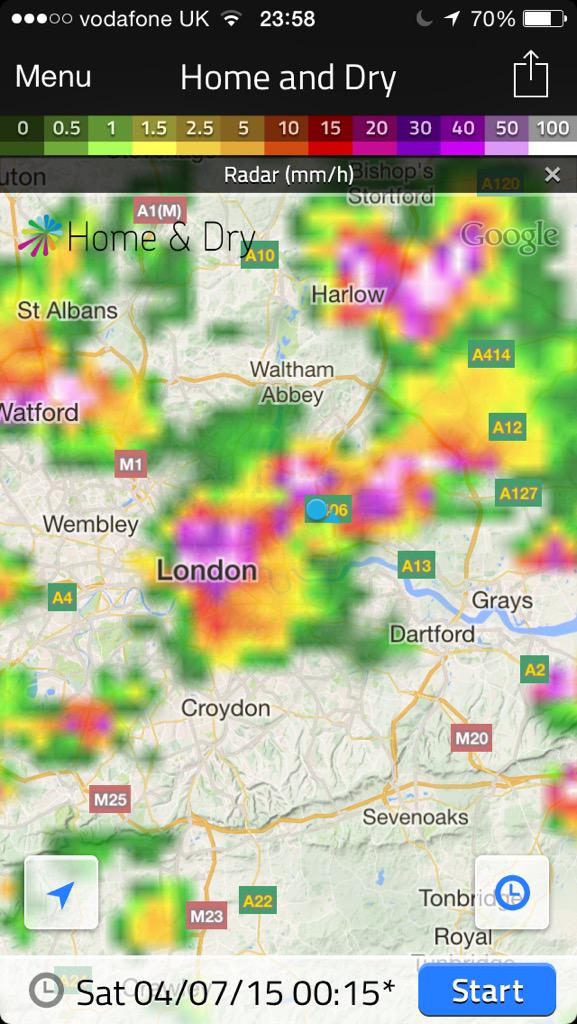
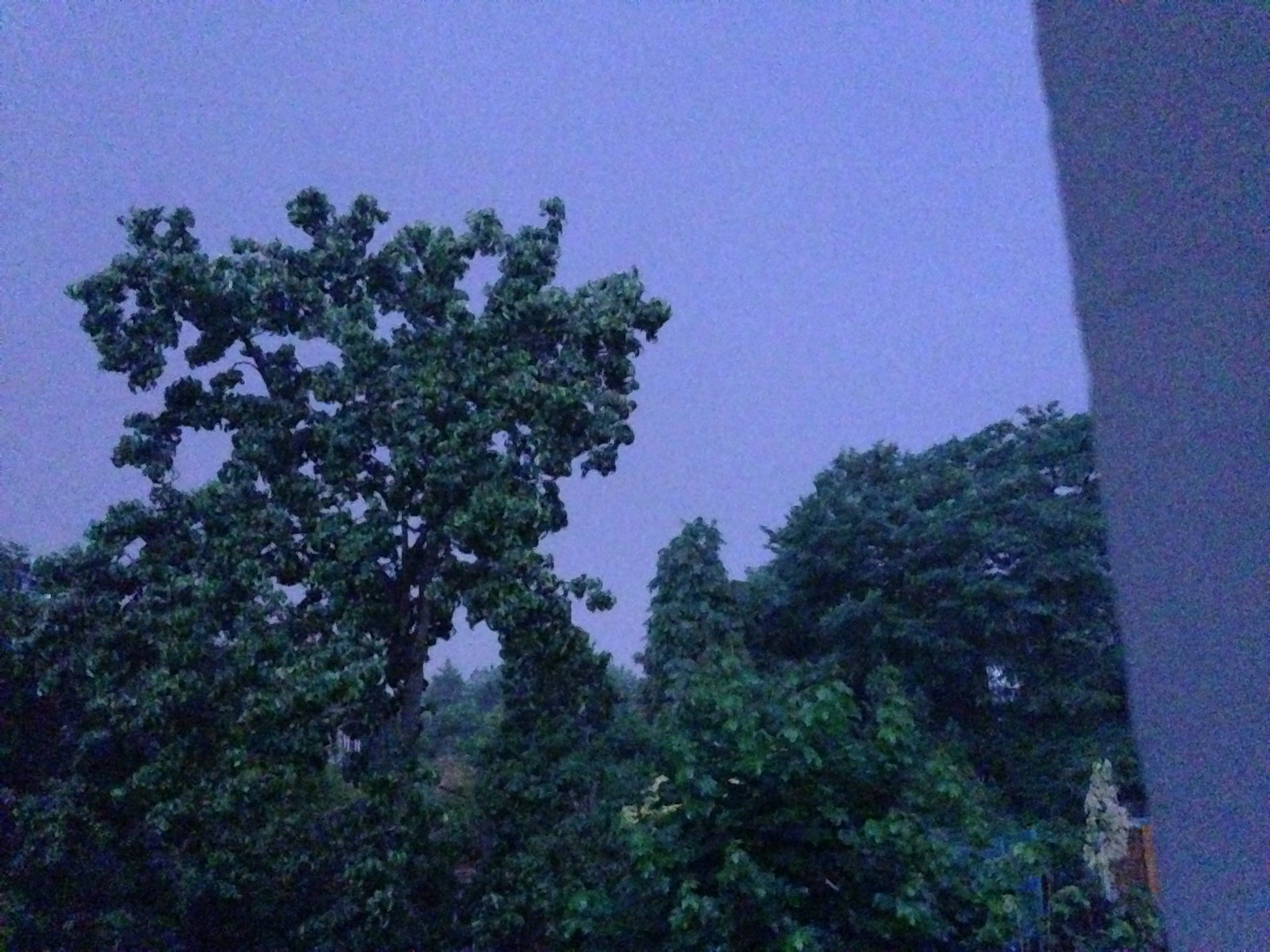
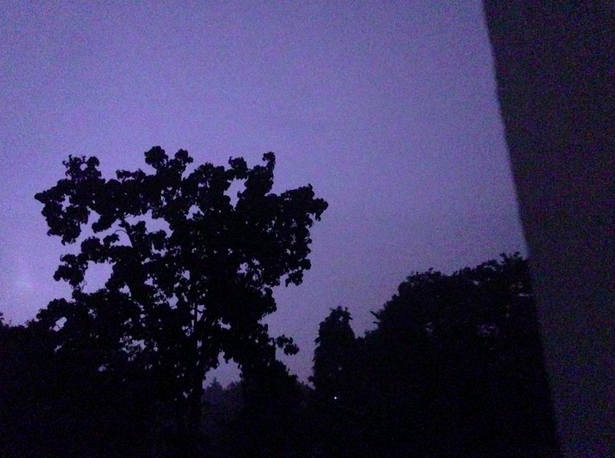
Two years ago I wrote a blog asking what had happened to decent summer thunderstorms that were so common during my youth in the 1980s. Last night was the fourth time Wanstead has experienced a really good light show, complete with multiple lightning strikes and Hammer Horror-esque thunderclaps. The first storm passed over at 23:43, delivering 3.7mm rain at a rate of 20mm/hr. Another followed shortly after at 23:58, a pressure trace revealed a 1mb fall as the storm passed through. Nothing special as I have seen a 6mb drop in similar circumstances. By this time the sky was alive with lightning – yet again I failed to capture any lightning bolt but did manage to photograph my garden at the moment night became day – the world’s most powerful flashgun!
The radar picture of the storm at 23:58What would you give for a flashgun this powerful? The storm at its peak at 00:22
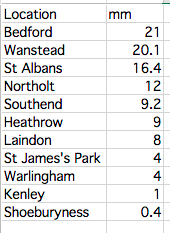
At 00:19pm occurred the brightest flash of lightning almost instantly followed by a very loud crack of thunder, the kind you hear on those Hammer Horror films with Peter Cushing. Looking at the rainfall of weather stations around the south-east it appears that Wanstead was in the thick of the action, clocking up 20.1mm of rain and second only to Bedford. The amount represents 47% of what normally falls in an average July. As always in these situations some places get a deluge while others remain almost dry.
There was 112,833 lightning strikes across UK & Ireland between 9pm and 9am on July 4th Image courtesy of Blitzortung
Looking further afield around London an observer in Blackheath reported an hour to 90 minutes of ‘roaringly good storminess’ that brought a house party to an abrupt end. He counted 15 flashes of lightning a minute, lots of CC but a few CGs too, including one close as the storm kicked off.
Elsewhere an observer in Highams Park reported 30 flashes per minute. In Dorset another observer 50mm of rain, most of which fell in an hour. The storm that tracked over the Salisbury region had what seemed like 3x the lightning of the storms in the SE corner.
Forecasting of the event was handled better by some agencies than others. For location accuracy the MeteoGroup discussion had an edge over the Met Office.
The Trappes (Paris) ‘loaded gun’ ascent for July 3 can be found here – warm / dry layers between 900 and 800 hPa and ~2000 J/kg of CAPE, with high CAPE values expanding aerially as the trough neared. Approach of the trough caused cooling aloft – not sufficient for the capping inversion to break around Paris itself but farther west and north.
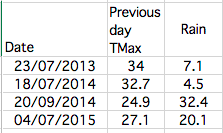
Lightning streamers were visible moments before each thunderbolt. These come out of the ground to meet the main bolt – a sure sign that Wanstead was right underneath a cellA pressure trace at 11am on July 4th shows the peaks and troughs during the stormThis table shows the most notable thunderstorms that have passed over Wanstead during the past two years
June finished hot in complete contrast to the opening few days which were a continuation of a disappointing May.
There were six occasions when the maximum exceeded 25C – the highest being 30.8C on 30th, the warmest June day for four years.
Mean temperature for the month was 16.9C, 0.8C above the 1981-2010 mean. Rainfall of 17.5mm was 34% of average – the last three Junes have been notably dry.
There were 189.5 hours of sunshine recorded in this area which is 106% of what we can expect to see during an average June. The wettest day occurred on the 20th with 11.1mm. There were two days of thunder recorded.
So what has July got in store weatherwise? The models this morning (July 1st) suggest a battleground between Atlantic cooler air and hot continental air, a common feature at this time of year. The persistent heat on the continent looks like it will waft back and forth across the south-east – creating the risk of thundery downpours as it meets resistance from successive cold fronts.
Just 17.5mm of rain fell in June – 34% of average
The model output suggests the Atlantic air will eventually win through, allowing more changeable conditions in a week’s time. There is also a signal that high pressure will re-establish with a return to fine and very warm weather. As things stand the models remain finely balanced.
In contrast to the models my long range method suggests overwhelmingly that we are in for a warm July, up to 1.7C above average, at 60% probability
The next highest chance is for rather warm at 40% probability. If you add the probabilities together the chance of a rather warm to warm July can be put at 100% – perhaps a repeat of last year’s and 2013’s classic July is about to unfold?
Rainfall is looking below average, at 60% probability. There’s obviously a risk here that a couple of direct hits from thunderstorms would see the monthly total exceeded. I don’t have enough data to estimate sunshine but I would guess average to slightly above.
My June outlook was only good in that it ruled out any chance of a very warm month – the final mean was rather higher than I thought. I was also out with the very low rainfall – the signal was for something average. Sunshine was broadly average as I’d estimated
The Heronry Pond in Wanstead Park is suffering from low water levels again
1st Sunny, bright start quickly turned cloudy with intermittent drizzle through the day. Turned windy at 6pm and was really blowing around midnight.
2nd Drizzle in the wind at obs time and very windy, wind only decreasing by evening. A dreadful day though warm.
3rd Sunny start though cloud gradually increased. Feeling humid and summery at last.
4th Sunny start with cloud dotted with alto cumulus and cirrus. Rain between 5am and 6am – though storms passed to our west and east.
5th Bright start after earlier rain – the thunderstorms seemed to pass to our west and east. Very humid and felt oppresive in the morning.
6th Sunny start with cloud bubbling up. Much cooler and fresher feel. Lots of long sunny spells.
7th Sunny, gin clear start. Just a few fair weather cumulus all day. Gorgeous.
8th Bright start though alto cumulus shaded early sun. Variable cumulus after that – feeling chilly.
9th Cloudy and brisk wind from NE. Feeling chilly.
10th Bright start with sunny intervals throughout the day.
11th Sunny start with few cirrus, sky then completely cleared.
12th Sunny start though cloud bubbled up through the day – felt very close at sports day. Distant thunder heard at 8pm with light rain – much less than was threatened.
13th Cloudy start, mostly calm, still and dull – a real nothing day though some late brightness after 2pm pushed up the temperature briefly. Mild overnight with some light drizzle before obs time.
14th Drizzle in the wind up until 11pm and falling temp. Then a brief sunny interlude before it was cloudy again.
15th Cloudy start then briefly clearing before, at 1pm, more cloud appeared. Clear overnight allowing temp to fall until 4.10am but clouding over by morning – bright warm sunshine at 9am.
16th Sunny start but very cloudy at times. This continued all day – though the night was cloudier hence warmer.
17th Sunny start but with lots of cloud around.
18th Lots of long suuny spells but cooler than yesterday.
19th Cloudy up until 11.30pm and cooler. Broke to sunny spells and much warmer at 2pm.
20th Bright start though warm from started pushing through just before 1pm. Some sunny breaks but rain pushed in. Was in Cheltenham but Woodford Wells reported thunder: Between 1650and 1730 12mm fell followed by a decreasing amount of 2.4mm up to 1814 all BST Two thunder claps at 1715 and 1728.
21st In Cheltenham it was a mostly cloudy day though with more sunny intervals after midday. Rain spread in just before midnight with more in the early hours.
22nd Cloudy start though with brief sunny break at 10am. Some drizzle 11.15am then drier with sunny intervals.
23rd Bright start. Cloud broke to give warm sunny spells .
24th Sunny periods after a rather cloudy start. Felt very warm in the sun during walk around London with Neil and family.
25th Sunny start though hazy cloud developed from 10.30am, rather obscuring the sun at times, though it was bright all day. 26th Warm till late into the evening – still 18C at 11pm.
26th Bright start though cloudy, broke to sunny spells and felt warmer than forecast.
27th Sunny start though with cloudier spells all through the day. A very warm evening.
28th Sunny start quickly became cloudy with rain turning up at noon during early lunch. This later cleared to sunny spells and a pleasant afternoon.
29th Sunny start though with high cloud obscuring the sun at times.
30th Sunny, gin clear all day. only ‘cloud’ was distant grass fire.
The 30th was wall-to-wall sunshine until late in the evening when alto-cumulus and cumulus were observed



















You must be logged in to post a comment.