This August was the third dullest since 1881. I’ve seen mentioned recently that August used to be regarded as an autumn month. For the past couple of years the final ‘summer’ month has been very disappointing for anyone looking for fine weather – much more akin to September or even October.
A storm in south London gave this eerie light seen at Southwark Bridge on the 5th
The first third of the month began pleasantly enough with a couple of days exceeding 27C. And on the 22nd the temperature reached 31.4C, only the third occasion that the mercury has risen above the 30C mark this summer. But summery highlights were few and far between.
Just under 120 hours of sunshine were recorded – that’s 62 per cent of the monthly average, the dullest August since 1968.
There were six occasions when the maximum exceeded 25C. Mean temperature for the month was 18.2C, which is on the nose of the 1981-2010 mean. Rainfall of 79.8mm was 159% of average. The wettest day occurred on the 24th with 18.4mm of rain.
What has September got in store weatherwise? The models today (September 1st) suggest a very slow progression of high pressure ridging into the UK from the west this weekend. Until then a cool northerly flow will persist with a mix of sunshine and possibly heavy showers. Most models suggest that by the end of the week a trough will run south, bringing a spell of cloud and rain before high pressure from the west eventually cuts off the cool northerly, replacing it with little or no wind, warmer sunny spells by day and misty nights – typical late summer / early autumn weather. Models then split over what will happen with the high next week. It could stay settled or, according to the ECMWF and GFS, the start of a breakdown could happen at the end of next week.
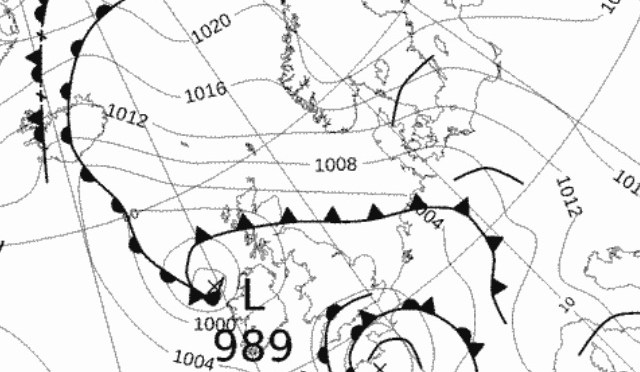
The synoptic chart shows the frontal set up that brought the greatest daily rainfall on the 24th
My long range outlook method suggests that September will be average temperature-wise, a mean of about 15.4C, at 52% probability. The next highest probabilities are for something rather warm and warm, both at 14% probability, though something rather cool also comes out 14% probability.
The highest probability for rainfall is 45% for something average. The next highest probability is for a dry September, at 23%. Rather wet works out at 14%.
My data for sunshine only stretches back to 1878. There is a 60% chance of average sunshine in September.
My August outlook was OK – I went for an average to rather cool August. I also said there was a 73% chance of a duller than average August – so not bad overall.
Here follows the full weather diary for August…Full stats for the month here:http://1drv.ms/1rSfT7Y
1st Bright but hazy start. Cloud gradually thinned to give a sunny afternoon with just a few clouds. Warmer.
2nd Sunny start with decreasing cloud.
3rd Sunny start quickly turned cloudy and blustery with brief burst of rain at 4pm. Then dry with variable cloud overnight and breezy.
4th Bright start but lots of cloud around and breezy. This lasting through the day.
5th Cloudy start, a few bright intervals and a strange light as thunder clouds passed to the south. Some light rain.
6th Cloudy start but cloud thinned to become sunny just before 2pm. Then variable cloud through the day with another eerie sunset.
Many places around the coast recorded far more sunshine than Wanstead, typical of the type of weather experienced in August
7th Sunny start though was very cloudy at times.
8th Bright start and cloud quickly melted away to leave a stunning, sunny day in Sussex and Camber. Some cloud was seen a few miles inland but even this eventually melted away. Night turned chilly with heavy dew by dawn.
9th Sunny until 3pm then a bank of cloud brought cloudier spells. Warm overnight.
10th Bright start with sunny intervals. A burst of rain at 2pm damped the ground then it was mostly cloudy for the rest of the day.
11th Cloudy, calm start, spits and spots of rain before more organised rain in evening.
12th Cloudy start then brief sunny spells late morning before clouding up again. Warm front stalled over South Coast dumping 32mm on Herstmonceux.
13th Cloudy with rain spreading in late morning, this lasting until 3pm with odd burst of drizzle for rest of night. Some 78mm in Polegate and flooding reported in Brighton.
14th Cloudy and very humid with some brightness late morning. Showers returned at 3.30pm then more general rain arrived at 8pm.
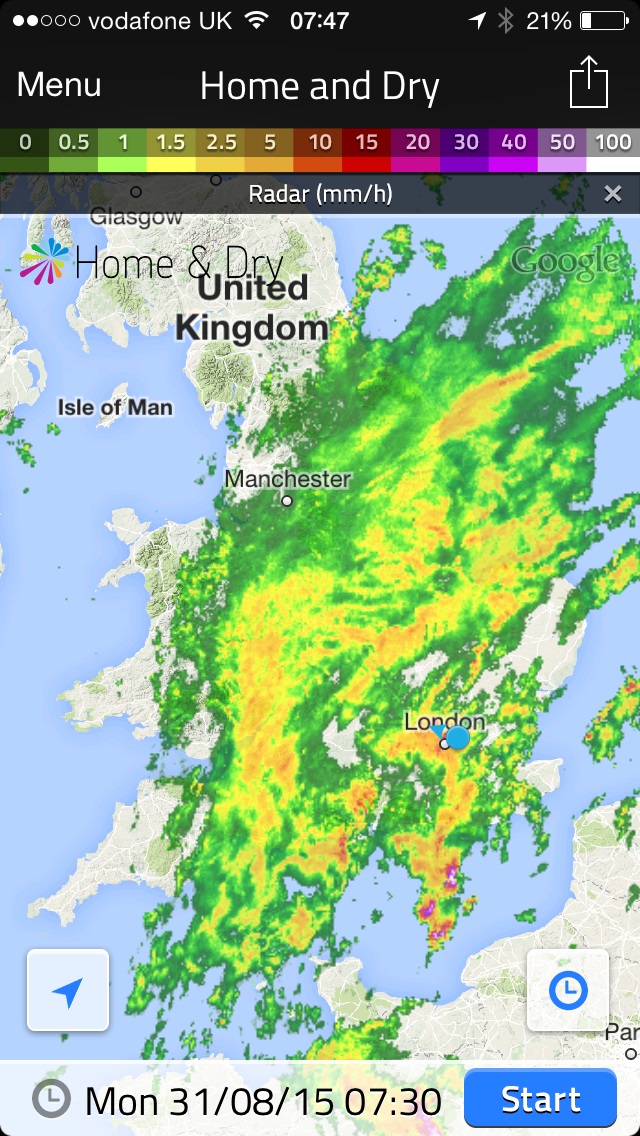
This radar shows the area of rain that brought over 10mm to Wanstead on 31st
15th Sunny start, clouded over at 2.30pm but then became sunny again at 5.30pm. Clear spells overnight.
16th Sunny start then cloudier in the afternoon. Very still air though made it feel pleasant.
17th Sunny start then cloudier around lunchtime. Sunny spells late afternoon though sun didn’t feel that strong.
18th Sunny start though quickly clouding over and dull. Some spots of rain on way to airport but dry in Wanstead.
19th Sunny start then going downhill with rain in the evening and overnight.
20th Bright start, clouding over.
21st Bright start before breaking to sunny spells and warm.
22nd Long sunny periods and 3rd occasion of 30C.
23rd Bright start but cloud built to give rain between 12.45 and 2.45pm.
24th Dull, rainy with rain between 9am and 11am.
25th Rain between 1pm and 3pm. Showers overnight then more general rain at obs time.
26th Dull and rain morning with squall blowing through at 1.30pm. Brightening up by 5pm then some bright spells late afternoon.
27th Bright start but with heavy cloud present. A brief shower in the afternoon before a clear evening made it chilly overnight.
28th Sunny start with light breeze, tending to cloud over middle part of the day. Skies cleared again to give sunny, pleasant evening.
29th Sunny start, cloud filled in by 3pm then rain arrived at 4pm, with moderate bursts.
30th Cloudy and humid start. Cloud stuck around all day – airless and therefore felt pleasant.
31st Cloudy start after overnight rain. The rain soon returned after 10.20am and fell, often heavily through until 12.30pm.
The title of this monthly review is probably very misleading as July was a month that blew hot and cold.
The Casella ‘check’ thermometer registered 35.8C on July 1st – 0.3C lower than the AWS reading, within the contraints
The start of the month began with the July all-time record being set: 36.1C. The month ended with a couple of very chilly nights: 6.9C in the early hours of 31st with a grass minimum of 4.5C. I haven’t yet been able to go through my records but, according to the Met Office, temperatures in southern England on the same night that fell to 1C represent an all-time low July record.
There were ten occasions when the maximum exceeded 25C. Mean temperature for the month was 18.6C, 0.1C above the 1981-2010 mean and the coolest July since 2012. Rainfall of 70.4mm was 162% of average though it is worth noting that three quarters of this was recorded on two days.
There were 174 hours of sunshine recorded in this area which is 91% of what we can expect to see during an average July. The wettest day occurred on the 24th with 32.4mm of rain. There were two days of thunder recorded.
So what has August got in store weatherwise? The models this morning (August 1st) suggest very little change in the overall pattern of things. The jet stream is still well south across the Atlantic and is likely to remain so for the forseeable future. However, because we are on the eastern side of the troughed flow across the eastern Atlantic this allows the potential for some very warm or even hot conditions to be drawn up across the UK in the coming five days and possibly beyond. However, the longer projections turns the flow more west to east across the south of the UK again returning cooler air to the SE as well in week two.
This means a continuation of changeable conditions as low pressure remains anchored in the north-west or north of the UK. Thunder could be likely.
In contrast to the models my long range method suggests that we are in for a rather cool August, about 1C below average, at 41% probability. The next highest probability is for something average at 27% probability. So an average to rather cool August works out at 68% probability.
Rainfall is uncertain. There is the same probability for dry (50% average) and very wet (175% average): 23% probability. However, the next highest probability is for average at 18%.
This grainy image shows distant lightning illuminating a cloud. The storm was centred over St Albans on July 16th
My data for sunshine only stretches back to 1878. There is a 73% chance of a duller than average August.
My July outlook was very poor, I predicted a rather warm to warm month – but it was nothing like last year’s or the 2013 classic. My rainfall and sunshine predictions were also hopelessly out. However, it was the first month since January that my temperature forecast has been wide of the mark. It’s just weather – in that it frequently doesn’t do what you think it’s going to do.
Here follows the full weather diary for July…Full stats for the month here:http://1drv.ms/1rSfT7Y
1st: Sunny until after midday when cloud bubbled up and took edge of temperature. Hottest July day ever was set at 5pm. Breeze made it feel bearable.
2nd: Sunny start though cloud quickly built with rain at midday. Just 0.3mm fell which evaporated on impact with the hot ground.
3rd: Sunny, clear day though humidity began to build from mid afternoon with the appearance of cloud. Still sunny spells till late into the evening. Big thunderstorm from around midnight for an hour.
4th: Sunny and muggy start. Long sunny spells, hardly a cloud in the sky until later. Sunny dawn but rain arrived at 9am.
5th: Light rain to start. This cleared late morning to sunny spells. Feeling muggy.
6th: Sunny start though lots of fair weather cumulus bubbled up.
7th: Cloudy start with light patchy rain around 11.30am, clearing to sunny spells. Some rain after 9am.
8th Cloudy and blustery with rain in the air. A few showers around.
9th: Sunny with just a few clouds, low humidity. Sky completely cleared after 3pm for a gorgeous evening.
10th: Sunny start. Some cloud bubbling up as jetstream neared – lots of cirrus and then cirrocumulus forming. Turned sunnier late afternoon. Also dawned clear and sunny.
11th: Long sunny spells with just a few cirrus and cumulus at times. Feeling warm and humid. Some light rain around midnight but not amounting to much.
12th: Cloudy and comparatively cool compared with recently. Light rain at 5pm with drizzle in wind through evening. More rain at 7.30am that fell intermittently up to obs time.
13th: Light rain to start with bursts through morning to 10.45am. Further bursts of light rain into early afternoon then overcast and muggy all night. More drizzle early am.
14th: Drizzly start – this continued into late morning. Then overcast and muggy. More drizzly burst overnight into the early hours – drizzle was persistent from 8.30am to 9am.
15th: Sunny intervals after light drizzle.
16th: Bright and sunny spells tending to turn more cloudy after midday. Big electrical storm around midnight with 67 flashes per minute seen to the north-west.
17th: Light drizzle to start turned to bright spells and a pleasant summer’s day.
18th: Sunny start with cloud bubbling up late afternoon. Light rain shower at 8.30 at end of Music in Wanstead Park and again in early hours at 6am.
19th: Sunny morning tended to cloud in at midday before cold front cleared to leave sunny evening. Mackerel sky at dusk with light rain at 8.15am.
20th: Showery rain to start.
21st: Sunny start but clouds bubbled up through the day for long sunny spells. Warm with a breeze.
22nd: Sunny start, cloud bubbling up during the day with spots of rain at 5pm – heavy shower in Wanstead.
23rd: Cloudy with occasional bright spells, feeling humid.
24th: Drizzly start. rain started falling at 11am. Outbreaks of prolonged rain through the day, heaviest between 5pm and 6pm. More rain after 8pm but then a drier interlude before more rain at midnight as occluded front came back. Last tip of the gauge just before 4am.
25th: Sunny and breezy though much cooler. A pleasant evening at John’s party though. Cloudy spells overnight before rain moved in at 9am.
26th: Rain to start with heavy outbreaks up to 1pm. Further outbreaks of rain through the day and into the evening.
27th: Drizzly bursts of rain to 11am. Then dry and bright.
28th: Bright and breezy to start. A light shower in evening then cool and clear – sunny start.
29th: Bright start but cloud filling in. Burst of rain at 8.30pm then variable cloud overnight.
30th: Bright but a burst of rain just after 10am. Then mostly cloudy with a few bright breaks.
31st: Sunny start but cloud filled in.
Legend has it that the weather on St Swithin’s will be the same for the next 40 days.
St Swithin’s day, if thou dost rain,
For forty days it will remain;
St Swithin’s day, if thou be fair,
For forty days ’twill rain na mair.
St Swithin’s Day is probably among the most well known of weather folklore – but, taken at face value, it is probably the most unreliable.
Grasslands around Wanstead Park have gradually turned brown because of the lack of rainfall since March
Since 1848 Wanstead and the surrounding region has enjoyed 93 dry St Swithin’s Days (56%). From these the longest dry spell that followed was just 18 days, in 2000. On average, if St Swithin’s is dry, the weather stays fair for 3 days, with rain arriving on the 18th. Many dry St Swithin’s Days (17%) are followed by rain the next day – these results skew the median for rain after a dry St Swithin’s to just 2 days!
Another interesting observation is that the 40-day period that followed a dry St Swithin’s is on average 13% WETTER than if it rained on July 15th.
So what does this mean for the rest of July and the summer? Looking back at other years that have seen a mostly dry and warm pattern in the run up to St Swithin’s Day we should see a continuation of frequently dry, warm and sunny conditions, interspersed with rainy days and, perhaps, thundery breakdowns. A typical British summer!
Putting superstition and singularities aside current weather models back this up.
St Swithin’s reputation as a weather saint is said to have arisen from the translation of his body from a lowly grave to its golden shrine within Winchester cathedral, having been delayed by incessant rain for 40 days
St Swithin was born around 800AD and died on July 2, 862, at Winchester, Hampshire. According to historians he was fond of building churches in places where there were none. St Swithin, who was bishop of Winchester, was buried in the churchyard of the Old Minster at Winchester, where passers by might tread on his grave and where the rain from the eaves might fall on it.
His reputation as a weather saint is said to have arisen from the translation of his body from this lowly grave to its golden shrine within the cathedral, having been delayed by incessant rain for 40 days.
The basis of the St Swithin’s saying follows the fact that by July 15th summer weather patterns are already well established and tend to persist through the coming weeks.
In meterological terms the position of the frontal zone around the end of June to early July, indicated by the position of the jet stream, determines the general weather patterns (hot, cold, dry, wet) for the rest of the summer. Like a little stream in its bed, the frontal zone tends to ‘dig in’ shortly after the summer solstice.
As the path of our weather systems is controlled by the jet stream, a more southerly location of the frontal zone – as happened last year – is likely to bring unsettled, wet and cool weather. On the other hand, a frontal zone shifted further to the north – as is happening this year – will help the Azores high to build over western Europe, thus bringing dry and pleasant weather to the UK.
Other western European countries also have similar St Swithin’s day sayings – that follow the principle rule. In France they say ‘Quand il pleut a la Saint Gervais Il pleut quarante jours apres’ – If it rains on St. Gervais’ day (July 19th), it will rain for fourty days afterward.
In Germany the Siebenschlaefer or seven sleepers day (July 7th, after the Gregorian calendar) refers to the weather patterns of the following seven weeks.
The media are always keen to say ‘a heatwave is on the way’ when it is more likely to just be a short spell of fine weather with temperatures a few degrees above average.
The Daily Express, which usually goes over-the-top when there is any sign of heat on the horizon, has been relatively quiet of late
Forecasts of 30C and above see editors up and down the land reaching for their stock pics of office workers and kids enjoying ice creams in parks.
‘Hotter than the Costas’ and other hackeneyed headlines are wheeled out as photos of scantily-clad women frolicking in the sea at Brighton illustrate this amazing fact – the more ubiquitous shirtless lorry drivers on the capital’s roads never seem to make the final editions.
So how do you quantify a heatwave? Even in an average year the UK normally sees at least one spell of very warm weather that can often feel much warmer than it actually is.
Looking at data for the London area stretching back to the early 1800s there has been plenty of hot spells, including the summer of 1808 where birds reportedly ‘dropped out of the sky’ from heat exhaustion.
The term ‘heatwave’ does not appear in any publication in the British Newspaper Archive until 1867. The Manchester Courier and Lancashire General Advertiser on May 11th 1867 features a letter from Mr R.H. Allnatt. Writing from the British Hotel, Jersey, he states that “…the atmosphere became most oppressive. A heat-wave seems to have passed over the island, and from noon till sunset the thermometer stood in shade at 90 deg.”
The World Meteorological Organization’s description of a heatwave is “when the daily maximum temperature on more than five consecutive days exceeds the average maximum temperature by 5°C, the normal period being 1961-1990″. Though it has no official definition the UK Met Office, working with the Department of Health, provides a ‘Heat-Health Watch System’ for England which is triggered when a threshold temperature in the South East is 31°C by day and 16°C overnight for at least two consecutive days.
A mean daily temperature of 23.5°C or higher has been achieved in this area on 199 days since 1852. To qualify for the Met Office’s Heat-Health Watch System the list, which goes back 163 years, narrows. However, to make my job easier, I have narrowed the list further to 3 consecutive days where the mean has been 23.5°C or higher. Though I loathe really hot weather in my experience I can put up with it for a couple of days. It is only when it gets to the third day of hot, sleepless nights that it starts becoming unbearable.
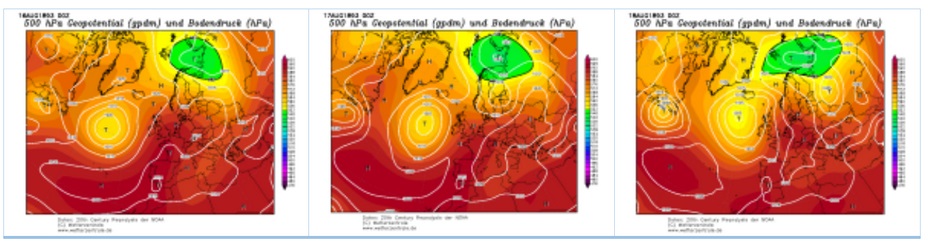
The 500mb renanalysis chart of the heatwave of August 1876
The first heatwave that fits my parameters, and ranks 7th in the heatwave premier league, began on August 13th 1876. Obviously in those days news would have taken a while to filter through. On the front page but tucked away at the bottom of the far right column of Reynolds’s Newspaper on August 20th a report talked on “excessive heat in Norfolk”:
“The weather has been intensely hot in Norfolk, and two fatal cases of sunstroke are reported from Blofield. A similar casualty occurred at Thorndon. A spark from a Great Eastern Railway engine has fired a barley field near Wherstead, Suffolk, in consequence of the extreme drought. The damage done is estimated at £300.”
A report on the “Glorious Twelfth” in the London Daily News on Monday 14th says:
“Not a cloud obscured the burning rays of the sun, and in the middle hours of the day moving about on the moor was not unattended with danger.” The weather was the complete opposite of the previous two years where “rain fell so continuously that only the keenest of the keen ventured abroad”.
500mb reanalysis of the 1893 heatwave
It would be another 26 years before Greenwich would see another heatwave of the same magnitude. Tucked away on page 16 of Lloyd’s Weekly Newspaper on Sunday 20th August 1893 a national round-up column spoke of ‘The Excessive Heat’ of the past week of that heatwave which ranks 11th in the league of heatwaves.
“A farmer, named Calvert, of Barlow, died of sunstroke on Tuesday whilst engaged in harvest work. A man named George Wight fell down in the street at Birmingham on Tuesday, and was taken to the hospital, where it was stated that he was suffering from sunstroke. The intense heat had a remarkable effect on the temperature of the sea in the Channel. A Sandwich correspondent said the water was the warmest it had been for 25 years.”
Several cases of sunstroke were recorded among soldiers from Plymouth Garrison. A regiment from West Riding were ordered off parade while some regiments took the unprecedented step of parading in shirtsleeves. An engine-driver, when running the express into Stoke station, became seriously ill and died directly after his admission to hospital. His death is attributed to the intense heat. Harvesters in Ashford, Kent, also downed tools after a fatality and several cases of sunstroke.
National newspapers of the day took a broader view of proceedings. The Daily Telegraph‘s assumption on the cause of the heatwave and prognosis of conditions was actually better than it is today.
“Not more than twice or thrice in the present century probably has heat as intense and persistent as that now registered been experienced in England. Since Saturday, when announced the formation of an anticyclone over the British islands, there has been a nearly constant and slowly progressive increase of temperature, until yesterday the maximum thermometric reading of the year so far was attained, 90 degrees in the shade being recorded at the Meteorological Office, Westminster.”
The Times on the same day remarked on how people were dealing with the intense heat:
“Such is the force of habit that the social mechanism still keeps working, though nobody really cares for anything except the heat. In the shops, in the Stock Exchange, even in Parliament, people meet and go through the form of doing business, but their langour tells its own story — that the sun has been too much for them.”
The paper describes a “great thunderstorm that had kept everyone in the south of England awake a week earlier” that was assumed to have been the end of a hot summer. But the heat built again.
“Sunday was one of the most exhausting days in human memory; and Tuesday and yesterday, at all events in London, were days to be remembered and quoted. Nothing more like a Italian scirocco has ever been felt here than the west wind which blew at midday yesterday. Very scientific thermometers, indeed, pretend that the heat was nothing exceptional, but the skin, the brain, and the temper of the average man told a different story.”
It would appear that the return of the heatwave took forecasters by surprise and the paper continues on with a familiar ‘why weren’t we warned’ tone:
“And the worst was that the forecast, to which our excellent Meteorological Office has taught us to look with so much confidence, promised quite other things. It spoke of weather unsettled, thundery, and showery later,” and in the north it promised ” westerly and varying breezes; changeable, showery, thundery, cooler. “What tricks were the barometers playing ? Was Ben Nevis having its little joke, or was the office itself suffering from sunstroke?”
On its front page on Saturday, August 19th, The Yorkshire Evening Post featured a prominent sketch of a City gent Picture courtesy of the British Newspaper Archive
The Daily Chronicle turned its editorial attentions to the “alarming” effects the heat was having on peoples’ attire
“The social effects began to operate at an early stage at Westminster, on temper as well on habiliments. They have now penetrated that last refuge of conventional respectability, the City, where the chimney-pot de rigueur has been dethroned by the straw of comfort, and the waistcoat has actually disappeared before the coloured silk scarf.”
The paper reports of people falling ill with fever in the heat, possibly caused by water supply. While the Thames, thanks to reforms by the County Council, was not smelling Glaswegians close to the Clyde were not so fortunate, the river being “overpoweringly odorous all the summer”.
“We must grin and bear it, as may. We shall grumble when the temperature falls, pretty much as we are doing now. For, Macanlay somewhere says, man is never satisfied with what he has, but is always straining after what he has not. And this is particularly true of Britons and their weather.”
Little is written of the 17th ranked 1906 heatwave that ran from August 31st to September 2nd though a diary note on page 3 of the Portsmouth Evening News on Thursday 6th September said the effect of the heat proved decidedly detrimental to education in Portsmouth. It reports:
“Not that the attendance has fallen off to any appreciable extent as result of the very trying weather, but its effect has been very marked, nevertheless, as the youngsters have proved very heavy and slack, with the result that the lot has been decidedly trying.”
The glorious summer of 1911, surprisingly, did not produce a spell that would satisfy my heatwave criteria.
August 9th, 1911, saw the first incident of 100F (37.8C) being recorded in London. The record beat the previous high on 97F. The report also makes mention that many areas recorded at least 97F
The season, which produced hot weather throughout July and August, is worthy of mention, however, because August 9th saw the first occasion 100°F was recorded in London. Considering the magnitude of this milestone the media of the day seemed reluctant to go overboard with the coverage, simply reporting the facts. The day after the hottest day ever the Dundee Evening Post had some advice on attire for hot weather, including a reported sighting of Keir Hardie in a “duck suit”.
By 1923, a heatwave that placed 14th, reports were going beyond records of temperature and heat-related deaths. On July 16th a reader of the Gloucester Citizen was bemoaning the fact that visitors to London were being subjected to “heatwave profiteering”.
Ice was in short supply and only available in restaurants and cafes and the price of fruit and salad had risen “beyond reason”. The author writes:
“A Fleet Street shop, for example, lemons have suddenly risen from a modest penny to a more formidable threepence, and the explanation is: “There has been an eruption at Etna, you know”. “To point out that the present stock of lemons was received long before Etna began to make its dangerous influences felt is merely to invite a shrug of the shoulders and gesture indicating “take it or leave it.”
The London Letter column in the Hull Daily Mail on Friday 13th July mentions MP’s braving the stifling heat to hear Prime Minister Stanley Baldwin’s statement on European policy, and also “London The Boil”.
“The heat wave continues to keep in its fiery grip. It absolutely dominates the daily lives of our seven million population, whose habits are rapidly approximating to those much nearer the equator. Hyde Park ladies fashionably attired may be seen sitting under sunshades beneath the shadiest trees in their stockinged feet. Their shoes rest beside them on the parched grass.”
“In Fleet Street there has been a long queue, as nondescript as an old-time butter queue during the war ration period, outside a shop where ice cream wafers are sold at the rate of about two hundred a minute. Men are wearing white suits, waistcoats have vanished, straw hats are at a premium. Most of the licensed bars are doing little more than pussyfoot trade in long iced teetotal drinks. An actor appearing in SoThis is London, says that he gets home half-an-hour earlier nowadays. Though the theatre is quite well filled, the audience is too hot to applaud. So the show goes slick through.”
The column, written decades before the advent of air conditioned comfort became the norm, also gives advice on where to keep cool in the capital. Previous favourites had included the cold-storage warehouses along the riverside at Blackfriars Bridge, the Monument and Westminster’s “Byzantine” tower.
“I am quite certain the coolest place in London is in a boat under the stone bridge that spans the Serpentine. Scores of overheated Londoners seek these cool arches. There, if you can crush in, you may smoke a cigarette, in almost too chilly comfort, while London boils just outside.”
The Yorkshire Evening Post on Friday, August 29th 1930 Image courtesy of British Newspaper Library
The heatwave of August 27th – 29th 1930, which ranks 15th,produced another interesting ‘London Letter’ column in the Portsmouth Evening News about too-hot cabs and heatwave profiteering: a greengrocer raising the price of lemons from 1d to 13d, despite there being crates available in storerooms!
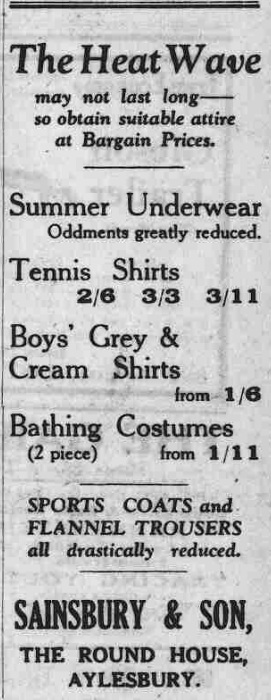
This ‘Sainsbury & Son’ advert appeared on p7 of The Bucks Herald on Friday, August 19th, 1932
Two years later and newspapers were reporting the ‘hottest day for a generation’. The heatwave of August 18th – 20th August 1932 saw the temperature reach 99°F (37.2°C). This heatwave ranks 9th.
“Tragedies attributable to the heatwave were reported from all parts the kingdom yesterday. From the provinces 14 heat deaths were notified. Three cases of suicide which the Paddington coroner said were attributable to the effects of the intense heat and ill health were subjects of inquests Paddington yesterday afternoon.”
The Leicester Chronicle reported cases of heat exhaustion and the curious sight of people carrying home butter in jugs while the 7.25pm and 7.30pm express trains from King’s Cross to the Western Highlands had shower baths installed in sleeping cars to help passengers cope with the heat.
The heatwave of August 6th – August 8th 1947, which ranks 18th, was sparsely reported save for the usual heat stroke casualty stories and the fact that Cheltenham recorded 11 hours of sunshine on one sweltering day.
By 1948 signs of a move away from straight reporting of heatwaves were beginning to appear. An Hour in the Heatwave, a report taken during the hot spell of July 28th – 30th, ranked 12th, was published in the Essex Newsman.
The reporter, Gilbert Saunders, gave a simple but highly readable account of people going about their daily life in the heat.
“In the stadium The other side of the river, where Chelmsford have their stadium, Ted Boxall, private builder, was getting on with a job that he started on Wednesday and hopes to finish by today. He is making a surround and small archway for the counter over which cups of tea are passed to directors and guests in the board room under the grandstand. Ted (who asked : “You’re not mistaking me for Mr. Rowe, are you?”) was surrounded with litter of Essex boarding and sawdust. He paused to wipe a hot brow, explained that he does “lots of odd jobs” for the club. Ted gets a hand from the players when its needed. Earlier this week he finished off two sets of concrete steps, one each side of the grandstand, so that fans will be able to get on the raised ground without having to scramble up the sides of a small mountain of ash and clinkers.”
An hour in the heatwave, published in the Essex Newsman – Friday 30th July 1948
“On the Corner At London Road corner, his face red from the heat but bearing the everpresent grin, Special Constable Thorn clicked and swivelled his 6ft 3in and kept the traffic moving, all unaware that the next day’s Essex Chronicle was already printing a letter suggesting that his courtesy, service, and goodwill should be rewarded with the Freedom of Chelmsford.”
“In the Newspaper Office And inside the building of the Essex Chronicle, Norman White, bespectacled family man, sat down at the side of the roaring press and took a bite at some sandwiches. The first of seven editions was streaming out. “Ought to be pretty early tonight,” he shouted above the din. “With luck we should all be away between half-past nine and ten …… “
The Aberdeen Journal, in its edition published on Friday 30th July, reported on conditions in London and how the population was coping (or not!) with the heat:
“The metropolis last night was like a large restless household—with all the lights ablaze, doors and windows thrown open, the family fretful, and endless pots of tea brewing far into this morning.
“Perhaps one in ten among the 8,000,000 of us slept after midnight. For the rest, we tossed and turned and saw out this heatwave night, when temperatures were never below 71 degrees, a variety of ways. About midnight I walked past the gaunt old Edwardian mansions in Kensington. With the exception the lights that burned from every window, the scene was reminiscent of the early days of the Blitz.
“Families trekked across the roadway in varying stages of undress to their little bits of ornamental gardens. With them went camp beds, bed linen, umbrellas, “in case,” the children, and the household pets, choose a cool open-air camping spot and feel wonderfully adventurous and spartan in the process.”
Yorkshire Evening Post – Thursday 14 August 1947
“At regular intervals the adolescent members of the squatting colonies were dispatched to the tea and coffee stalls on the corner, and perhaps for the first time in years these traders ran out of stocks. On the Kensington-Chelsea boundary, where life becomes noticeably less inhibited and on occasions less swish, a mixed group of young artists was sleeping on the pavement off Fulham Road.
“Round the next corner, where many theatrical and film stars live, several had slung hammocks on their meagre front lawns – one actually suspended between the bathroom windows of two adjacent houses. Midnight street wear for both sexes was cool if unconventional —silk pyjamas, bath robes, tennis shorts, and one in kilt and bathing costume top who could have gone straight into the arena at Lonach.”
The column goes on to describe the situation in the House of Commons where the heat had reached “almost Turkish bath intensity”.
“Some members were in natty tussore silk suitings, but this helped little, and it was many of their number who appealed to the Speaker to have more windows opened. The Speaker, panting like the rest of us, said they were all open. If they wanted more cool breezes from the Thames, members would have to smash the windows.”
More evidence of reportage became evident during the June 1952 heatwave which ranks 8th.
A report on life in the heatwave published on July 5th 1952 Image courtesy of the British Newspaper Archive
Peter Chambers, of the Evening Express, wrote:
“London is hot. It is going to get hotter. That merry mercury column is poking up into the eighties already. That’s what faces us at the height of a heatwave.
“Bus tyres sizzle on the melted tarmac in the streets. At office windows, the girls are pattering away at their typrewriters with damp, discouraged fingers.
“It’s a scorcher. Even the sparrows are panting.”
The reporter describes the scene at London Bridge at 9.30am: “Well, as I came over London Bridge with the 9.30 surge of sweltering suburbia, a bus conductor hopped off his traffic-jammed vehicle and grabbed a couple of ice chips off a Billingsgate lorry. One for him, one for the driver. “What I want, mate,” said the driver ungratefully, “is a ‘ole block of the freezin’ stuff – to sit on.” That is the male reaction to the heatwave.
“The female reaction is typified by the secretary in this office, who buzzes off to the ladies’ room every half-hour to atomise herself with eau de cologne. Ever since she read that fragrant publicity handout, which said “It’s not enough, girls, NOT to be hot and sticky, you’ve got to smell NICE-TO-BE-NEAR…”
The author takes a walk past Embankment and up to Trafalgar Square: “The girls are in topless frocks. Even the men have got their jackets off – a sight abhored further east, where the rigid convention of the City demands that you sweat it out in your dark worsted, regardless.”
At 1pm he finds foreigners feeding the pigeons by Nelson’s Columns and Londoners feeding themselves on bags of strawberries priced at 1/9. By 3pm he’d made it to the Serpentine Lido along with 3,000 other people. He describes at like “Margate on a Bank Holiday”.
The summer of 1959 was glorious but many cool nights saw the season fall short of my 23.5C threshold. It would be a long time before summers were nice again.
The top 6 of my league of heatwaves are all occupied by much more recent events, including 1976 and 1990, both of which are dealt with in the blog I wrote last year – 50 years of London heatwaves. The heatwave that topped them all, in terms of sheer intensity and produced the UK’s hottest day ever, happened in 2003.
I have vague memories of the weeks of sunshine in 1976 but the hot spells that stick in my mind the most are August 1990, when the UK temperature record was set in Cheltenham, Gloucestershire, and August 2003 when an 8-day hot spell saw the all-time UK temperature record broken when 38.5C was reached at Brogdale, near Faversham, Kent.
In terms of length, heat and sunshine, therefore, 2003 comes out on top. Though many people will argue that 1976 is the more impressive summer that year produced two spells that satisfy my criteria, coming in second and fifth. The first heatwave saw temperatures soar above 31° C for six consecutive days from June 23. The start of the second, on July 3, saw Bjorn Borg win the first of five Wimbledon mens’ titles as he prevailed over Ilie Nastase in 35°C heat. The summer of 1995, which saw my driest-ever August with just 0.7mm of rainfall all month, comes in 3rd, with six days of mean temperatures of 23.5°C or higher.
Looking back through history it is not really surprising that 2003 comes out on top. While it was hot in London the heatwave across the Channel contributed to the death of over 70,000 people throughout Europe, France being the most affected.
A complete set of 500mb reanalysis charts have been uploaded and can be watched as a GIF movie
* There were hot spells before 1852 but I have excluded these: Luke Howard’s maxima observations from Plaistow, Stratford and Tottenham were taken under non-standard conditions and may be on the high side. I have instead focused my investigation on data recorded at the Royal Observatory, Greenwich.
** For some reason the data during a couple of years in the 1950s was incomplete – to fill in these gaps I used official data gathered at Kew. The data is completed up to the present day using my own observations taken since 1988.
*** As already mentioned prior to these dates data is unreliable as conditions for collection were not strictly controlled. However, there are many records of extreme heat. On Sunday, August 1, 1868, the Gloucester Journal published a report on the “Heat of previous years” detailing an account of hot spells going back to 1806. “Mr. G. J. Symons gives a number of interesting particulars in reference the heat of previous seasons in this country. We abstract the following
1806: Very hot in parts of June and July. At Plaistow the temperature was 95 degrees on June 10th, and 90 degrees or upwards on three days.
1808: Very hot from July 12th to 19th. On the 12th a thermometer in perfect shade in a window in St James’s Park was 81.5 degrees at 3pm, and on the 13th at the same hour, 94 degrees. On the same day four men and seven women were killed by sunstroke in various parts of the Midland counties, and numerous coach and other horses were also killed. On the 15th a very violent and destructive thunderstorm in Gloucestershire, Monmouthshire, and surrounding counties.
1818:July a very hot month. At Tottenham on the 24th Luke Howard registered 93 degrees at Somerset House on the same day it was 89 degrees, and in the Strand 87 degrees at noon. The mean temperature of that day at Greenwich was 79.2 degrees, which was higher than any other day between 1814 and 1863. The following paragraph appeared in the Gentleman’s Magazine for September, 1818: “It is worthy of remark that the heat of the present summer has been universal. From the north to the south of Europe the heat has been greater and more lasting than for 40 years On July 24th the thermometer here (where!) was 98 degrees, which had never been reached except on July 16th, 1793. At Paris July 31st it was 93 degrees and at Philadelphia 100 degrees.” From 19th to 21st violent thunderstorms in the west of England.
1825: July remarkable, if not unique, in its constant and excessive temperature. At Stratford Luke Howard registered 90 degrees or upwards on seven days, the highest being 97 degrees on the 18th.
1826: The heat was very great. In May the thermometer reached 76 degrees, June 92, July 89, August 85. Two men were killed by sunstroke near London. The fields were as brown as the roads. After two months’ drought the rivulets were gone, and many of the wells dry. The hay crop was deficient from long drought. Country is parched, and corn in some places, though only a few inches above ground, was shooting into ear. Several hills and moors caught fire. In Worcestershire the excessive heat and drought almost wholly destroyed the pasturage, and trees were lopped to feed the cattle.
1846: July 5 was very hot, 93.3 degrees being registered at Greenwich, and 94 degrees at Clapham (94 degrees has been recorded there again in the only other instance at that station.
1852: July of this wet year was remarkably hot, the mean monthly temperature (66.6 degrees) having only been exceeded by July 1778 when it was 67 degrees; and July 1859 when it was 68.1 degrees. Tho extreme heat, however, was only 90.3 degrees at Greenwich.
1857: On June 28, 92.7 deg. was recorded at Greenwich.
1858: June was a very hot day, 94.5 degrees being reached at Greenwich.
1859: Temperatures of 92, 92.5, and 93.0 degrees were recorded at Greenwich.”
Total days where the mean temp was 23.5C or higher
There are 2.5 times as many hot days during summer in London as there were 100 years ago – that’s the result I have found while looking at data for Greenwich going back to 1851.
Very hot conditions, where the mean daily temperature is 23.5°C or higher, as defined by the Met Office’s Heat-Health Watch System, have been achieved in this area on 199 days since 1852.
The Met Office, and other meteorological agencies, use 30-year averages to smooth any spikes of hot and cold years – so the result, in my view, is quite remarkable – even though it is just one dataset.
Looking at the data overall it can be seen that while average maxima has decreased by 1.6°C since 1881-1910, minima has increased by 2.1°C.
30-year hot day max / min average since 1881
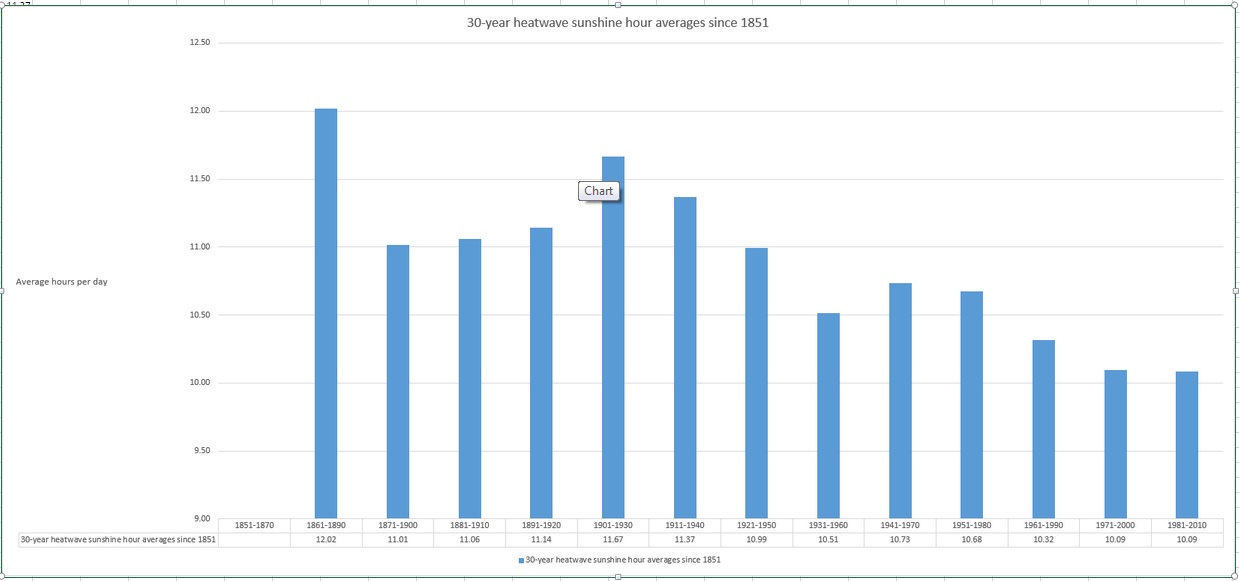
The decreased maxima is possibly explained by the fact that the sun shines, on average, just over an hour less than it did a century ago. The reason for this could be because of increased air pollution and aircraft contrails?
The increased minima, on the other hand, could be being caused by the fact that vast tracts of suburban front and back gardens are now paved over – along with the loss of the shade of many trees. This, and increased road and house building, acts as a huge radiator, keeping nights warmer than they would have been a century ago.
Experts would question the hybrid nature of my dataset, even though my observing sites are very close to those of Greenwich. It is a shame that many of the first climatological stations, such as Camden Square set up in the early 19th century by George Symons, are not still around as they would now offer an unquestionable insight into just how much London’s climate has warmed.
Sunshine hours have decreased since the 19th century
You could argue that there is no doubt that the warming in these data is man made though, perhaps, paved gardens keeping summer nights warmer would be a lot easier and cheaper to solve than fulfilling the carbon capture policies of many of the world’s governments. But that is an argument for another post.
For now, as the capital’s population continues to increase, it is vitally important that planners get the next generation of property developments right to keep the population cool when a heatwave strikes. Extreme heat severely affects public health, not least the suicide rate – a study has shown that above 18°C, each 1°C increase in mean temperature has associated with a 3.8 and 5.0% rise in suicide and violent suicide respectively. Planners cannot just leave it to energy-hungry air conditioning to bring relief – developments should incorporate plenty of shade and natural cooling in their designs to help counteract the health impacts of future heatwaves.
* There were hot spells before the period in this post but I have excluded these: Luke Howard’s maxima observations from Plaistow, Stratford and Tottenham were taken under non-standard conditions and may be on the high side.
** I have focused my investigation on data recorded at the Royal Observatory, Greenwich. For some reason the data during a couple of years in the 1950s was incomplete – to fill in these gaps I used official data gathered at Kew. The data is completed up to the present day using my own observations taken since 1988.
This summer is looking an average one. Before you write it off, however, average summers do come with decent spells of warmth and sunshine. But I think the old saying that an English summer consists of three fine days and a thunderstorm will be used more than once this year…
To reach my conclusion on this summer I have used pattern matching of meteorological data from this area for March, April and May stretching back to 1799.
The dry and sunny weather of March and April was tempered by a very average May. The mean for the spring season was 10.5C with 75.8mm of rain and 511 hours of sunshine.
If you take into account all years that were within +/- 10 per cent of these figures, for rainfall and then mean temperature, you get the following table.
The ‘best fit’ years were revealed as 1844, 1870, 1880, 1943, 1995, and 2009. As an average this summer could be expressed as: Mean: 17.4C (about average) Rainfall: 127.3mm (below average) Sunshine: 567hrs (about average)
Or, expressed in probabilities, I concluded the following:
Very Warm ( above 20.4) 0%
Warm (19.4 – 20.3) 0%
Rather warm (18.4-19.3) 17%
Average (16.9C – 18.3C) 50%
Rather Cool (15.9 – 16.8) 33%
Cool (14.9 – 15.8) 0%
Very cool (below 14.8C) 0%
Very Wet ( 3.8 x average) 0%
Wet (2.9 x average) 0%
Rather wet (1.9 x average) 0%
Average 50%
Rather dry (0.7 x average) 33%
Dry (0.5x average) 17%
Very dry (0.25 x average) 0%
So from the above you could deduce that the next three months will be average to rather cool, with average to slightly below average rainfall. Sunshine average.
Trying to predict daily detail over the next 3 months is impossible, but looking at the ‘best fit’ years mentioned above it is probable that the opening 10 days of June will be among the coolest of the summer.
Of interest to most will be when are the hot spells most likely to happen. Considering the median of all rain days a dry spell happened without fail between the dates of June 28th – June 30th and August 15th – August 19th; both these spells likely ending with thundery breakdowns. Another date to bear in mind for a possible two-day fine spell is July 24th-25th.
So, all-in-all, a mixed bag. Looking at the ‘best-fit’ years, however, it is worthwhile noting that although the overall picture looks average there exists the record-breaking dry August of 1995 and the notably wet and thundery July of 1880.
My summer forecast last year was broadly correct. How this one will fair obviously only time will tell. One could argue that what I’m forecasting is just climatology which has a good chance of being correct should no external influences, such as a huge eruption on Mount Etna, have a bearing on the end result.
* Taking into account the fact that temperatures in London are up to 0.66C warmer than they were 100 years ago I have added 0.66C to mean temperatures before 1915.
** Obviously, in the event of a series of direct hits from thunderstorms, my rainfall estimate could be hopelessly short – a symptom of abundant solar energy at this time of year which creates a ‘noisy’ atmosphere compared with winter.
*** The 1981-2010 average mean for summer in this region is 17.6C, with 144.9mm of rain and 564 hours of sunshine
With all the talk of heatwaves this week it won’t be long before the media switches from piping on about the UK facing “10 years of miserable summers” to “Is our climate getting warmer?”.
But the simple fact is that the UK’s climate has always varied greatly – some years, as in the last two, the pattern for summer has brought mostly miserable weather. Other years we get a run of warm, dry summers.
A case in point was the heatwave of July 1808. Far removed from images of freezing Georgian winters and miserable summers the July of 205 years ago was among the warmest ever. The monthly mean for July 1808, according to the Central England Temperature series, was 18.4C – the 6th hottest July since the beginning of the series in 1659.
Readings taken by Luke Howard at Plaistow show the build up of heat to the 14th. The series on the right, taken in Wanstead, around 3 miles to the north-east, will be added to by the author as July unfoldsLuke Howard, the ‘father of meteorology’ who at the time lived in Plaistow, referred to the heatwave in his diary on July 13th: “Temperature at 9am 84F. The intense heat of the maximum lasted nearly three hours till about 4pm. At 6pm the temperature was 90F.” Another entry mentions a reading taken nearby. “Another at Plashet, a mile and a half eastward, indicated 96F as the maximum under the shade of a house.”
While Howard’s methods of measuring the temperature ran short of modern standards, his thermometer was hung under a laurel bush, the values still give a valid insight into the heatwave.
Tales of the heatwave, which particularly affected east and north-east England, can be seen in letters sent to local newspapers around the country. Many describe labourers dying from heat exhaustion while working in fields. Farm animals and horses suffered a similar fate. One letter from Hull, published in the Coventry Mercury, said: “At Sigglesthorne, the honey in some beehives melted, ran out upon the ground, and most of the bees drowned in it. At Sutton, a lamb and a dog belonging to the Rev Mr Croft of Rowley, expired in the heat; and several birds dropped down dead, while flying over the streets of this town.”
Of course it is impossible to know about the health of people and animals that died but that birds dropped out the sky suggests extreme heat.
While temperature records of July 1808 are not unheard of in an English summer one record that remains is the size of the hail – which fell in damaging storms when a thundery breakdown arrived on the 15th.
The main storm missed Wanstead and the surrounding area – though Howard, writing in his Plaistow observatory, knew the weather was on the turn: “Dew on the grass, a fine breeze from ENE. Much lightning in the west this night, a few drops of rain.” Howard would have been referring to all the action about 120-odd miles west where one of the most ferocious storms in recorded history was unfolding.
Much was reported in the local press on the days following the storm which affected an area from Somerset northwards. As well as local records Luke Howard also noted national events in his diary: “After several days of uncommon and oppressive heat the city of Gloucester experienced a storm of thunder and lightning which extended many miles round and exceeded in awful phenomena any one remembered for many years past.”
Trees were “shivered to atoms”, livestock killed by lightning, crops were ruined and countless windows and glasshouses smashed by huge hailstones. A lot of the detail of the storm was compiled by a man named Crocker, then governor of Frome school, Somerset. One account from Batcombe describes a hailstone that measured 13.5 inches in circumference. To give you an idea of the size of a 342mm circumference hailstone I, with the help of my daughters, made one of my own. It is thought the size of the 1808 hailstone may, along with a storm in 1697, be the national record for hailstone size – being 20mm greater in diameter than those measured in a Horsham, West Sussex, storm in 1958
Howard’s report continues: “The most tremendous circumstance of this storm was the destructive hail shower which accompanied its progress.”
The Tornado and Storm Research Organisation (TORRO) grades haistorms from H1-H10, where the hail increases in size from 5-10 to over 125mm in diameter. From the historic descriptions the 1808 storm was an H8/9.This exceeds the British record made during the Horsham, West Sussex, storm of September 5, 1958, which produced hailstones up to 80mm in diameter. Hailstones for the 1808 storm were about 109mm in diameter. Since 1650 there have been 119 independent H5 hailstorms in England and Wales.
Since 1900 there has been a halving in the frequency of recorded destructive hailstorms. Scientists are undecided on whether this is a result of climate change or just a variability of the British weather. But any future uptick in destructive hail should be tempered by this historic record.
It is my belief that people’s current expectations for summer were raised to unrealistic levels when we had a run of warm, dry summers a few years ago. The fact is that because of our maritime climate warm, dry summers occur in this country only occasionally. ‘Default’ summer weather is changeable, rather cloudy and, for many in the north, rather cool
So, if any media outlets do start coming out with any stories of “unprecedented heat” or “worst storm in history” bear in mind that it has probably all happened before.














 Wanstead Meteo
You must be logged in to post a comment.