With the 10th anniversary of the Boxing Day Tsunami this year it has often occurred to me whether the British Isles has suffered from a similar catastrophe in centuries gone by.
The ‘Extraordinary Phenomenon’ reported in the Morning Post, Wednesday, June 5, 1811
With such a vast coastline it is certainly possible but written records of any events seem to be scarce. An entry in Luke Howard’s Climate of London, however, suggests that a phenomenon very similar to what happened in Asia in 2004 happened on our shores.
An entry on May 31, 1811, in Howard’s diary describes an “Agitation of the sea at Plymouth” that began at 3am – the sea fell instantly 4ft and immediately rose 8ft. “Universal consternation” pervaded the whole port, vessels in Catwater were thrown about in the greatest confusion with many dragging their anchor; some drifted and several lost their bowsprits and yards.
At 6.45am the sea rose to the height of 11ft and again receded. At 9.30am the tide suddenly stopped and suddenly ebbed 6 inches. At 10.30am it ebbed again in the same manner and then flowed to high water.
At the time it was noted that two gales from the SSW and E preceded this phenomenon but at the time it happened the wind was light from the SSW.
A few days later, on June 8th, the tide was again seen to flow and ebb several feet in as many minutes which continued at intervals over 4 or 5 hours. Immense swells were seen to flow into the harbours of Sutton Pool and Catwater at a rate of 4 knots an hour. During the time of the boar thunder and lightning was “excessive”.
These events coincided with a volcanic eruption near the shore of Ferraria, São Miguel, creating the short-lived Sabrina Island named after the British frigate HMS Sabrina, whose captain, Commander James Tillard, first identified the island and claimed it for the United Kingdom. The eruption caused destruction to many homes. The islet itself disappeared in the following years.
The event isn’t on record as being a tsunami but the symptoms seen in Plymouth all those years ago are similar, albeit on a much smaller scale, to those seen across Asia in 2004.
Could a tsunami affect the UK in the future? The British Geological Survey says not.
Signals for winter have always been well reported by the media. Back in the 1980s weather anoraks across Britain would wait with bated breath to read Bill Foggitt‘s latest prognostications for the coming winter. Though Foggitt had some success his observations, among other weather ‘gurus’, often amounted to weatherlore that has only a slightly greater than evens chance of being right.
One popular myth is that very large blackberries mean a harsh winter. The fact that this has more to do with plentiful rainfall plumping up the fruit at harvest time is ignored.
Colin Finch’s 38F minus rule is altogether different and provides a very good guide to the kind of weather we can expect in January and February. For the rule to work the maximum temperature must be 38F (3.3C) or less for four consecutive days before Christmas Day.
Colin, an amateur meteorologist who passed away in 1991, spent much time researching his rule in the 1970s. He found that most of the coldest winters since the end of the second world war gave a hint of things to come in the weeks leading up to Christmas: the Decembers of 1946, 1955, 1962, 1968, 1969, 1978 were all followed by cold late winters. In 1984 and 1985 the cold spell arrived at Christmas. Other years to loosely follow the rule, 1986, and 1990.
A few weeks ago I was reminded about Colin’s findings and decided to have another look, using daily record data for this area stretching back to 1806.
The results were surprising. If there is a run of cold days (3.3C or less) around mid-month the chance of an average to colder than average January and February is 94% and 74% respectively. The chance of an average to colder than average March is 96%. Also notable is that the chance of a severe spell in January (4C colder than normal) is 30%.
So much for the figures. What are the chances of a run of cold days between now and Christmas Day?
Sunset Southwark Bridge
Up until this week the weather has been fairly quiet with little rain and cold, often frosty nights. But westerlies are now roaring back in from the Atlantic and could be a hint of what is likely to prevail later in the winter. However, the ‘crunch’ time for the 38F minus rule comes soon after the middle of the month. If a spell of Arctic weather develops at that time, even if it lasts only a few days, then the chances of a major cold spell after Christmas are much higher.
As I write this blog the models suggest that a run of cold days may just be possible. It is also notable that the likelihood of a sudden stratospheric warming event, argued by many to be a precursor for conditions that would favour the development of a cold spell, is increasing with a peak set for mid January.
We’ll see but Colin Finch’s findings all those years ago are fascinating and are still relevant today.
* The following obituary appeared in an edition of Weather magazine, a publication of the Royal Meteorological Society, in 1991.
“Colin Finch – The news of the sudden death of Colin Finch on Friday, 23 August 1991 at the tragically early age of 55 will be received with sadness by Members of the society and readers of Weather.
There is no doubt that Colin was one of the most enthusiastic amateur meteorologists that the Society has ever had and, without seeking publicity for himself, he was responsible for making many other amateur enthusiasts aware of the Society and encouraging them to join.
Colin’s interest in the weather began when he was a small boy and received a considerable boost during the snowy and very cold winter of 1946/47 when he was 10 years old. In 1949, at the age of 13, he began to take regular temperature and rainfall readings and gradually added more sophisticated equipment. His record of daily weather data was unbroken until July 1991 when he became too ill to continue.
When he left school in 1953 he joined the Meteorological Office as a Scientific Assistant at Kingsway and was trained under the keen eye of Dick Ogden. Later, after a spell at Heathrow Airport, he left the Office frustrated by his inability to develop a career because he didn’t have sufficiently good educational qualifications. Instead, he turned to a successful business career but his enthusiasm for weather observing and forecasting increased.
Each day he plotted and analysed synoptic charts compiled from short-wave Morse code transmissions which he took down by hand. In the 1960s and 1970s it was quite normal for him to spend Saturdays plotting a chart for the whole of the Northern Hemisphere from Morse broadcasts. Later he had facsimile and satellite-receiving equipment installed at home.
By the late 1960s he was liaising with local authorities and the police in Surrey, warning them of the likelihood of severe weather events. In 1970 he joined the then newly introduced BBC Radio London and every Friday morning he would discuss current weather events and give climatological background data about the week ahead. For these broadcasts he would get up in the early hours to plot a synoptic chart before he went to the studio.
After the broadcasts he would go to the City for a normal day’s work. He kept up this punishing schedule for several years. When the Society introduced the highly successful one-day Saturday discussion meetings in September 1972 Colin was one of the first amateur meteorologists to give a presentation and he was a regular contributor to these occasions. He was an imposing figure, 6ft 4in tall, and was easy to seek out at meetings.”
The final month of autumn was most notable for its rainfall with 19 consecutive days of measurable precipitation and just four completely dry days .
November 22nd by Perch Pond. Drizzle early morning couple with damp air left mist floating above the surface
The month was warmer than average; the mean temperature of 8.9C was 0.9C above average, making it the 19th warmest November since 1797: 2.2C warmer than last November, though only the warmest since 2011.
The sunny and start on the 1st was quickly replaced with an unsettled, cooler regime week which lasted for nearly three weeks. A brief respite on the 20th was followed by more rain – with 12mm and 15.2mm on the 22nd and 23rd. It was wetter than average: 97.5mm represents 165 per cent of what we’d expect to fall in a normal November.
Despite it being wet it was only the 40th wettest November in the series back to 1797.
The warmest day occurred on the 1st with 17.2C recorded. The first frosts of autumn were recorded. The lowest temperature occurred on 24th when the mercury fell to -1.5C.
Sunshine was average with 60.5 hours recorded – that’s 103 per cent of mean. The sunniest day was on the 4th when 6 hours of sunshine were recorded.
Over the next couple of weeks speculation on Christmas Day weather will inevitably build. Will Christmas be white or green?
Shoulder of Mutton pond, Wanstead Park
At this range it is impossible to tell from standard meteorological models though from the 15th, 10 days before the big day and when models can start to be relied upon for at least a general trend, the pieces of the weather jigsaw will start to fall into place.
Latest odds offered by bookies William Hill for a single snowflake at London Heathrow are currently 8-1, slightly longer than I’d expect at this time of year. With high pressure building and a general cooling trend this week I’d expect those odds to start to come down.
In terms of proper snow falling and settling, there has not been a white Christmas in Wanstead for over 30 years. In 2010, we could still see the Christmas card Victorian snow scene in small patches if our gardens, but these were leftovers of a previous dump, so it doesn’t count. Frustratingly, there has been snow on several Boxing Days in Wanstead (1995 and 1996) and in the weeks running up to Christmas, but not on Christmas day itself. The most typical Wanstead Christmas day weather is mild and dry, although it has rained on 12 of the last 33 Christmas days.
The period just before Christmas last year was very stormy
In an earlier blog I had a look at what the last 170 or so Christmas Days in London were like weatherwise and found that snow actually falling on the day is extremely rare. Since 1840 there have been just 19 occasions of snow or sleet falling on the capital on Christmas Day which equates to a probability of just under 11%. If you consider that the last ‘white Christmas’ (see note) was in 1996, then we are well overdue one.
But the weather doesn’t adhere to human created calendars and behave like it should on any given day. But patterns in any given year can sometimes repeat though correctly predicting they will happen is more down to luck. Nevertheless I’ve had another look at my calculations for this winter and see if there is any way I can make a prediction for Christmas Day.
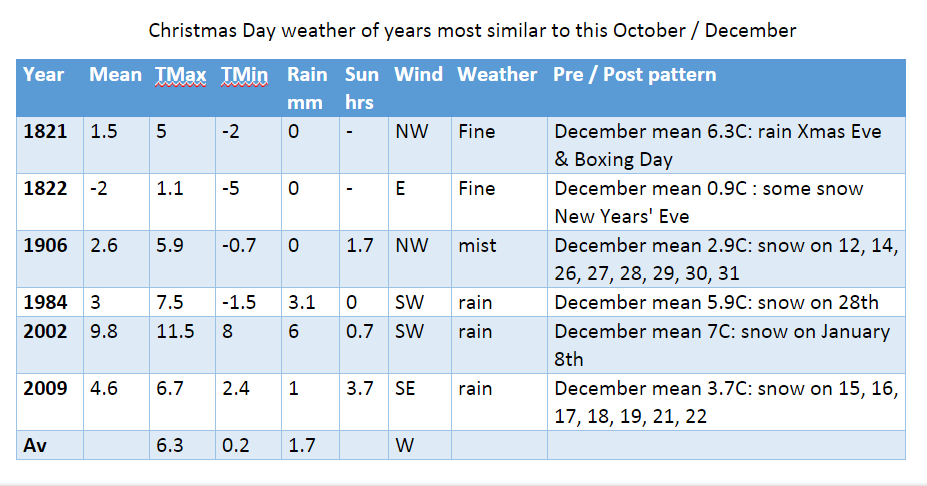
I firstly had a look at Christmas Day stats overall since 1840. The most common group of maxima in the series is 8.1C and above. This occurred 69 times or 40%. I then had a look at the years that most closely follow this October and November. None of the years saw a white Christmas, however it is interesting to note that five out of the six years saw some snow during the month. Snow often falls before and after Christmas. Why that is no-one knows.
So my guess for the weather on Christmas Day this year is for a maximum temperature of 6C after an overnight low of around 0C. With a little rain likely I suppose there is a chance of at least something sleety falling though I’d be surprised if, on Christmas Day morning, we pull back the curtains on a wintry Dickensian scene.
* The definition of a white Christmas used most widely – notably by the bookies – is for a single snowflake, even if it lands in the midst of heavy rain, to be observed falling in the 24 hours of 25 December at a specified location recognised by the Met Office.
** On average, snow or sleet falls in the UK 5 days in December, compared with 7.6 days in January, 6.8 days in February and 6 days in March. White Christmases were more frequent in the 18th and 19th centuries, even more so before the change of calendar in 1752, which effectively brought Christmas back by 12 days. Climate change has also brought higher average temperatures over land and sea and this generally reduces the chances of a white Christmas.
There is a higher chance of snow this year. The average for lying snow in Wanstead at 9am in winter is 6 days
Probabilities for winter for the London area would be a more apt title for this post but that’s not very exciting compared with the hyperbole published almost daily by the likes of the Daily Express.
Much has been written about the sources of their forecasts over the past couple of years. Splash headlines that promise Armageddon Arctic conditions or Biblical blizzards never seem to materialise. So without boring you further I’ll move on to my own views on how I think the next 90-odd days will unfold.
Taking into account more sophisticated methods than my own there seems to be a signal for something colder than last year – though that’s not saying much given that 2013/14 was the 11th warmest winter on record with NO snow falling observed in this area.
Jack Frost could also be around more this winter than last
Though it was abandoned by the Met Office years ago I have decided to base my predictions more on analogues this year. I have a lot more data at my disposal – the series I use now extends past 1881 back to 1797.
The figure I arrived at, taken as an average of the closest matching autumn periods, is a mean temperature of 4.2C with rainfall totalling 156mm over the months of December, January and February – that’s about a degree colder than average and about average rainfall – though I think it could be less given that December is looking relatively dry on the current model output.
The probability of a winter with a mean temperature of between 3C and 4C is 33% – the most likely outcome – though this low figure emphasizes the mixed signals this autumn. With this in mind a winter similar to 1984/85 is possible which saw a brief cold snap at the end of December together with a two-week cold spell that began during the first week of January. There was also a 10-day cold spell during February of that winter.
To try to add value to the above outcome I also had a look at the likelihood of this winter being as mild as last winter.
It has been noted in the past that mild winters often come in twos. I had a look back through the series to see if this was true.
The occurrence of two very mild winters in succession is 27/217 (12.4%). The occurrence of a very mild winter being followed by a very cold or severe winter is 16/217 (7.4%). So while, from these simple stats, another mild winter is more likely, it is not really high enough to consider over the average I found in the first calculation made from straight autumn statistics.
A final fact to consider is just how mild and wet this year has been. Every month this year, apart from August, has been warmer than average by an average factor of 1.2. If December continues warm this year could possibly end as the warmest on record. However, it is also possible that nature is about to redress the balance.
* Forecasting models use probability on any given outcome. Millions of observations are fed into the Met Office database (and other countries’ weather agencies) every day. Supercomputers then crunch through this data to give probable outcomes. With the volatility of the atmosphere it is not surprising that certainty of any outcome often falls away rapidly. Forecasting has improved greatly in the last 20 years – though anything the models churn out beyond three to five days should be handled with caution. Long range models can give *some* idea of general trends for the months ahead – but changing just one variable can vastly alter an outcome at the end of the run.
* *Over the past few months I have been collating data for the area around Wanstead. This data is freely available from the excellent Met Office library and is emailed via Excel spreadsheet. Rainfall stats include a near-complete daily archive, stretching from 1961 to 2003, from City of London Cemetery . Sadly the rainfall station, along with many others, ceased to supply the Met Office after cuts were made shortly after the turn of century. Prior to 1961 I have used monthly figures taken at the Greenwich Royal Observatory stretching back to 1881. Though this is 6 miles away the difference in temperature between the two areas would be miniscule compared with rainfall data and so can be used. I use my own stats for the period after 2003.
Christmas in Victorian London is often portrayed as very cold and snowy – picture perfect images of Yuletides past always scream out at us every year we open a box of Christmas cards.
The Temple, Wanstead Park, always looks that much more stunning with a covering of snow
But a look back through the meteorological records of the Royal Observatory at Greenwich reveals a very different reality.
The 1840s and 1850s, decades where most Christmas traditions marked today began, were often very mild, wet and windy – indeed before 2015 the warmest Christmas Day maximum temperature at Greenwich occurred in 1852 when the mercury reached 13.3C.
Like modern times, however, there were exceptions and 1840 was very cold – the record for Christmas Day mentions “trees coated with rime (ice) 3/8 inch thick”!
The following 20 years saw Christmas morning much milder – well over half had maxima of 6C or higher. In 1843, the year Charles Dickens first published A Christmas Carol and the public sent their first Christmas cards, the temperature reached a balmy 10.1C – though dense fog probably made it feel at least a bit more seasonal.
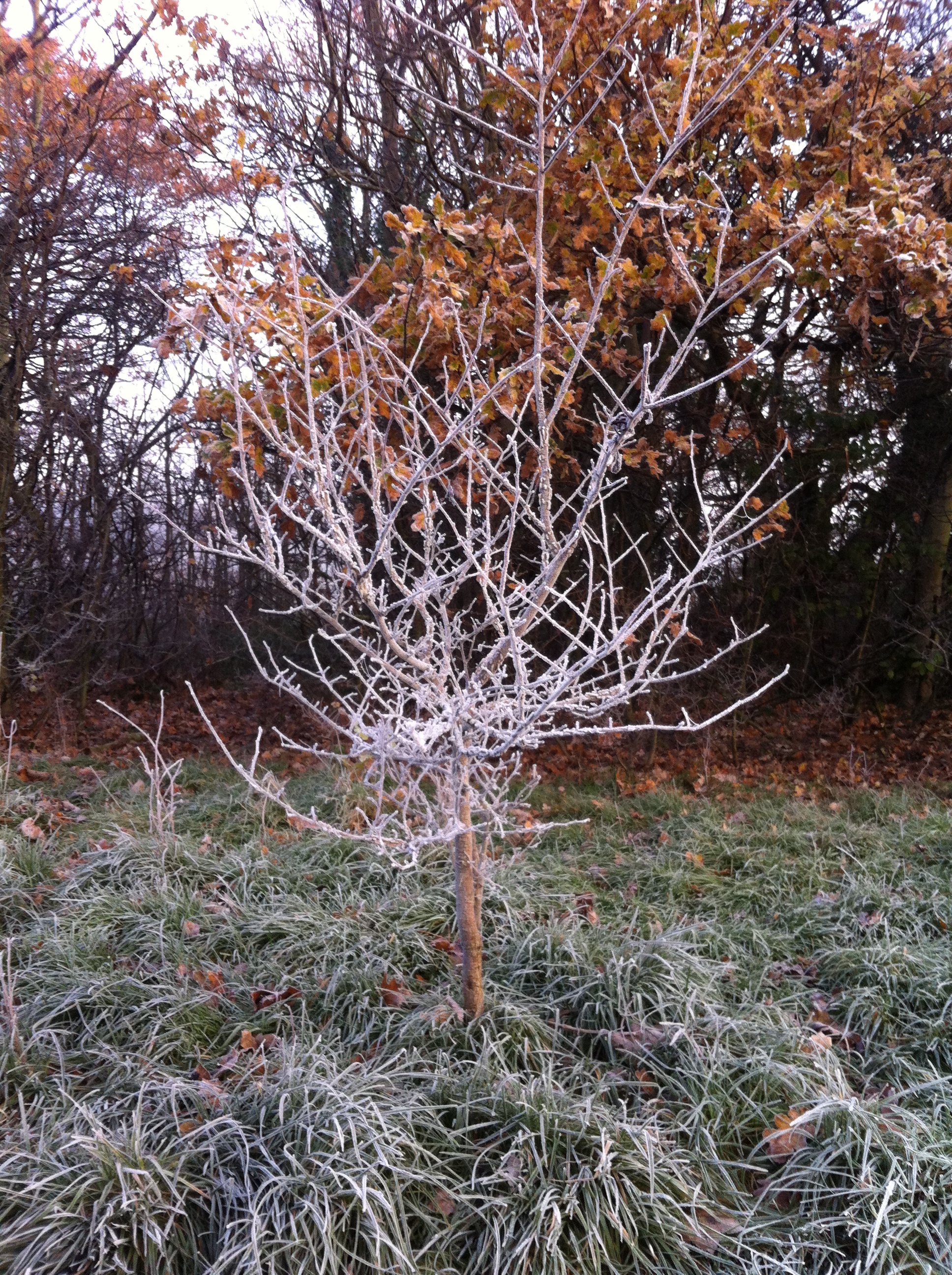
Frost is a common feature of Christmas Day
Four years later in 1847, the year the capital’s Tom Smith invented the Christmas cracker, things were a bit colder – a high of 4.2C and overcast with rain late evening. The following year an image of Victoria and Albert celebrating with their family around a Christmas tree appeared in the Illustrated London News. Like many things Royal down the years it really captured the public’s imagination of taking a spruce or similar evergreen into their living rooms and decorating it every Yuletide.
Christmas two years later, in 1849, was at least cold enough for something wintry to fall. London, however, was still coming to terms with its worst-ever cholera outbreak. With around 14,000 deaths from the disease Christmas was probably not a high priority that winter.
When Good King Wenceslas was first included in Carols for Christmas-Tide in 1853 the day was cold but there was still no “deep, crisp and even” snow or “rude wind’s wild lament”. The day stayed calm and clear.
Though the period either side of December 25th began to be marked with cold, snowy spells it would be another 11 years before London experienced its first official white Christmas in 1864. Sleet, which fell at the end of a 4-day cold spell, probably added to the drama of swimmers taking part in the first Christmas Day swim in the Serpentine, Hyde Park. With a high temperature of just 1.4C it’s quite feasible the few who braved it probably had to break the ice before they took the plunge.
Five years later London experienced another white Christmas with snow falling in a north-easterly breeze – the start of a four-day cold spell.
The joint-coldest Christmas Day on record followed in 1870 with a mean temperature of -7.2C. The building of the Royal Albert Hall was scheduled to be completed by December 25th but it was not until March 29th 1871 that it was officially opened by Queen Victoria.
The remainder of Victoria’s reign was marked with far more white Christmases, a period where nearly two-thirds of Decembers were marked with extended cold, snowy spells. Fog and frost were also frequent.
With a new century and new monarch Christmas-time turned milder and London would have to wait until close to the end of Edward VII’s reign in 1909 to see a ‘white Christmas’ – a poor affair with just a bit a sleet mixed in with the rain late morning. Many probably failed to notice it but it still counts as a white Christmas according to modern bookie’s standards.
Christmas Day can also be stormy
Four of the 26 Christmas Days of George V’s reign were white but the mean temperatures suggest they were all marginal affairs – the core cold weather happening either before or after the 25th. Of note also is the dominance of south-westerlies that brought mild and wet weather – nine out of ten Christmas Days in the 1920s saw rain falling – far in excess of the average for rain on Christmas Day which is 47 per cent.
Just one Christmas was white during George VI’s reign, a ‘good covering of snow’ was recorded by observers at Greenwich in 1938 – the snow falling at the end of a 7-day cold spell.
Sunshine was not a dominant feature of Christmas Day prior to Queen Elizabeth II coming to the throne – the average total in Greenwich from 1877 to 1951 was just under 0.8hrs. Yet the average sunshine total for Christmas Day for the first four years of Elizabeth’s reign jumped to 5.2 hours. The 6.5 hours on Christmas Day 1952 is a record that still stands today! It is remarkable that this record was set just over a fortnight after the Great Smog contributed to the deaths of 4,000 people though other studies put the figure at 12,000 people.
The Clean Air Act 1956 ironically saw the return of dull Christmas Days – though 1956 was a white Christmas with a light covering of snow and a maximum of zero Celsius.
White Christmas Days that followed included 1957 (showery sleet), 1964, 1968 (sleet), and 1970.
Christmas Day 1976 was the last time snow actually fell on Christmas Day in this area though, officially, the last white Christmas was 1996 when a few sleety flakes fell in the early morning.
Christmas Days since then have been mostly mild affairs in London. Of course we had a taste of what a Dickensian Christmas Day was like four years ago when the mean temperature for the day was -1.9C. There were still small patches of snow in our gardens but these were leftovers from a previous dump, so it doesn’t count as a white Christmas. Frustratingly, there has been snow on several Boxing Days in Wanstead (1995 and 1996) and in the weeks running up to Christmas, but not on Christmas day itself.
The warmest Christmas Day in this area occurred in 2015 when a maximum of 15.2C was recorded. Warm air sourced from off the west coast of Africa sent dew points soaring, the minimum on Christmas Day night into Boxing Day did not fall below 13.5C, another record.
The synoptic chart for 0000z Christmas Day 2015 shows ever-warmer air being pumped northwards over the British Isles.
It is surprising how varied the weather can be on Christmas Day – we always think that Yuletide in the ‘Olden Days’ was a cold affair but a look back to 1840 reveals there were times when it was just as mild as it has been in recent years.
Christmas Day morning 1927: the wettest with some 24.9mm recorded
* Statistics for every Christmas Day since 1840 can be found here.
** The definition of a white Christmas used most widely – notably by the bookies – is for a single snowflake, even if it lands in the midst of heavy rain, to be observed falling in the 24 hours of 25 December at a specified location recognised by the Met Office.
*** In the past 170-odd years there has only been 19 white Christmases: in 1864 (sleet), 1869, 1876, 1878, 1884, 1895, 1909 (sleet), 1916, 1919, 1925, 1927, 1938, 1956, 1957 (sleet), 1964, 1968 (sleet), 1970, 1976, 1996 (sleet)
Just over 140 years ago The Grotto in Wanstead Park was destroyed by fire.
An account of the fire appeared in the November 29th edition of the Essex Newsman
The building, once part of the grand estate, was being used as a store room since the park’s acquisition by the Corporation of London. The fire, according to a local report at the time, initially started in a cottage adjacent to the Grotto and was discovered about 9 o’clock on November 20th 1884 by a man who had been walking through the park.
Mr G. H. Sparrow, of Latimer Road, Forest Gate, raised the alarm with Wanstead Fire Brigade who, despite arriving quickly, were too late to stop the fire spreading from the cottage to the Grotto. Their efforts were further hampered because the Ornamental Water was being cleansed – a supply of water was 250 yards distant from the River Roding, a fact that cost precious minutes.
By the time the fire was subdued the place was entirely destroyed – only the outside walls and entrance remained intact, probably more or less what you can see today.
The building was composed of shells, pebbles, fossils, rare stones, looking glasses and “a fine painted window that was built at an immense expenditure by the Countess of Mornington”. Its destruction removed the only remaining monument of what was once one of the great estates in the Eastern Counties.
The Grotto seen from across the Ornamental Water
I’ve often wondered if the weather could have played a part in the demise of the Grotto. The monthly average for November, however, suggests not. A mean of 5.7C is on the cold side compared with recent Novembers and although it was a dry month with 45mm of rain – that total is nothing out of the ordinary for the time of year.
Conditions on the day were bright though chilly, the temperature only rising to 7C after an overnight low of 2C. Perhaps one contributing factor was the north-westerly breeze which would have helped drive the flames through the structure.
One could also point to the fact that Ornamental Waters had no water to douse the flames as it was being cleaned. Though the fact that it was empty is nothing new as the entire lake system had retention problems from the park’s inception.
Perhaps it is a case that fires do just sometimes happen regardless of how careful we are in preventing them.
It is sad that bad luck seemed to hit the Grotto just like it saw the demise of Wanstead House decades before.
Save for the warmest Hallowe’en on record and a notable depression on the 21st October was a relatively quiet month.
The month was warmer than average; the mean temperature of 13.7C was 1.9C above average, making it the 5th warmest October since 1797: 0.7C warmer than last October, though only the warmest since 2011.
The dry and sunny start was replaced with a very unsettled regime at the end of the first week which lasted until the end of the second week – with 39.5mm of rain falling over the 12th and 13th, a notable total for this region. It was wetter than average: 82.4mm represents 123 per cent of what we’d expect to fall in a normal October.
Despite it being wet it was only the 74th wettest October in the series back to 1797.
The warmest day occurred on the 31st with 21.5C recorded. Many nights were warm with date records matched or broken. Cold nights, relative to the time of year were few. The lowest temperature occurred on 4th when the mercury fell to 2C – a ground frost was narrowly avoided with the grass minimum thermometer falling to 0.2C.
Sunshine was slightly below average with 103.6 hours recorded – that’s 97 per cent of mean. The sunniest day was on the 5th when 9 hours of sunshine were recorded.
One hundred years ago this week local newspapers were hailing the bravery of one of its residents who perished in the opening weeks of the Great War.
Claude Gould’s obituary notice appeared in the October 30th 1914 edition of the Chelmsford Chronicle Image copyright of Local World Limited. Image created courtesy of the British Library Board
Claude Gould died after the armored cruiser he was serving on, HMS Hogue, was torpedoed by a German U-boat during a naval engagement in the North Sea known as the Action of September 22nd 1914. Two other cruisers were sunk, leading to the deaths of approximately 1,450 sailors. The loss of the three ships remains the biggest maritime disaster in British naval history.
In the October 9th edition of the Essex County Chronicle Mr Gould, of Spratt Hall Road, was described as “a man of exceptionally fine physique, handsome presence, and frank, engaging manners”. The paper points out that he was the eldest son of George ‘Johnstone’ Gould, a “distinguished name in theatrical circles” in the West End and elsewhere.
Claude, who was Chief Yeoman of Signals, had been a member of the Royal Navy for 16 years and since 1912 had been stationed at Chatham, Kent, though he continued to spend most weekends in Wanstead before being mobilised at the beginning of August.
His abilities had been noted during his Naval manoeuvres and he had been recommended for appointment to the battleship Collingwood before he was lent to the Hogue when war broke out.
A survivor of the disaster noted Claude’s final act of bravery. As the ship sunk he was seen destroying his code-book to prevent it falling into the hands of the enemy.
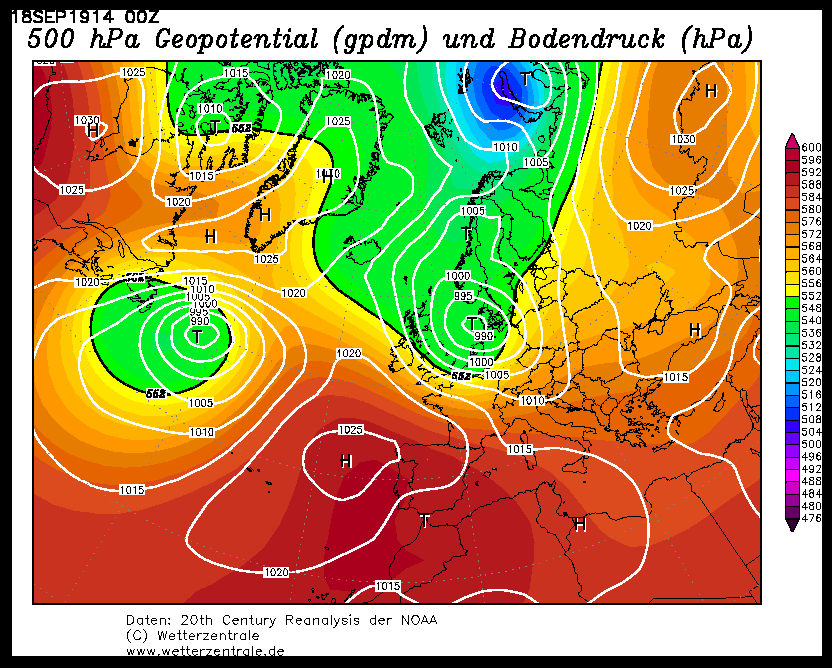
This reanalysis chart shows the depression centred just off Denmark that brought gales in the North Sea, forcing naval destroyers away from escorting cruisers including Hogue. The Air Ministry’s Daily Weather Report for September 17th reports SW’ly severe gale force 9 off Dungeness and Dover – the cause of the heavy seas that forced the destroyers to depart their patrol
Five days before the incident naval destroyers, which had been assigned to protect the cruisers as they patrolled the North Sea, were forced to depart by heavy weather, a blip in a month that overall was dry and bright. Had the weather been different the destroyers would have remained present and the ships would surely have not been such an easy target for the German submarine, the U-9.
The losses from the Action of September 22nd caused a public outcry, eroding confidence in the British government and damaging the reputation of the Royal Navy at a time when many countries were still considering which side in the war they might support.
In terms of weather events September was a relatively quiet month save for the two thunderstorms that seemed to mark the Scottish Referendum as the results became apparent in the early hours of Friday 19th.
Clouds above could be seen developing rapidly at 2.30pm on 19th September
September 2014 was warmer than average; the mean temperature of 16.4C was 1.1C above average, making it the 16th warmest September since 1797: 1.6C warmer than last September, the warmest since 2011.
The month was marked with lots of dry, sunny days, the two thunderstorms on the 19th contributing 89 per cent of the rainfall for the month. It was dryer than average – the 44.8mm that fell is 86 per cent of what we would expect in a normal September.
Despite this it was only the driest September here since 2011.
The warmest day occurred on the 18th with 25.6C recorded. Most nights were warm though a couple of nights were chilly: 5.4C was recorded on 24th
Sunshine was below average with 126.9 hours recorded – that’s 91 per cent of mean. The sunniest day was on the 8th when 12 hours of sunshine were recorded. There were 2 days with thunder recorde.














 Wanstead Meteo
You must be logged in to post a comment.