Category Archives: London weather

Wanstead Weather: 2017 review

This year finished as the 10th warmest on record – some 0.7C warmer than the 1981-2010 average. Screen Shot 2018-01-05 at 12.54.53

Only three months of 2017 were roughly average – the means being within +/-0.7 every month, bringing the mean temperature to 11.9C.

Rainfall was less remarkable with the year finishing roughly average. The total of 607mm (101% of 1981-2010 average) puts it as the 119th wettest since 1797, just over 40mm wetter than 2016.

It was also a slightly duller than average year with 1,391.2 hours of sunshine recorded. That’s 94 per cent of average, the 91st sunniest since 1881.

Screen Shot 2018-01-05 at 13.45.16


For a review of each month, click January, FebruaryMarchAprilMayJuneJulyAugustSeptemberOctoberNovember, December

To view full stats follow this link:http://1drv.ms/1kiTuzv

You can read the national review of weather events at the Met Office blog here.

Screen Shot 2018-01-05 at 14.23.28


Screen Shot 2018-01-05 at 14.25.44


London’s January extremes since 1959

I’ve put together a few top 10s of stats for Wanstead, St James’s Park and Heathrow for the month of January.

Probably most notable is just how impressive the depth of cold was during the cold spell of 1987. When considering St James’s Park the temperature on the 12th never rose above -6C: nearly 4C colder than any January day in 1963, the coldest winter in modern times.

My winter forecast for the London area can be found here.

Screen Shot 2018-01-03 at 21.26.39

Screen Shot 2018-01-04 at 14.47.01

sjp

Some national UK January values according to TORRO

Hottest: 18.3C Aber, Gwynedd – 27th 1958
Coldest: -27.2C Braemar, Grampian – 10th 1982
Wettest: 238.4mm Loch Sloy main adit Strathclyde – 17th 1974

Climatology

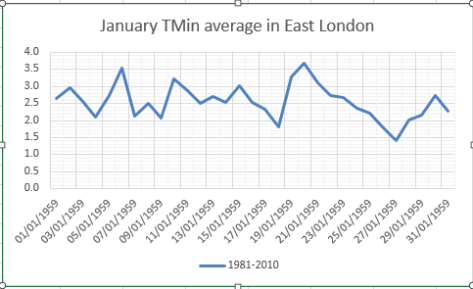
Here’s a couple of graphs showing the maxima, minima and rainfall. Notice the spike  which reflects the singularity which has an 84 per cent probability.

jan av tmax

jan av min

jan av rain

December 2017: average temps, wet

December 2017 was a wet month. Just over 83mm of rain was recorded, 157 per cent of average, the wettest December since 2012 and the 38th wettest since 1797.

Screen Shot 2018-01-03 at 19.30.21
The snow depth on December 10th reached 5cm at its maximum

The monthly mean finished 5.6C, precisely average and the coolest December for five years.

Some 48 hours of sunshine were recorded, 120 per cent of average, slightly less than last year.

The most notable event was the on December 10th which produced the best snowfall in 5 years

Air frosts: 10. Ground frosts: 14. Snow falling: 2. Snow lying: 1.

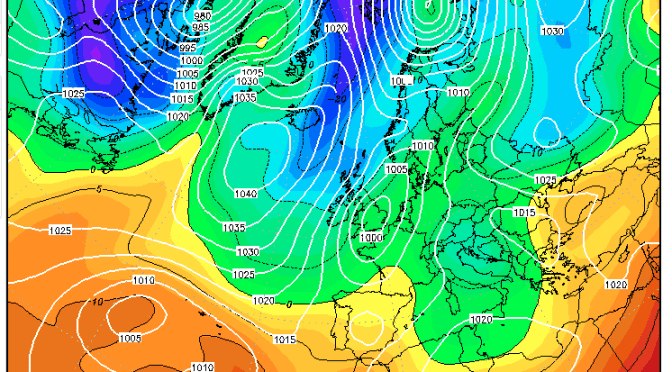
January (on the 3rd) is looking like it may produce more snowfall events similar to December though, with models suggesting a build in heights to the north. A look at the output, including GFS and ECM, suggests the UK will be in a battleground between a cold airmass to the east and warm Atlantic air to the west.

It would seem to back up my winter forecast and also the December analogues with nothing warmer than average.

Average: 33%
Rather cold: 17%
Cold: 17%
Very cold: 0%
Severe: 33%

Screen Shot 2018-01-03 at 19.29.51

Full stats for December here:http://1drv.ms/1rSfT7Y

Summary for December 2017
Temperature (°C):
Mean (1 minute)  5.8
Mean (min+max)   5.5
Mean Minimum     2.8
Mean Maximum     8.3
Minimum          -3.7 day 11
Maximum          14.2 day 30
Highest Minimum  9.8 day 21
Lowest Maximum   2.4 day 10
Air frosts       10
Rainfall (mm):
Total for month  83.7
Wettest day      14.6 day 10
High rain rate   12.1 day 31
Rain days        21
Dry days         10
Wind (mph):
Highest Gust     25.1 day 30
Average Speed    3.5
Wind Run         2570.0 miles
Gale days        0
Pressure (mb):
Maximum          1036.4 day 22
Minimum          970.3 day 10
Days with snow falling         3
Days with snow lying at 0900   1
Total hours of sunshine        48.3 (120%)
Screen Shot 2018-01-03 at 19.30.41

London Grimness index

The last three months in east London have been sunnier than average – hard to believe as we move into a regime of easterlies that will bring showers and anticyclonic gloom.

Screen Shot 2017-12-21 at 21.30.14
A sunless outlook from the Met Office last December

With no sun and short days  it is no surprise that many are probably already feeling short-changed in the solar stakes.

A blog by XMetman on a ‘grimness index’ got me thinking how London fairs in terms of sunshine, temperature and rain in any given winter season.

Using the same criteria, and assuming that most people welcome sunshine, it can be seen that since the least grim winter of 2007-08, the season, over the past 10 years, has been growing steadily worse.

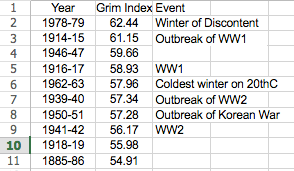
Screen Shot 2017-12-21 at 21.51.54The grimmest winter, considering statistics back to 1881, was, ironically, the 1978-79 ‘Winter of Discontent’ when, again ironically, ‘Sunny Jim’ Callaghan was in Downing Street as widespread strikes coincided with the coldest winter for 16 years. On looking at the Top 10 of grim winters it is striking how most coincide with depressing world events, the Great War, World War 2 and the Korean War!

grim index

The Tory ‘Crisis? What Crisis?’ campaign was probably my first memory of a general election broadcast.

A repeat of December 1990 this weekend?

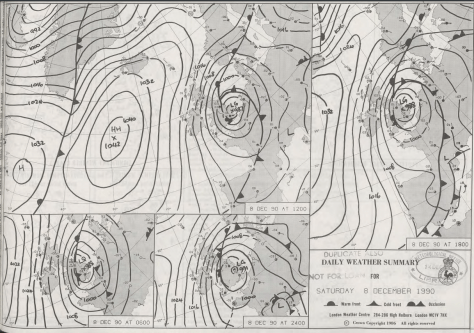
The outlook for possible snow over the weekend reminds me of a similar synoptic set-up in December 1990 that left large parts of the Midlands northwards covered in deep snow, but that delivered only cold rain to the London area.

The situation in 1990 is explained on the excellent Booty Weather site.

“A low formed dramatically over central England on the 7th, large quantities of rain, turning in many places to snow, fell on its western and northern flanks. On the 7th and 8th very heavy snow fell over northern England, Wales, the Midlands and south west England, with heavy drifting in gale force winds, causing considerable disruption to traffic and cutting power lines.

coventry“The snow did not freeze, however, but melted very rapidly during the next few days, as the temperature rose a little. By late on the 8th, many parts of the Midlands had 20cm or more of lying snow. Acocks Green, Birmingham, reported 42.5cm on the 8th. The Peak District had 38cm at Middleton and 25cm at Winksworth. Newcastle under Lyme reported 28cm, and many other places had more than 20cm. Drifts up to 60cm on motorways in the Derby area, and at Carlton in Coverdale, near Leyburn, a report of 240cm. Snowfall on the 9th in the Dorchester area in 1990 was the heaviest pre-Christmas fall in that area since 9 December 9th, 1967.”

My stats in London suggest that the system was a bit of a non-event here. Another account of December 1990 is covered here.

rain


met office
Met Office synoptic charts, general situation and surface obs for December 8th 1990

story

November 2017: below average, dry

November 2017 was another dry month. Just over 33mm of rain was recorded, the driest November since 2011 and the 40th driest since 1797.Screen Shot 2017-12-02 at 17.23.28

The monthly mean finished 7.1C, 1C below average and only the fourth cooler than average month this year.

Some 71 hours of sunshine were recorded, 122 per cent of average – the sunniest November since 2007.

Air frosts: 6, Ground frosts: 17, snow falling: 1 (just a few flakes on the 30th, the first November snow in years.)

The start of December looks like it start mainly dry, an anticyclone over the Atlantic that has brought respite from last week’s cold weather will pull away into the continent to be replaced by low pressure. This depression will track across northern England gradually pulling cold, Polar air across the UK on Thursday.

The models go against what has followed dry Novembers in the past – patterns overwhelmingly suggest that December will be average to rather mild and on the dry side. Winter is looking average overall.

Here follows the full weather diary for November…Full stats for the month here:http://1drv.ms/1rSfT7Y

Summary for November 2017
Temperature (°C):
Mean (1 minute)  7.4
Mean (min+max)   7.1
Mean Minimum     3.5
Mean Maximum     10.6
Minimum          -2.7 day 24
Maximum          15.5 day 22
Highest Minimum  12.3 day 21
Lowest Maximum   3.7 day 30
Air frosts       6
Rainfall (mm):
Total for month  33.3
Wettest day      8.5 day 10
High rain rate   12.1 day 22
Rain days        14
Dry days         16
Wind (mph):
Highest Gust     22.1 day 23
Average Speed    2.7
Wind Run         1952.8 miles
Gale days        0
Pressure (mb):
Maximum          1029.6 day 17
Minimum          985.2 day 22
Days with snow falling         1
Days with snow lying at 0900   0
Total hours of sunshine        71.2
Screen Shot 2017-12-02 at 17.24.28

London’s December extremes since 1959

I’ve put together a few top 10s of stats for Wanstead, St James’s Park and Heathrow for the month of December.

Probably most notable is how the month in 1978 lurched from being very mild and wet to very cold in under three weeks later, setting up one of the coldest-ever winters.

Screen Shot 2017-12-02 at 12.41.15

dec recs

December Heathrow

Some national UK December values according to TORRO

Hottest: 18.3C Achnashellach – 2nd 1948
Coldest: -27.2C Altnaharra, Highland – 30th 1995
Wettest: 199.1mm Dalness, Highland – 17th 1966

Climatology

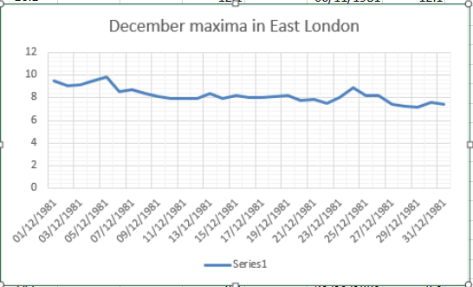
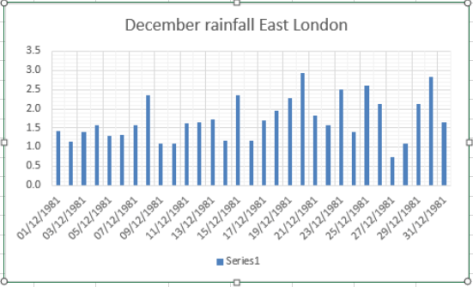
Here’s a couple of graphs showing the maxima and rainfall. Notice the spike just before Christmas day which reflects the singularity which has an 84 per cent probability.

december maxima.PNG

December minima.PNG

december rainfall.PNG

London winter forecast 2017/18

I’ve been doing these written winter forecasts for five years now but this year I’ve never seen such a spread of probabilities as to how winter may pan out. So, if by the end of reading this you are none the wiser, you’re not alone!

The mean temperature for winter 2017/18 is looking average overall with average precipitation. While that doesn’t sound exciting for anyone looking for colder weather and snow I think the figures mask frequent 3 or 4 day-long cold snaps from the Arctic interspersed with milder interludes from Atlantic incursions; typical characteristics of a pattern driven by the troposphere. For anything longer term we have to hope for a warming of the stratosphere, a sudden stratospheric warming over the Arctic, that downwells into the troposphere, reversing the general westerly circulation. We are overdue an ‘SSW’ event but, even if one were to happen, its effects wouldn’t be felt until much later in the winter.

The current cold snap follows the recent disruption of the polar vortex. The ‘displaced polar vortex’ regime seems to be becoming more common as the Arctic gets warmer and maintains more open water during winter. This leads to anomalous ridging over the Arctic, which results in a displaced or bifurcated vortex, which leads to somewhere in midlatitude getting persistent anomalous cold. There was very cold air around last year but the UK missed out; the heart of the cold plunging down far to our east with snow falling on beaches in Crete!

This week’s cold snap looks like it will be short lived though the ‘displaced vortex’ could be an early sign of yet another pattern transition in the troposphere. Looking at the latest model output it is uncertain how long the next polar vortex perturbation will be.

So, whether we see any cold, snow-worthy, air this winter is a lottery – though I think our chances are a lot better than they have been for the past 5 years.

Because October and November have been so dry I’ve had very little to work with in terms of stats to try to find if the current pattern is similar to previous autumns. Instead I’ve looked in depth at ENSO, QBO and local meteorological data.

ENSO

The El Niño–Southern Oscillation (ENSO) is a periodic variation in winds and sea surface temperatures over the tropical eastern Pacific Ocean. It is forecast to be mildly negative (La Nina) over the coming winter. Many doubt whether it has an impact on our winter but there seems to be a connection with strong La Ninas and very mild winters. Because it is forecast to only be mildly negative it’s impact may be very small. I had a look at similar years were ENSO was -0.4 in September and came up with the following.

Screen Shot 2017-12-01 at 13.55.24

QBO

I also had a look the quasi-biennial oscillation (QBO), the quasiperiodic oscillation of the equatorial zonal wind between easterlies and westerlies in the tropical stratosphere. This produced the following table of probabilities.

Screen Shot 2017-12-01 at 13.59.48

Singularities / patterns

My traditional method of looking back for similar patterns of weather in the autumn produced this table.

Screen Shot 2017-12-01 at 14.02.38


 So, considering all three tables together, would suggest, probably bizarrely given the cold start to this month, a rather mild December followed by an average January and February.
Screen Shot 2017-12-01 at 14.08.18

London’s November extremes since 1959

I’ve put together a few top 10s of stats for Wanstead, St James’s Park and Heathrow for the month of November.

Probably most notable is how the month in 2010 lurched from being so warm at the start to so cold three weeks later, setting up December to be one of the coldest on record.

wanstead

November SJP

heathrow

Some national UK November values according to TORRO

Hottest: 21.7C Prestatyn, Clwyd – 4th 1946
Coldest: -23.3C Braemar, Grampian – 14th 1919
Wettest: 211.1mm Lluest Wen Reservoir, Rhondda – 11th 1929

November climatology

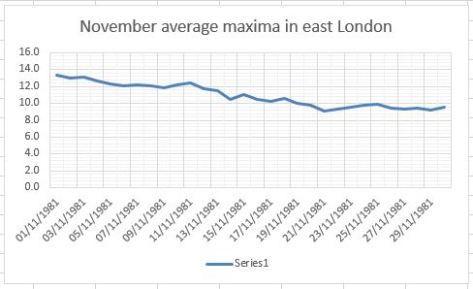
In terms of climatology November maxima, considering the 1981-2010 average, shows a steady fall until the 15th. And another steady fall to the 22nd before things level off. This would reflect the November singularities; St Martin’s Summer, between 15th and 21st, peaking on the 18th, occurs in 66 per cent of years. The Early December storms singularity can arrive this month, on the 24th, the air off the Atlantic raising the mean temperature.

november average maxima

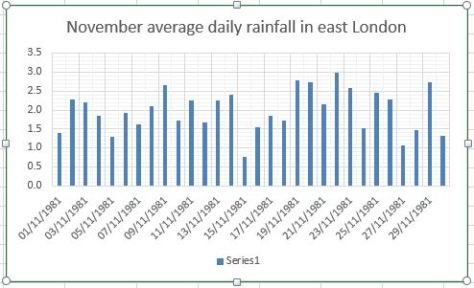
The average rainfall graphic shows that downpour amounts are variable through the month. A tendency for dry weather around the 15th reflects the St Martin’s Summer singularity.

november rain

This graphic shows the average 9am air pressure in November since 2013.

pressure


October 2017: warm, very dry and dull

October 2017 was a very dry month. Just 12.6mm of rain were recorded, the driest October since 1995 and the 11th driest since 1797.

The monthly mean finished 13.1C, 1.3C above average and the seventh warmer than average month this year.

Some 81 hours of sunshine were recorded, 76 per cent of average – the 4th duller than average month in a row. Just three months have been sunnier than normal in 2017!

Air frosts: 0, Ground frosts: 2

The first half of November looks like it will be predominantly anticyclonic. Expect lots of calm weather with the usual frost and fog.

Here follows the full weather diary for October…Full stats for the month here:http://1drv.ms/1rSfT7Y

Summary for October 2017
Temperature (°C):
Mean (1 minute)  13.2
Mean (min+max)   13.1
Mean Minimum     9.7
Mean Maximum     16.6
Minimum          0.9 day 29
Maximum          22.2 day 16
Highest Minimum  15.8 day 13
Lowest Maximum   11.3 day 30
Air frosts       0
Rainfall (mm):
Total for month  12.6
Wettest day      2.8 day 18
High rain rate   12.1 day 11
Rain days        8
Dry days         23
Wind (mph):
Highest Gust     23.5 day 02
Average Speed    3.4
Wind Run         2495.1 miles
Gale days        0
Pressure (mb):
Maximum          1034.0 day 27
Minimum          996.3 day 19
Days with snow falling         0
Days with snow lying at 0900   0
Total hours of sunshine        0.0