Before I’m accused of going all Daily Express the following is based on winter statistics for the London area and other variables rather than the latest expert hopecast.
Even before looking at the data in depth the chart below shows that a warmer than average summer is more likely after a mild winter. The winter just gone was the third mildest in a record going back to 1797.
There are some real corkers in that list, including 1995 when this area recorded the driest August on record. Other notable summers included 1990 – England in the semi-finals of the World Cup and another notably fine August: the then hottest UK temperature was set that year when a maximum of 37.1C was recorded at Cheltenham – a record that lasted until 2003. The year 1989 also stands out with a notably sunny summer.
So far, so good. But what about rainfall? Some 145mm of rain fell this winter – pretty much on the nose average for this region. Combining warm winters with similarly average rainfall gives the following list.
Though some years have disappeared there are still some decent summers, and notably sunny too. The year 1975 stands out as does the sunniest summer on record, 1911! Both were also very dry summers.
Altough the teleconnection with El Nino is tentative in our part of the world the winter seemed to follow the pattern of most positive ENSO episodes, so it is worth having a look to see where the data goes. The latest forecast by NOAA suggests:
A transition to ENSO-neutral is likely during late Northern Hemisphere spring or early summer 2016, with a possible transition to La Niña conditions during the fall.*
If the forecast goes to plan the second ‘rainfall list’ would narrow further:
Viewed by graph reveals that ENSO values of all the years decreased over the course of the year. Series 1 is 1998, series 2 is 1983 etc.
In conclusion, the results would suggest that there is a 66% chance of a decent summer with below average rainfall and above average sunshine. In terms of details June 1st is still a very long off in meteorological terms – so whether it includes any heatwaves that would put it my premier league of hot spells is anyone’s guess at this range.
If it’s anything like 1959, 1975, 1983 or 1998, however, I think most folk will be happy.
*The above contradicts some forecasts which suggest a continuation of the general pattern that persisted during the winter: warm SSTs in the Atlantic / warm water south of the Grand Banks were largely responsible for the cyclonic westerly type of weather that caused the mild weather. In summer this would cause changeable weather rather than long spells of settled weather.
Legend has it that the weather on St Swithin’s will be the same for the next 40 days.
St Swithin’s day, if thou dost rain,
For forty days it will remain;
St Swithin’s day, if thou be fair,
For forty days ’twill rain na mair.
St Swithin’s Day is probably among the most well known of weather folklore – but, taken at face value, it is probably the most unreliable.
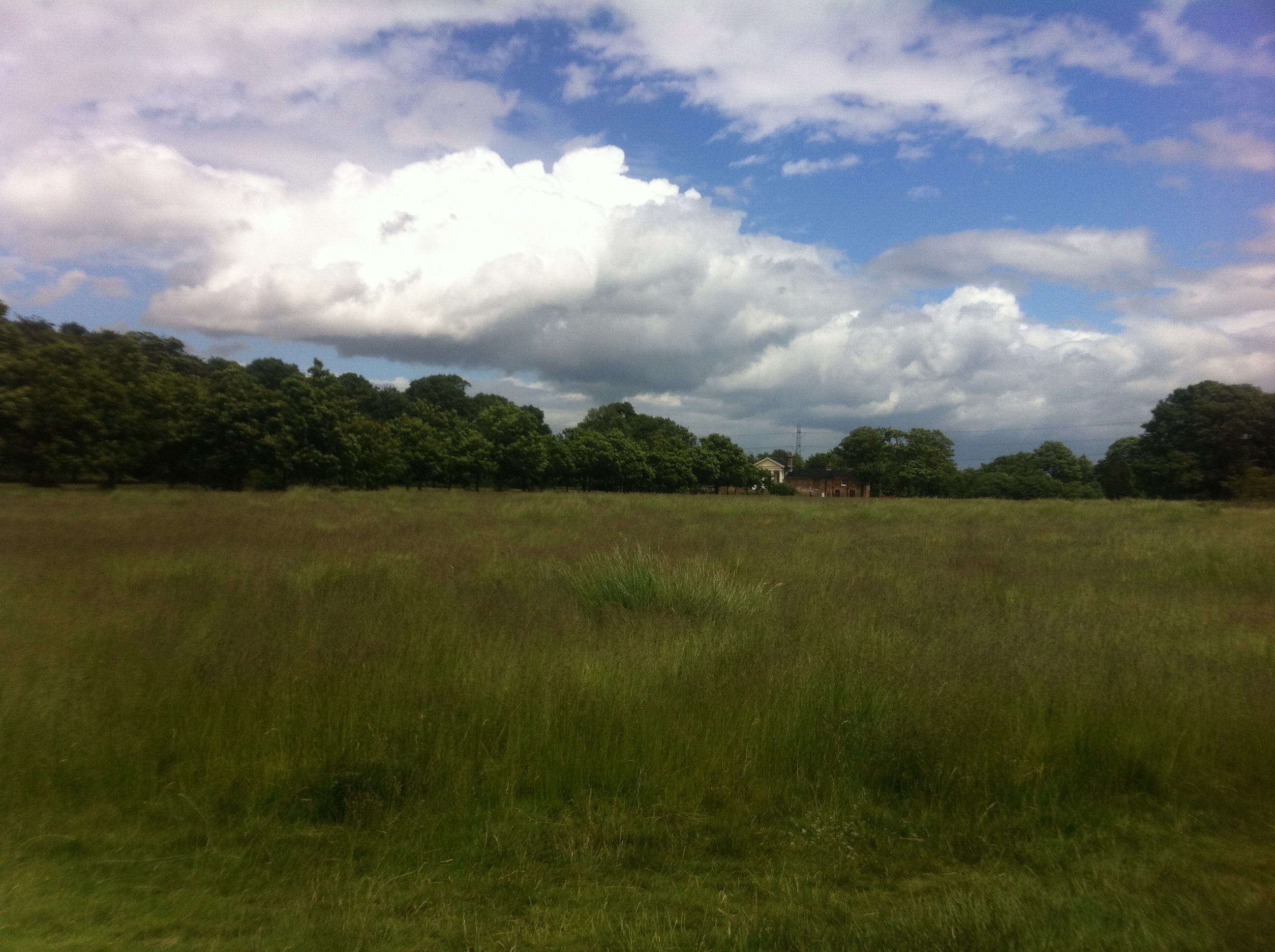
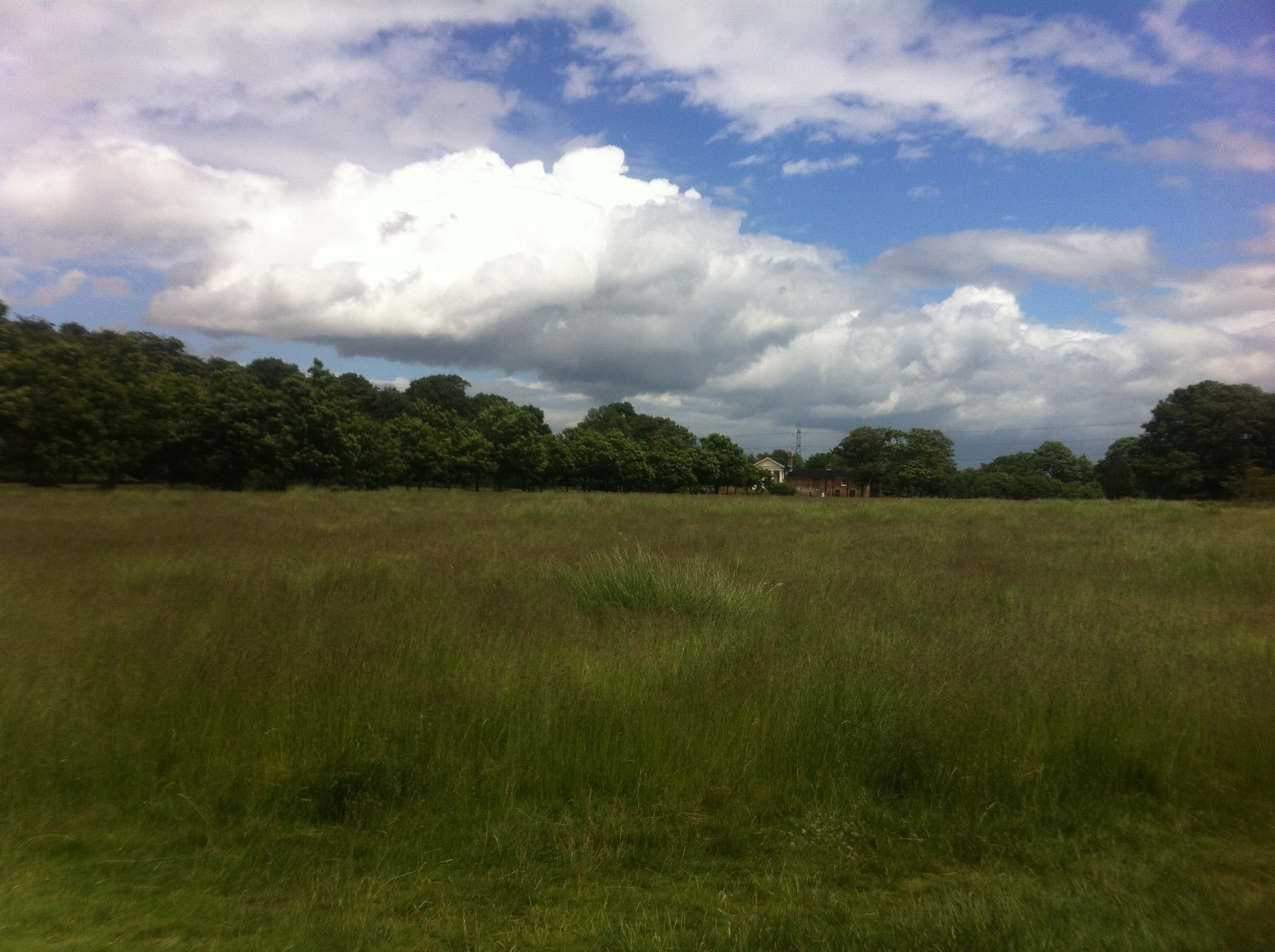
Grasslands around Wanstead Park have gradually turned brown because of the lack of rainfall since March
Since 1848 Wanstead and the surrounding region has enjoyed 93 dry St Swithin’s Days (56%). From these the longest dry spell that followed was just 18 days, in 2000. On average, if St Swithin’s is dry, the weather stays fair for 3 days, with rain arriving on the 18th. Many dry St Swithin’s Days (17%) are followed by rain the next day – these results skew the median for rain after a dry St Swithin’s to just 2 days!
Another interesting observation is that the 40-day period that followed a dry St Swithin’s is on average 13% WETTER than if it rained on July 15th.
So what does this mean for the rest of July and the summer? Looking back at other years that have seen a mostly dry and warm pattern in the run up to St Swithin’s Day we should see a continuation of frequently dry, warm and sunny conditions, interspersed with rainy days and, perhaps, thundery breakdowns. A typical British summer!
Putting superstition and singularities aside current weather models back this up.
St Swithin’s reputation as a weather saint is said to have arisen from the translation of his body from a lowly grave to its golden shrine within Winchester cathedral, having been delayed by incessant rain for 40 days
St Swithin was born around 800AD and died on July 2, 862, at Winchester, Hampshire. According to historians he was fond of building churches in places where there were none. St Swithin, who was bishop of Winchester, was buried in the churchyard of the Old Minster at Winchester, where passers by might tread on his grave and where the rain from the eaves might fall on it.
His reputation as a weather saint is said to have arisen from the translation of his body from this lowly grave to its golden shrine within the cathedral, having been delayed by incessant rain for 40 days.
The basis of the St Swithin’s saying follows the fact that by July 15th summer weather patterns are already well established and tend to persist through the coming weeks.
In meterological terms the position of the frontal zone around the end of June to early July, indicated by the position of the jet stream, determines the general weather patterns (hot, cold, dry, wet) for the rest of the summer. Like a little stream in its bed, the frontal zone tends to ‘dig in’ shortly after the summer solstice.
As the path of our weather systems is controlled by the jet stream, a more southerly location of the frontal zone – as happened last year – is likely to bring unsettled, wet and cool weather. On the other hand, a frontal zone shifted further to the north – as is happening this year – will help the Azores high to build over western Europe, thus bringing dry and pleasant weather to the UK.
Other western European countries also have similar St Swithin’s day sayings – that follow the principle rule. In France they say ‘Quand il pleut a la Saint Gervais Il pleut quarante jours apres’ – If it rains on St. Gervais’ day (July 19th), it will rain for fourty days afterward.
In Germany the Siebenschlaefer or seven sleepers day (July 7th, after the Gregorian calendar) refers to the weather patterns of the following seven weeks.
What kind of summer is in store this year? According to Richard Kirwan’s weatherlore we’re odds on for a dryer than average season.
Summer overlooking The Temple in Wanstead Park
Kirwan, a Dublin-based chemist with a keen interest in the weather, deduced from observations made from 1677 to 1789 that the weather around the spring equinox provided a very good pointer to what was in store in the months ahead.
The lore, noted in Luke Howard‘s Climate of London, suggests that the probability is five to one in favour of a dry summer.
The detail, however, hinges around key dates.
1/ When there has been no storm before or after the vernal equinox the ensuing summer is generally dry, at least five times in six.
2/ When a storm happens from an easterly point on the 19th, 20th, or 21st of March the succeeding summer is dry, four times in five.
3/ When a storm arises on the 25th, 26th, or 27th of March, and not before, in any point, the succeeding summer is generally dry, four times in five.
4/ If there should be a storm at SW, or WSW, on the 19th, 20th, or 22nd of March, the succeeding summer is generally wet, five times in six.
Howard goes on to say: “Dry summers (this philosopher states) are the consequence of uniform winds, from whatever quarter they may blow; as wet summers are of their variation, particular if in opposite directions.”
Again, “Southerly winds are most frequently accompanied with rain in most parts of Europe at least, and probably in most parts of our hemisphere; but northerly and easterly, with clear dry and serene weather.”
And it seems reasonable to suppose that the wind which is to prevail during the summer, may most frequently set in with the vernal equinox.”
I’ve had a look back through my own records and this theory falls down, when you consider the absolute detail, on notable summers including 1995. But then, just like weather forecasting at short range, it is all about ‘chance’ – five times in six is still only an 83 per cent certainty.
There is also the matter of how Kirwan and Howard defined a “storm”. What we would call a storm now would be very rare in the second half of March anywhere around London, possibly less rare in the Dublin area. I am also assuming that Kirwan remembered to take into account the switch from the Julian to the Gregorian calendar in 1752.
What is notable, however, is how far ahead of their time Kirwan, Howard and other scientists were in having the thought to notice these patterns – something that continues to fascinate amateur and professional meteorologists alike today.
Signals for winter have always been well reported by the media. Back in the 1980s weather anoraks across Britain would wait with bated breath to read Bill Foggitt‘s latest prognostications for the coming winter. Though Foggitt had some success his observations, among other weather ‘gurus’, often amounted to weatherlore that has only a slightly greater than evens chance of being right.
One popular myth is that very large blackberries mean a harsh winter. The fact that this has more to do with plentiful rainfall plumping up the fruit at harvest time is ignored.
Colin Finch’s 38F minus rule is altogether different and provides a very good guide to the kind of weather we can expect in January and February. For the rule to work the maximum temperature must be 38F (3.3C) or less for four consecutive days before Christmas Day.
Colin, an amateur meteorologist who passed away in 1991, spent much time researching his rule in the 1970s. He found that most of the coldest winters since the end of the second world war gave a hint of things to come in the weeks leading up to Christmas: the Decembers of 1946, 1955, 1962, 1968, 1969, 1978 were all followed by cold late winters. In 1984 and 1985 the cold spell arrived at Christmas. Other years to loosely follow the rule, 1986, and 1990.
A few weeks ago I was reminded about Colin’s findings and decided to have another look, using daily record data for this area stretching back to 1806.
The results were surprising. If there is a run of cold days (3.3C or less) around mid-month the chance of an average to colder than average January and February is 94% and 74% respectively. The chance of an average to colder than average March is 96%. Also notable is that the chance of a severe spell in January (4C colder than normal) is 30%.
So much for the figures. What are the chances of a run of cold days between now and Christmas Day?
Sunset Southwark Bridge
Up until this week the weather has been fairly quiet with little rain and cold, often frosty nights. But westerlies are now roaring back in from the Atlantic and could be a hint of what is likely to prevail later in the winter. However, the ‘crunch’ time for the 38F minus rule comes soon after the middle of the month. If a spell of Arctic weather develops at that time, even if it lasts only a few days, then the chances of a major cold spell after Christmas are much higher.
As I write this blog the models suggest that a run of cold days may just be possible. It is also notable that the likelihood of a sudden stratospheric warming event, argued by many to be a precursor for conditions that would favour the development of a cold spell, is increasing with a peak set for mid January.
We’ll see but Colin Finch’s findings all those years ago are fascinating and are still relevant today.
* The following obituary appeared in an edition of Weather magazine, a publication of the Royal Meteorological Society, in 1991.
“Colin Finch – The news of the sudden death of Colin Finch on Friday, 23 August 1991 at the tragically early age of 55 will be received with sadness by Members of the society and readers of Weather.
There is no doubt that Colin was one of the most enthusiastic amateur meteorologists that the Society has ever had and, without seeking publicity for himself, he was responsible for making many other amateur enthusiasts aware of the Society and encouraging them to join.
Colin’s interest in the weather began when he was a small boy and received a considerable boost during the snowy and very cold winter of 1946/47 when he was 10 years old. In 1949, at the age of 13, he began to take regular temperature and rainfall readings and gradually added more sophisticated equipment. His record of daily weather data was unbroken until July 1991 when he became too ill to continue.
When he left school in 1953 he joined the Meteorological Office as a Scientific Assistant at Kingsway and was trained under the keen eye of Dick Ogden. Later, after a spell at Heathrow Airport, he left the Office frustrated by his inability to develop a career because he didn’t have sufficiently good educational qualifications. Instead, he turned to a successful business career but his enthusiasm for weather observing and forecasting increased.
Each day he plotted and analysed synoptic charts compiled from short-wave Morse code transmissions which he took down by hand. In the 1960s and 1970s it was quite normal for him to spend Saturdays plotting a chart for the whole of the Northern Hemisphere from Morse broadcasts. Later he had facsimile and satellite-receiving equipment installed at home.
By the late 1960s he was liaising with local authorities and the police in Surrey, warning them of the likelihood of severe weather events. In 1970 he joined the then newly introduced BBC Radio London and every Friday morning he would discuss current weather events and give climatological background data about the week ahead. For these broadcasts he would get up in the early hours to plot a synoptic chart before he went to the studio.
After the broadcasts he would go to the City for a normal day’s work. He kept up this punishing schedule for several years. When the Society introduced the highly successful one-day Saturday discussion meetings in September 1972 Colin was one of the first amateur meteorologists to give a presentation and he was a regular contributor to these occasions. He was an imposing figure, 6ft 4in tall, and was easy to seek out at meetings.”
St Swithun’s reputation as a weather saint is said to have arisen from the translation of his body from a lowly grave to its golden shrine within Winchester cathedral, having been delayed by incessant rain for 40 days
Legend has it that the weather on Monday will be the same for the next 40 days.
St Swithun’s day, if thou dost rain,
For forty days it will remain;
St Swithun’s day, if thou be fair,
For forty days ’twill rain na mair.
St Swithun’s Day is probably among the most well known of weather folklore – but, taken at face value, it is probably the most unreliable.
Since 1961 Wanstead has enjoyed 30 dry St Swithun’s Days (57%). From these the longest dry spell that followed was just 18 days, in 2000. On average, if St Swithun’s is dry, the weather stays fair for five days, with rain arriving on the 20th.
Another interesting observation is that the 40-day period that followed a dry St Swithun’s is on average 13% WETTER than if it rained on July 15th.
So what does this mean for the rest of July and the summer? Looking back at other years that have seen a mostly dry and warm pattern in the run up to St Swithun’s Day we should see a continuation of the mostly dry, warm and sunny conditions, perhaps with frequent thundery breakdowns, the first arriving on Thursday into Friday.
Putting superstition and singularities aside current weather models back this up.
St Swithun was born around 800AD and died on July 2, 862, at Winchester, Hampshire. According to historians he was fond of building churches in places where there were none. St Swithun, who was bishop of Winchester, was buried in the churchyard of the Old Minster at Winchester, where passers by might tread on his grave and where the rain from the eaves might fall on it.
His reputation as a weather saint is said to have arisen from the translation of his body from this lowly grave to its golden shrine within the cathedral, having been delayed by incessant rain for 40 days.
The basis of the St Swithun’s saying follows the fact that by July 15th summer weather patterns are already well established and tend to persist through the coming weeks.
In meterological terms the position of the frontal zone around the end of June to early July, indicated by the position of the jet stream, determines the general weather patterns (hot, cold, dry, wet) for the rest of the summer. Like a little stream in its bed, the frontal zone tends to ‘dig in’ shortly after the summer solstice.
As the path of our weather systems is controlled by the jet stream, a more southerly location of the frontal zone – as happened last year – is likely to bring unsettled, wet and cool weather. On the other hand, a frontal zone shifted further to the north – as is happening this year – will help the Azores high to build over western Europe, thus bringing dry and pleasant weather to the UK.
Other western European countries also have similar St Swithun’s day sayings – that follow the principle rule. In France they say ‘Quand il pleut a la Saint Gervais Il pleut quarante jours apres’ – If it rains on St. Gervais’ day (July 19th), it will rain for fourty days afterward.
In Germany the Siebenschlaefer or seven sleepers day (July 7th, after the Gregorian calendar) refers to the weather patterns of the following seven weeks.
…then we’ll only see a splash. If the ash before the oak then we’re sure to get a soak.
If this old weather saying carries any weight then this summer should be a corker…
This young ash on the corner of Montalt Road and Chingford Lane, Woodford Green, is much later into leaf than the adjacent oak
Only I wonder how many of the ash trees I noticed on my ride back from Enfield this afternoon are struggling to survive let alone burst into leaf. The initial onset of chalara fraxinea (ash dieback) over the past couple of years now seems to be taking its toll in a much bigger way on ash specimens around the countryside.
The tell tale dead branches are becoming a lot more common.
Some have blamed the spread of Chalara on cheap imports of ash trees from Holland – the first cases were confirmed in a nursery in Bucks early in 2012. Efforts were made to find and contain affected specimens but, throughout East Anglia and the South East, the disease seems out of control. It could be only a matter of time before the disease scars the landscape with dead trees in the same way that Dutch Elm Disease did in the 1970s.
From one poor management of trees to another – namely the ultra harsh pollarding of the London planes in Wanstead High Street. Whilst this style of management is nothing new and seems to be de rigeur among most London councils it does nothing for the scene of many roads and streets through the capital. What was once a rich canopy of green providing shady relief from the sun during high summer is just a few stumps. It takes a good few years for the canopies to regenerate – by which time it’s time for another visit from the tree surgeons…
Plane ugly: the harshly pollarded planes in Wanstead High Street
To blame, partly, is the spread of another tree pest – Massaria. This unseen pest ‘eats’ away the tops of branches – compromising the strength of the wood eventually to the point where, if unchecked, the whole limb comes crashing to the ground. London plane is very heavy wood – with branches weighing dozens of kilos there’s obviously safety issues with limbs dropping on peoples’ heads.
Though councils would argue otherwise I think the harsh pollarding is a cost saving measure – without this they would have the added cost of constant monitoring.
The fast-growing, non-native London plane was planted on the understanding that growth would be carefully managed and limited in height. But looking at some of the monster specimens around the capital that seems to have gone by the wayside a long time ago.
The City of London Corporation is well aware of the problem and is closely monitoring the capital’s stock.
If you have magnificent London plane near you make the most of it – the buzz of the tree surgeons’ chainsaws are getting closer.






 Wanstead Meteo
You must be logged in to post a comment.