Tag Archives: Environment

Years of anomalous warmth

Today marks the 866th consecutive day that the rolling 365-day mean has been above 12C, a level that is nearly a degree above the average annual mean temperature for this region.

The next longest period, back to 1960, was 499 days starting on June 9th 2003.

The graph below shows that since around 2015 this 23,644 day period has been stuck in a high rut.

Looking at months on their own it has now been over 20 since this station recorded a month around a degree cooler than average.

The monthly mean temperature anomalies considering 1981-2010 averages.

This September is looking like it will be yet another milder than average month. If the mean for 2024 finishes above the level of 12C it will be the third 12C year in a row!

Prior to this an annual mean of 12C has been recorded on only 11 occasions since 1960: 1989, 1997, 1999, 2002, 2003, 2011, 2014, 2018, 2020, 2022, 2023 .

London’s hottest heatwaves under the microscope

It is no surprise that London’s heatwaves are getting hotter but by what rate are they increasing?

Using a list of hot spells made nine years ago I set out to find how the 30-year trends have moved through the decades since 1852.

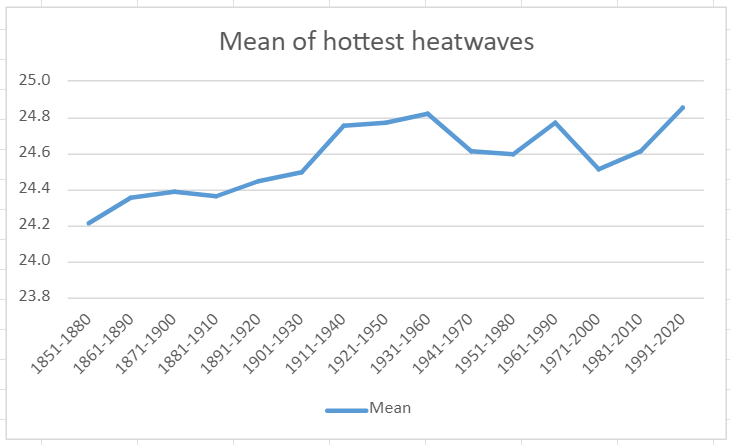
The mean of these hot spells has increased from 24.2C in 1851-1880 to 24.9 in 1991-2020, an increase of 0.7C.

Maxima during these spells, on the other hand, has decreased from 32.6C to 31.8C. It should be noted that the spell that produced this area’s hottest ever daily maximum, 40.1C on July 19th 2022, was a 2-day affair that didn’t qualify for the list.

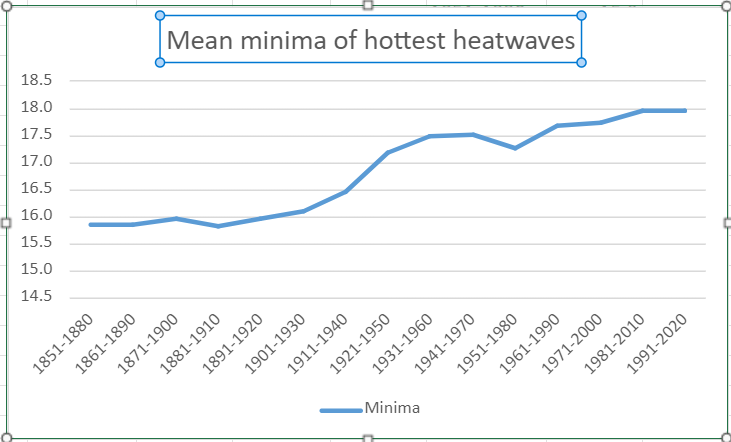
It is the minima that produces the most notable results with average low temperatures increasing over 2C from 15.9C to 18C! The urban heat island in full effect although the estate where a large proportion of these stats are gathered has changed little since it was built in the early 1900s.

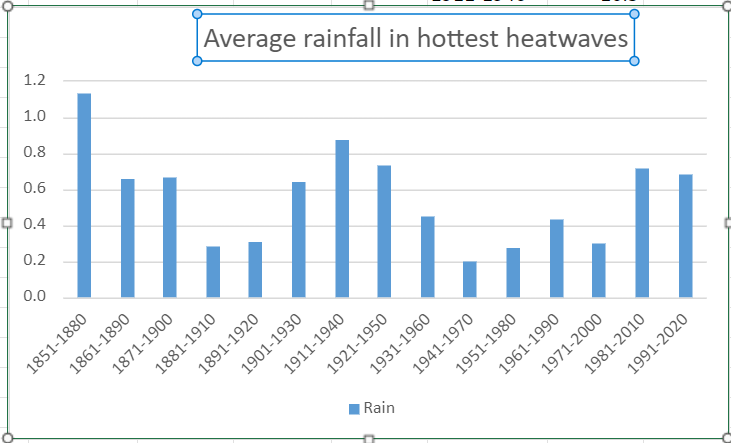
Rainfall during these hottest heatwaves is cyclical, in keeping with daily rainfall patterns observed over the same period.

Average sunshine in these heatwaves has shown a slight decline. It is no coincidence that maxima was at its highest during 1911-1950 when there was most sun. Increased cloud cover overall would take the edge off maxima while making the nights warmer.