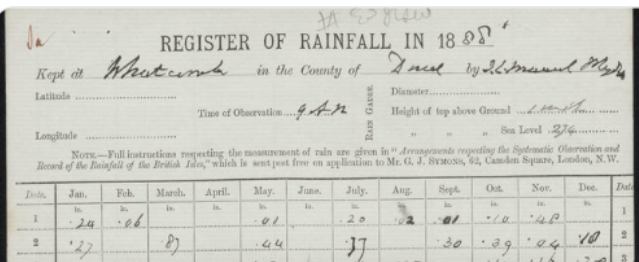
The Met Office Library holds millions of daily rainfall observations in its archives. Though anyone can access these physical treasures in person, and on request by email, a lot of these records taken before 1960 remain hidden away.
Yet these data provide an excellent insight into the behaviour of our weather on a local scale. As good as computer models are they are still a distance away from being able to forecast thunderstorms and frontal rain at smaller resolutions. Data from the literally hundreds of smaller rainfall stations set up in Victorian times would provide local government agencies the ability to identify where rainfall is historically heaviest and therefore areas where flash flooding is a greater risk.
For a number of years some of the archives have been digitised with the help of citizen science campaigns; the records of the Ben Nevis Summit Observatory being one historic station now digitised.
Though AI has improved computers still struggle with handwritten records; the best method is still to scan them all by hand before an army of volunteers get to input them onto online spreadsheets.
The cost to scan the rainfall archive pre-1960 would be £100,000. Though this sounds a lot for a ‘nice to have’ digital archive it could save millions in the cost of reactionary local authority work thanks to measures taken to plan against problems with flash flooding before they appear.

 Wanstead Meteo
You must be logged in to post a comment.